Odds of a super El Niño are climbing and are expected to continue increasing through the end of the year. The Climate Prediction Center now says there is a 97% chance the climate pattern will persist.
Could a fleet of ships spraying microscopic particles into the sky help calm one of Earth’s most powerful climate forces?
That’s the idea behind a new study exploring a controversial form of climate intervention.
BEYOND SUPER EL NIÑO: THE SECRET OCEAN PATTERN THAT COULD FUEL HURRICANES IMPACTING HAWAII THIS YEAR
A study by researchers at the University of California San Diego, published in Science Advances, suggests that strategically brightening marine clouds over the southeastern Pacific Ocean early in the development of a major El Niño could significantly weaken the climate pattern by disrupting the ocean atmosphere feedbacks that fuel its intensification.

Illustration showing a magnifying glass placed over a map of equatorial Pacific Ocean sea surface temperature anomalies, made in Paris, France, on July 10, 2026.
(Joao Luiz Bulcao / Hans Lucas / AFP via Getty Images)
El Niño describes natural temperature changes in the central Pacific Ocean that alter atmospheric circulation and can greatly influence global weather, and the world is in the heat of the determining climate pattern.
This study was published at a super time, that is, a Super El Niño time. Seasonal forecast models show that the El Niño event in the central Pacific Ocean is rapidly surging toward record territory – projects sea surface temperature anomalies peaking between 3 and 4 degrees Celsius above average — which would be historic territory.
EL NIÑO SURGES TOWARD ‘MONSTER’ TERRITORY, SIGNALING AN ACTIVE WINTER FOR EAST AND WEST COASTS
As scientists continue to forecast a warming world, this study suggests there may one day be a way to lessen the punch of one of its most influential climate drivers.
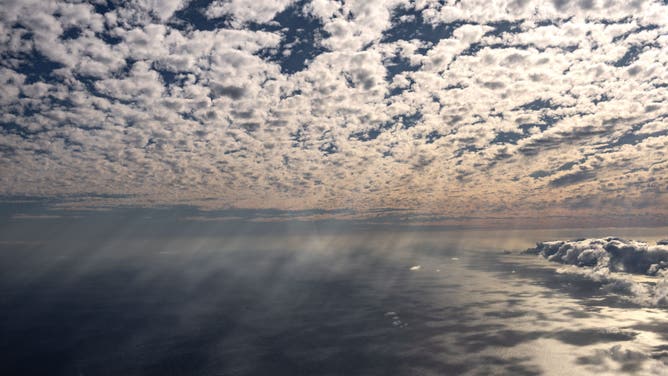
A view of the Pacific Ocean.
(Photo by Kent Nishimura/Getty Images / Getty Images)
The form of solar geoengineering aims to increase the reflectivity of low-lying clouds over the ocean so they bounce incoming sunlight back into space, instead of into the ocean, with an ultimate goal of cooling the ocean surface beneath those clouds.
ALASKA LANDSLIDE UNLEASHED ONE OF THE LARGEST TSUNAMIS EVER RECORDED, NEW STUDY SHOWS
The movie-like solution to the rising temperatures of the world’s oceans would be executed by shooting specialized particles into the sky, typically from specially equipped ships, into the marine boundary layer of a cloud.
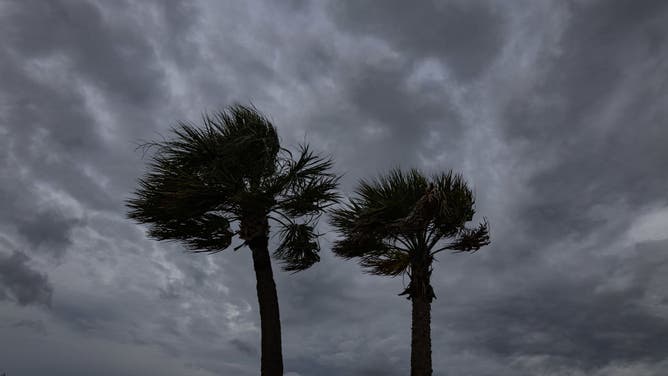
FILE – Palm trees blow in the wind ahead of Hurricane Idalia in Cedar Key, Florida, US, on Tuesday, Aug. 29, 2023.
(Christian Monterrosa/Bloomberg / Getty Images)
The sea salt particles sprayed into marine clouds would make them brighter so they reflect more sunlight back into space and cool the ocean beneath them.
The climate simulations found that strategically brightening marine clouds consistently weakened the simulated El Niño events by interrupting the chain reaction that normally allows the climate pattern to intensify.
Using an advanced seasonal climate model, the researchers recreated the historic 1997–98 and 2015–16 El Niño events and tested six cloud-brightening strategies that varied when the intervention began and how long it lasted.
The earliest and longest deployments proved the most effective at weakening El Niño.

Pipeline, Hawaii.
(Kirstin Scholtz/World Surf League via Getty Images)
Beyond historic El Niño events, the study also used the 2019-20 Australian bushfires as a natural test case. Researchers found that smoke from the fires brightened marine clouds over the South Pacific, helping cool the southeastern Pacific in a way they say likely contributed to the multi-year La Niña that followed.
The researchers found that when they replaced the wildfire smoke with simulated marine cloud brightening over the same region, the model reproduced many of the same atmospheric and oceanic responses.
Pulling off such an operation would be no small feat. The study estimates that replicating the strongest cloud-brightening scenario would hypothetically require about 2,400 spray-equipped ships working across an area equal to roughly 7% of Earth’s surface.
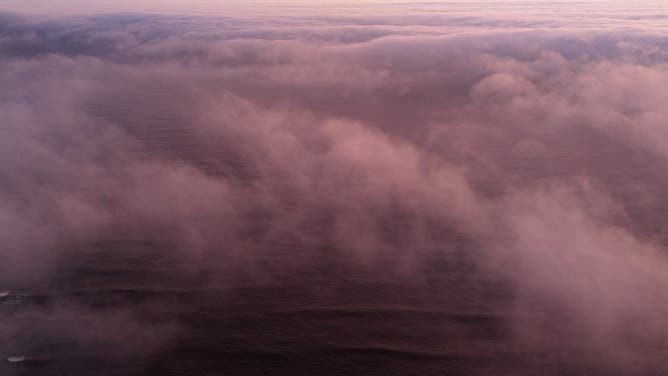
Low-hanging fog covers Lima’s coastline.
(Photo by Ernesto BENAVIDES / AFP via Getty Images / Getty Images)
The simulations also revealed potential unintended consequences. While marine cloud brightening weakened El Niño in the model, it also triggered unexpected warming over parts of Europe and Asia during one scenario—regions not significantly affected by El Niño itself—highlighting the possibility that deliberately altering one part of the climate system could produce unforeseen impacts elsewhere.
AFTER GREAT WHITE SHARK ATTACK, AUSTRALIA’S MOST POPULATED STATE DOUBLES DOWN ON DRONE SHARK PATROLS
The study also found that weakening El Niño could come at a cost, with several simulations showing an earlier—and sometimes stronger—La Niña developing afterward, highlighting how intervening in one part of the climate system can trigger downstream effects.
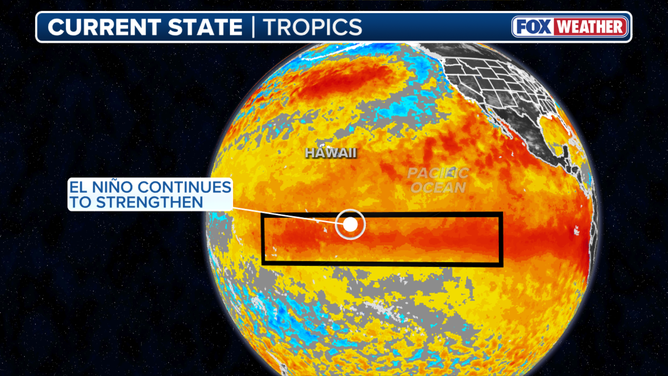
This graphic shows the El Niño zone.
(FOX Weather)
One of the biggest obstacles isn’t the technology—it’s the forecast.
Researchers note that marine cloud brightening would need to begin months before El Niño reaches its peak, but accurately predicting the strength and evolution of the climate pattern that is far in advance remains one of climate science’s greatest challenges.
ANCIENT ‘LOST WORLD’ COULD REWRITE HISTORY FOR HOW FIRST AMERICANS ARRIVED 13,000 YEARS AGO
For now, the idea of suppressing a Super El Niño remains firmly in the realm of scientific research.
The authors emphasize that their work is a proof of concept based on computer simulations—not evidence that scientists can currently manipulate one of Earth’s most powerful climate patterns.