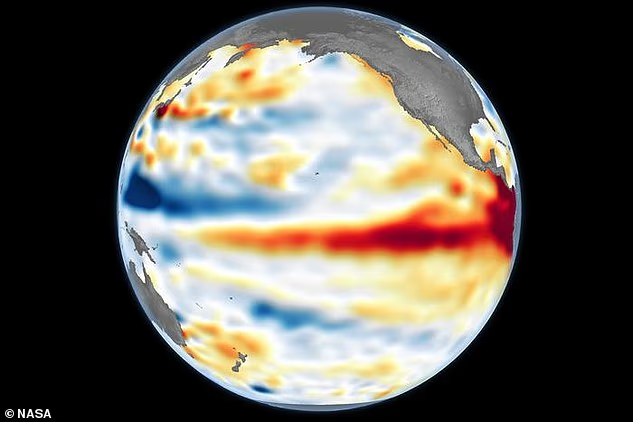
With the strongest Super El Niño on record now underway, scientists are investigating a controversial method that could stop the weather cycle in its tracks.
Researchers say that artificially brightening the clouds could shield the world from the floods, extreme heat, and wildfires that El Niño will bring.
By injecting tiny particles like salt into the atmosphere, scientists could make the clouds above the equatorial Pacific more reflective.
This geoengineering technique could reduce the amount of El–Niño–driven heat that makes it to the lower atmosphere.
According to the researchers’ new paper, published in the journal Science Advances, this effect is so strong that it could flip a hot El Niño year into a cooling La Niña year.
Deployed in the Pacific Ocean before Super El Niño, cloud brightening could increase the cooling and drying effects associated with La Niña by more than 40 per cent.
Co–author Dr Katharine Rick, a climate scientist from the University of California San Diego, says: ‘It’s a different way of thinking about geoengineering.
‘We need to understand a lot more, but if there is a way to use this in addition to the risk reduction tools to mitigate El Niños, why wouldn’t we consider it?’
Scientists say that artificially brightening the clouds over the Pacific Ocean could prevent the floods, extreme heat, and wildfires associated with the coming Super El Niño. Pictured: NASA satellite image of the El Niño weather pattern growing
Almost all scientists currently agree that the best way to reduce the human and financial costs of human–caused climate change is to cut greenhouse gas emissions.
But with the climate warming and emissions at their highest point on record, more researchers are considering the consequences of using geoengineering to artificially cool the planet.
One of the most popular techniques is marine cloud brightening, which aims to make the clouds over key patches of ocean more reflective.
These reflective clouds act like natural sunscreen, producing local cooling that leads to changes in rain, winds, and waves in other parts of the world.
The appeal of this approach is that cooling the right part of the ocean at the right time could have huge effects well beyond the area of cloud brightening.
The consequences of using marine cloud brightening are highly uncertain, and the researchers say that a real–world test would be far too risky.
However, the enormous clouds of smoke released by the 2019–2020 black summer bushfires in Australia provided a natural experiment.
Previous research conducted by one of the study’s co–authors showed that the smoke particles that wafted into the atmosphere acted just like the cloud–altering aerosols used in geoengineering.

Scientists modelled what would happen if marine cloud brightening was deployed in a small region (black box) right before the start of the 2015 El Niño event

They found that cloud brightening significantly cooled the equatorial Pacific (right), preventing the characteristic El Niño pattern (left) from developing

Previous studies found that the 2019–2020 black summer wildfires in Australia (pictured) produced an effect similar to cloud brightening, which may have played a role in creating cooling La–Niña–like weather patterns
A study showed that these smoke–brightened clouds drifted throughout the southeastern Pacific Ocean and played a key role in creating cooling La–Niña–like weather patterns.
Intrigued, the researchers decided to simulate what would have happened if this had happened before a Super El Niño instead.
They modelled what would have happened if, instead of natural smoke, artificial cloud brightening were deployed in the Pacific just before the major El Niño events of 2015 and 1997.
They found that this would indeed dampen the effects of the growing El Niño, with a bigger effect being produced the earlier the brightening began.
The researchers say they are not currently aware of any plans to test this method on the current Super El Niño, but add that governments could consider the option in the future.
Any decision to deploy geoengineering at a global scale would prove highly controversial because scientists are still unsure what the long–term consequences would be.
Recent studies have even suggested that some geoengineering techniques could inadvertently make the impacts of climate change worse.
One study conducted by Columbia Climate School found that a method called Stratospheric Aerosol Injection could wreak havoc on global weather patterns.

Deployed in the Pacific Ocean before the 2015 and 1997 El Niño events, cloud brightening could mitigate the worst of the heating effects without needing to permanently alter the climate
If the aerosols were released in the polar regions, they would likely disrupt tropical monsoon systems, which could have an effect on sea levels, they found.
The authors of this new study say that they would normally oppose deploying geoengineering at scale for these reasons.
However, the looming threat of a Super El Niño may require making an exception.
The extreme weather triggered by a Super El Niño will wreak havoc on the world and lead to trillions of dollars of economic damage, according to some economic analyses.
This study shows that a small, targeted burst of cloud brightening could avoid the worst impacts of El Niño without permanently changing the climate.
That suggests scientists could use geoengineering on a more controlled scale to smooth out the peaks and troughs of Earth’s natural cycles.
Lead–author Dr Jessica Wan, of the University of Chicago, says: ‘One of the biggest social concerns around geoengineering is the fact that if we use it to reduce long–term climate risks, we have to deploy it continuously for an indefinite period of time.
‘If we could target natural variability, we could get some of the benefits of geoengineering without having to employ it indefinitely.’