As the peace deal between the US and Iran collapses, renewed fears of all-out war have been ignited by America’s attack on an Iranian nuclear plant.
The sudden escalation has thrusted a decades-old, no-nonsense civil defense manual back into the spotlight, giving ordinary Americans clear instructions on how to survive a nuclear attack using mostly everyday materials.
This list of items absolutely needed for survival is surprisingly short, according to the book Nuclear War Survival Skills, which was first published in 1979.
It was written by inventor, engineer and civil defense expert Cresson Kearny, who worked at the Oak Ridge National Laboratory, one of the earliest nuclear research facilities during World War II.
Since then, the survival guide has been updated with more modern and up-to-date advice for those fearing a nuclear attack. The latest edition was released in 2022, coinciding with Russia’s invasion of Ukraine.
While many might think a nuclear war would be a hopeless situation, Kearny’s guide made the case that survival would be possible and would depend on acquiring seven key essentials.
Those include shelter from the nuclear fallout, clean drinking water, non-perishable food, sources of light, protective clothing, critical documents and money and a way to measure the radiation levels outside.
Kearny wrote: ‘The more one knows about the strange and fearful dangers from nuclear weapons and about the strengths and weakness of human beings when confronted with the dangers of war, the better chance one has of surviving.’
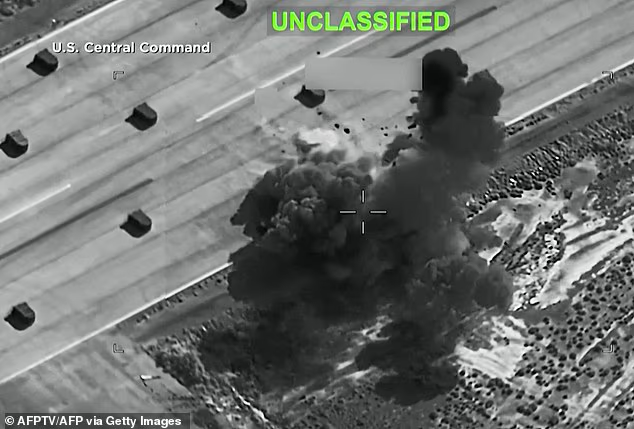
Footage of strikes on Iranian military positions from the US Central Command on Thursday

Civil defense expert Cresson Kearny’s nuclear survival book was updated with new material after the Russian invasion of Ukraine
Kearny claimed there was a fear during the Cold War that the US ‘would degenerate into anarchy’ after a nuclear attack on American soil with most people fending for themselves amid the death and destruction.
‘They forget the history of great human catastrophes and the self-sacrificing strengths most human beings are capable of displaying,’ the author said, adding that grain-producing regions of the US would be largely free of radioactive contamination.
‘History indicates that Americans in the food-rich areas would help the starving – like the heroic Russians who drove food trucks to starving Leningrad through bursting Nazi bombs and shells.’
With that in mind, the practical ‘how-to’ guide was written like a field manual for regular families, not doomsday preppers with bunkers filled with supplies.
Kearny’s goal was to show that expensive equipment and military training was not needed to make it through the fallout of World War III, with improvised tools being good enough – starting with the number one priority: shelter.
Building a shelter
The book detailed how Americans could create an ‘expedient’ shelter, with illustrated plans for using dirt, wood, doors, plastic sheeting and other common materials for quick protection against radioactive fallout.
A common example was a simple trench dug in a backyard or any open field, digging deep enough for survivors to sit or lie in.
The manual said to line it with plastic sheeting to keep it dry, add wooden poles or doors across the top as a roof and then pile at least two to three feet of dirt on top for radiation shielding.

The manual revealed how to build a homemade shelter by digging a large holes in a field or backyard and covering the top with dirt for protection against radioactive fallout

Kearny claimed a basic nuclear fallout shelter could be made by digging a hole in a yard or field, costing much less than expensive shelters built in the 1950s (Pictured)
Shovels, a pick, a bow-saw with an extra-blade, a hammer and heavy polythene film for rain proofing were listed among the items needed to build the shelter.
Kearny also advised keeping nails and wire on hand, along with an extra set of printed instructions.
If multiple people were to live within the shelter, building a manual air pump to circulate air would be vital, the author said.
Clean drinking water
The book revealed that you will need sturdy water containers, such as plastic jugs or heavy-duty trash bags to store and carry plenty of drinking water to the shelter.
At least a couple of gallons per person per day were recommended in case clean tap water stops flowing or becomes unsafe to drink.
A garden hose may be needed to siphon water from nearby ponds or other available sources, and a small bottle of ordinary household bleach may also be vital.
Adding a few drops of unscented, five to six percent sodium hypochlorite bleach for every gallon of water will kill bacteria and germs from any contaminated drinking source.
Non-perishable food
Kearny wrote: ‘Store at least a two-week supply of compact, nonperishable food. If your family includes babies or small children, be sure to store more milk powder, vegetable oil, and sugar.’
Kearny’s book included plans for a grain mill and bucket-stove which required no power and could be used with a fire. He also advises keeping a supply of wooden matches in a water proof container.
Radiation fallout meter
After a nuclear attack, radioactive dust might be outside your shelter, meaning you may not know if the conditions are safe or deadly when you open the shelter door.
Kearny invented a simple, homemade device that measures how strong the radiation is in your area after a nuclear strike which did not need batteries, electricity, or electronic parts to work.
Using a metal can, aluminum foil, some thread, tape and a ruler or paper scale, it works by detecting how radiation knocks electrons around inside the can, causing two thin foil ‘leaves’ to move apart just like a electroscope – which detects electrical charges.
Users simply need to time how long it takes for the leaves to drop back together, then use the chart in Kearny’s book to calculate how much radiation is still in the air.
The latest version of the survival manual has added information on where people can buy affordable commercial radiation measurement devices which have been invented since the book was originally published.

Pictured: A portable radiation detector
Valuables, money and vital documents
Kearny urged families should bring their money, credit cards, negotiable securities, valuable jewelry and their most important documents kept at home.
He believed that an initial nuclear crisis would not be followed by nuclear war. Instead, an unstable ‘nuclear peace’ may break out which would lead to survivors needing these items to prove their identity and also pay for supplies.
Lighting
Candles and materials to improvise cooking oil lamps would be vital in an emergency and a homemade shelter.
Kearny recommended having two clear glass jars about one pint in size, cooking oil and cotton string for wicks. He also advises bringing flashlights and a moisture-proof jar full of matches.
The 2022 edition added bringing more modern equipment, including LED lights and lithium batteries for better, longer-lasting illumination.
Protective clothing
Kearny recommended wearing heavy work clothes and heavy work shoes, noting that winter clothes would be vital after a nuclear strike, even if the crisis took place in summer.
These items, along with raincoats and ponchos, would likely become unobtainable once the crisis passes and survivors begin to leave their shelters.