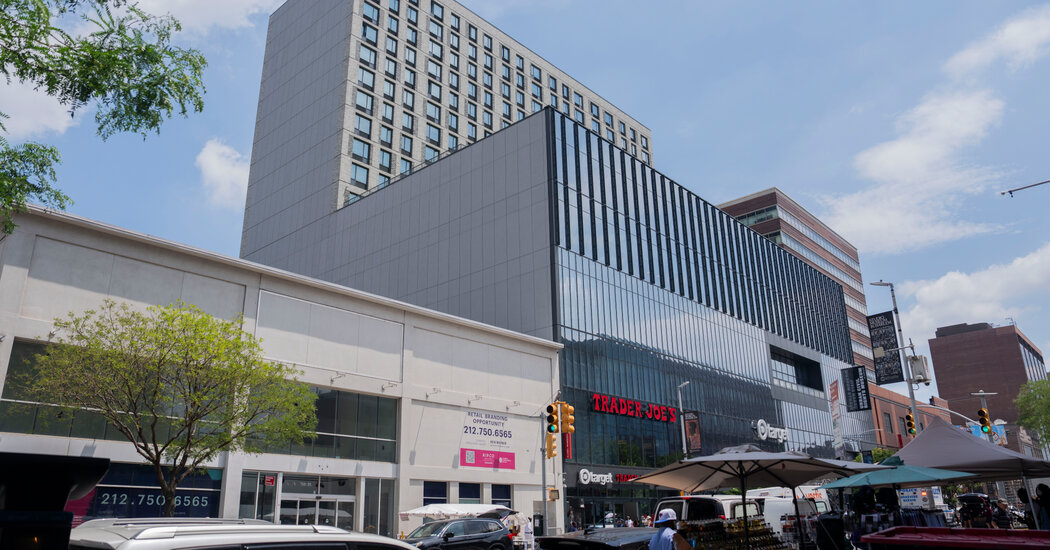
With their thirst for cheap, sprawling land, big-box retailers usually operate in the suburbs or on the outskirts of town. But in recent years, some have been ditching the traditional model of massive warehouses and vast parking lots in favor of smaller stores in cities and denser communities.
A new strategy involves teaming up with affordable housing developments.
As the nation’s housing shortage worsens, more states and municipalities, including California, Florida, Massachusetts and Philadelphia, have rolled out incentives and financing to encourage housing construction. Retailers like Costco and Target are riding that building push.
In the Baldwin Village neighborhood of Los Angeles, Costco has signed on to be the ground-floor tenant in an approximately $450 million residential project with 800 apartments that will include affordable housing and work force housing. The property will be the first U.S. residential development with a Costco and is scheduled to open in 2028. In 2024, a Target store in New York’s Harlem opened with a complex that has 171 affordable housing units, including 51 apartments for young people aging out of the foster care system.
For the retailers, the partnerships often mean access to scarce unused land, with the housing developers responsible for construction and other upfront costs. For the developers, a retailer like Costco can lend cachet and even contribute to the project’s garnering higher rents.
“The developer gets a well-known store brand that serves as a great perk to attract residents, while the retailer gains access to a busy new neighborhood with more foot traffic than traditional, stand-alone locations,” said David Leopold, executive vice president and head of affordable housing at Berkadia, a commercial real estate firm and multifamily lender.
Having a retailer offering essential services in underdeveloped areas can also encourage cities to offer incentives such as tax breaks and change zoning rules, he added.
Reducing costs and risks is especially important with the price of construction material jumping 50 percent from March 2020 to March 2026, according to federal price data.
Big-box retailers, which sometimes face community opposition over concerns like traffic, can also generate favorable attention from being tied to affordable housing, something that is considered a benefit to the community, said Yanitza Brongers-Marrero, a partner and housing practice leader at the architectural firm Moody Nolan in Columbus, Ohio.
In Los Angeles, the neighborhood’s community advisory group has been supportive of the Costco project. The retailer “will play a crucial role in serving the community and providing valuable amenities to residents,” the Empowerment Congress West Area Neighborhood Development Council said in a letter to the city backing Costco’s application for a permit to sell alcohol.
Both Ms. Brongers-Marrero and Ben Shaoul, the founder of Thrive Living, which is developing the Costco project in Los Angeles, said they expected this type of partnership to continue.
“We have been approached by several retailers who want us to replicate the same business plan,” Mr. Shaoul said. “They’ve effectively been priced out — that’s what it comes down to. These are the neighborhoods that really need the retail, that have been overlooked.”
Costco also recently signed on to open a 162,000-square-foot warehouse as part of a 280-acre project in Maryland’s eastern Montgomery County that will include affordable housing. (The county requires that 12.5 percent of new residential construction be affordable.) Construction will begin this year, and the retail and housing components in two years, said P. David Bramble, managing partner and a co-founder of MCB Real Estate, which is based in Baltimore and is developing the complex, called VIVA White Oak.
Mr. Bramble said it would be the first multifamily construction in this part of the county in 40 years. The development would have happened without Costco, he said, but Costco’s name helped to bring on other tenants. “Everyone wants to dance with Costco,” he said.
“If you want neighborhoods to be successful, you need mixes of income,” Mr. Bramble added. “If you want retailers to be successful, you need mixes of income.”
Costco did not respond to requests for comment about the new locations or its store strategy. Brian Harper-Tibaldo, a spokesman for Target, said the retailer had been early to adapt its stores for denser settings. Target has 16 locations in Manhattan, up from one in 2015.
Even with all of the benefits, said Ms. Brongers-Marrero, who has worked on a number of mixed-use projects, combining different uses can add complications. Fire-safety needs and noise complaints can differ between residential and commercial buildings. A building with retailers and housing, for example, might want to separate entrances with different levels of security features.
Andrew Katz, co-founder and principal of the Prusik Group, a commercial real estate developer that helped create the mixed-use space in Harlem, said that “retailers are very cognizant, especially in New York City, about the noise they make impacting residents.”
“The last thing that a Trader Joe’s or a Target wants is a residential tenant calling 311” with a noise complaint, he said.
Mr. Katz said that even when retailers wanted to enter a particular market, it could take years for them to work out the challenges.
That was the case for the Target store on 125th Street in Harlem, where concerns included not only finding adequate space but also working out logistics like where to unload merchandise. That would normally happen in a parking lot behind a store. The company took four years to commit to the location.
Without a parking lot, the solution was to add interior loading docks, which would have entrances on 126th Street, while retail tenants would enter on 125th Street, Harlem’s main commercial artery. Retail and office space sits above the loading area. To further minimize noise, the apartments are set back from the street, and residents enter on the quieter 126th Street.
The $242 million complex — just a block from the storied Apollo Theater, which has helped start the careers of numerous Black luminaries — houses the headquarters of the National Urban League and office space for nonprofits. There is also a forthcoming civil rights museum. Financing included more than $20 million from Empire State Development, New York’s economic development agency.
But moving away from what retailers are used to is hard for some, said Lisa Gomez, chief executive of L+M Development Partners, which builds affordable and market-rate housing and mixed-use projects. At Bridge Park, a mixed-use project in Dublin, Ohio, a short drive from Ohio State University, national grocery chains have turned down involvement because they weren’t happy with the lack of ground-level parking, said Nelson Yoder, a principal at Crawford Hoying Development, which worked on the project.
In Atlanta’s West End, Prusik and BRP Companies are working on a mixed-use development at the site of a demolished mall and are in talks with potential retail tenants. The site — near Spelman and Morehouse Colleges, an area Mr. Katz called underserved — would include affordable apartment housing. It is scheduled to break ground next year.
The success of the Harlem project can serve as a proof of concept, said Ms. Gomez, whose firm worked with Prusik and BRP on that development. “If somebody sees that they can make it on 125th Street or the Lower East Side, it makes it easier to sell in Atlanta.”