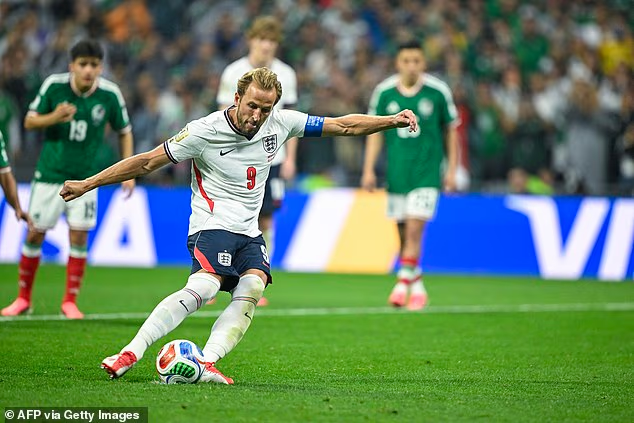
If tonight’s nail–biting quarter final between England and Norway reaches penalties, we can breathe a sigh of relief as Harry Kane steps up.
The England captain has the perfect penalty kick technique, according to a new study.
Researchers analysed various popular penalty methods, and found that shots are most successful when they’re high and wide.
In contrast, ‘safe’ shots – like the one Bruno Guimaraes unsuccessfully offered in Brazil‘s defeat to Norway – should be avoided, according to the researchers from the University of Reading.
Professor James Reade, co–author of the study, explained: ‘Harry Kane must have a foot like a traction engine.
‘His fantastic goal against Mexico perfectly demonstrated the risk and reward of hitting the corner of the net hard and fast.
‘We’ve seen our captain miss penalties before, but when he steps up you always feel confident he is going to score because he is so good at placing the ball where the keeper can’t reach it.
‘Penalty takers from all teams should be more like Harry Kane and hit the ball high, wide and hard.’
If tonight’s nail–biting quarter final between England and Norway reaches penalties, we can breathe a sigh of relief as Harry Kane steps up. The England captain has the perfect penalty kick technique, according to a new study. Pictured: Kane shooting a penalty against Mexico
For the study, the team set out to understand what makes a perfect penalty kick.
In total, they analysed 536 penalty kicks from the UEFA Champions and Europa Leagues.
Their analysis revealed that kick takers tend to shoot towards areas of the net where the goalkeeper has a greater chance of making a save, but the overall kick success rate is lower.
Instead, they should be aiming for the top corner of the net, which is statistically more likely to result in a goal, according to the researchers.
The results showed that for every 100 penalty kicks, players chose safer shots that put three more kicks on target (forcing the goalkeeper to make a save).
However, this caution costs them one goal they would have scored with riskier shots to the corners.
‘As we’ve seen often at this World Cup, penalty takers would rather look like they nearly scored than risk looking like they missed completely,’ Professor Reade said.
‘For the team, missing the target or having the shot saved amounts to the same thing.

‘Safe’ shots – like the one Bruno Guimaraes offered in Brazil’s defeat to Norway – should be avoided, according to the researchers from the University of Reading
‘But for the player, that difference feels huge. Egos are getting in the way of national success.’
Ahead of the World Cup, Professor Reade’s team also ran a simulation to determine the likely winner.
The researchers modelled every match of the 48–team tournament 10,000 times to produce probability estimates for each nation.
The model gives Argentina a 24 per cent chance of lifting the trophy, with Spain (13 per cent) and France (12 per cent) close behind.
England is joint fourth with Portugal, each with a nine per cent chance of going all the way.
Professor Reade said: ‘Argentina come out on top, but what stands out most from this simulation is how tight it is at the summit.
‘France and Spain are virtually indistinguishable in the model, and England aren’t far behind either.
‘It has been 60 years since England last lifted the trophy, and the simulation suggests football could finally be coming home.’