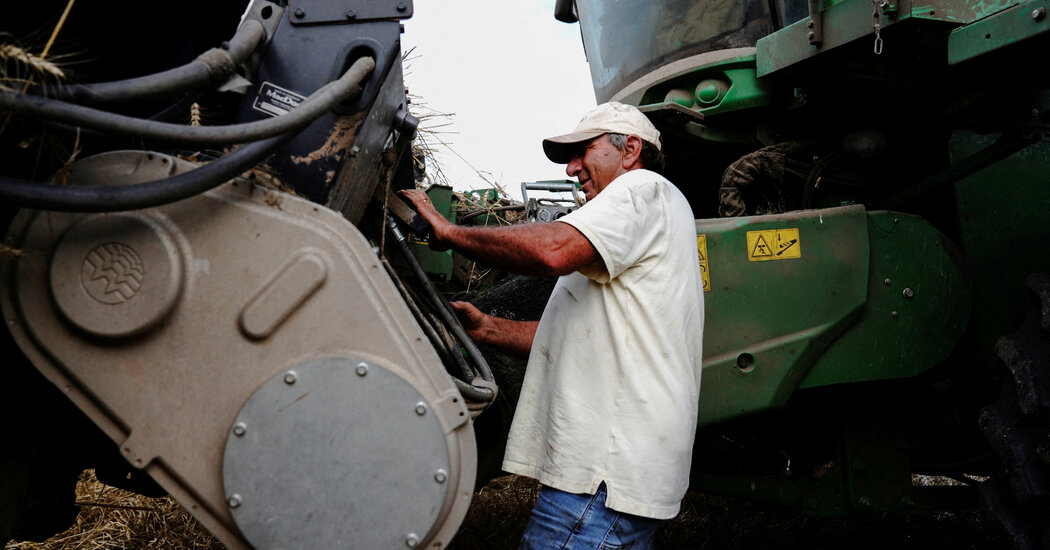
For decades, American farmers dealing with malfunctioning John Deere equipment were left with few options for repairs. The company allowed only authorized dealers to make fixes, withholding necessary tools from independent repair shops and individuals, driving up costs and wait times.
A settlement this week with the Federal Trade Commission will change that. The commission on Wednesday secured a right-to-repair settlement with John Deere as part of a lawsuit filed in January 2025.
The settlement “enables farmers to do what they’ve done for generations — fix their own tractors and other farm equipment — without having to pay an authorized John Deere dealer to do it for them,” Daniel Guarnera, the director of the F.T.C.’s Bureau of Competition, said in a statement on Wednesday.
Deere & Company’s farming equipment has become more reliant on computerized components, which makes it easier for the company to maintain restrictions on who can repair its products. The company also produces the only software tools that are able to make electronic repairs to the equipment.
It had previously only made those tools available to authorized dealers.
Manufacturers have opposed “right to repair” laws, which have passed in several states in response to what customers have said are corporate restrictions on repairing their products. The companies have argued that access to the software could result in safety concerns and intellectual property theft.
This week’s settlement will eliminate those restrictions and allow John Deere owners to take their tractors or harvesters to local repair shops or make adjustments themselves.
Deere had denied the allegations that it had violated federal and state laws by restricting who could repair its equipment. But on Wednesday the company welcomed the decision in a statement.
“This is good news for our customers and for the future of how Deere equipment is supported,” Denver Caldwell, the company’s vice president of customer support, said in the statement.
Without the ability to repair their own equipment, farmers have sometimes been forced to wait weeks and pay thousands of dollars for a simple fix.
When a John Deere tractor belonging to Walter Schweitzer, 64, had mechanical issues while he was bailing hay in 2020, he called an authorized dealer about diagnosing the machine. Mr. Schweitzer, a third-generation farmer and rancher who raises black Angus cattle stock in Geyser, Mont., was told that a tech was not available to travel to his farm with the necessary computer for another week.
For farmers, a window of time like that can result in a crop being ruined.
Mr. Schweitzer had a nearly 50-year-old tractor he was able to use to finish his work, an option not every farmer has. Even when a tech was finally able to test the machine, it took weeks of start-and-stop testing before the problem, a faulty fuel sensor, was diagnosed.
Only a few hours of labor was completed in that time, Mr. Schweitzer said, and he estimated the real cost to be “five, six hundred dollars.” But Mr. Schweitzer, the president of the state’s farmers union, added that his “bill was nearly four grand.”
He added that the authorized dealers also had their hands tied, and were beholden to the company’s requirements. If he had access to the diagnostic computer, Mr. Schweitzer said, he could have determined the issue himself. “We could have ordered the part, and most likely I could have replaced the part,” he said.
Under the terms of the settlement, Deere will be subject to additional federal oversight, be required to make available any future repair resources and instruct authorized dealers to promote the availability of the tools. The terms will last 10 years, but may be extended if Deere violates the order.
The states included that sued the company — Arizona, Illinois, Michigan, Minnesota and Wisconsin — also received payment for attorney fees and other costs as part of the settlement.
When the lawsuit was filed by the F.T.C. last year, it signaled support from the federal government for right to repair. .
In 2021, the F.T.C. published a report examining how tech companies were harming competition by restricting the ability to repair. That same year, in an executive order, President Joseph R. Biden Jr. called on the F.T.C. to prevent equipment makers from limiting individuals’ ability to make repairs themselves.
Farmers like Mr. Schweitzer hope the settlement will be a steppingstone for stronger protections for consumers.
“We need to work with Congress to codify that right to repair into law,” he said, “and for all equipment manufacturers, not just John Deere.”