FOX Weather Correspondent Brandy Campbell reports from the Johnson Space Center in Houston, where preparations for the Artemis II space mission are underway as NASA revealed the crew members.
HOUSTON– Do you have a love for space and want to help be a part of the next research phase to send people to the Moon and Mars? Well, NASA has good news for you.
The space agency is seeking applicants to be participants in the Moon and Mars Exploration Analog mission, which is set to begin no sooner than August 2027 at Johnson Space Center in Houston.
For one year, the participants will live and work in isolation and confinement while simulating interplanetary transit and planetary surface operations, including simulated spacewalks, NASA said.
WHICH COUNTRY WILL LAND ON THE MOON NEXT AS THE SPACE RACE ENTERS A CRITICAL PHASE
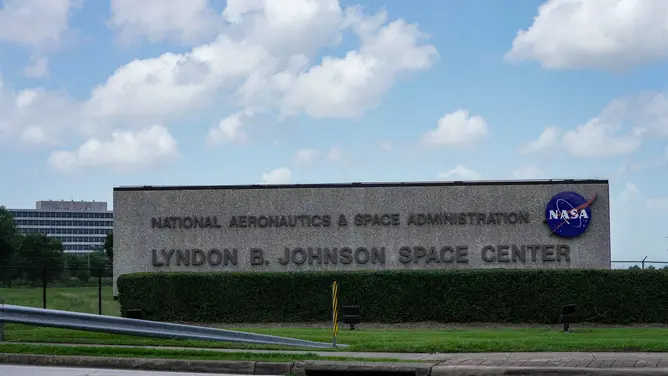
HOUSTON, TEXAS – JUNE 17: NASA’s Lyndon B. Johnson Space Center entrance is photographed on Tuesday, June 17, 2025 in Houston.
(Raquel Natalicchio/Houston Chronicle / Getty Images)
“This mission is the first in a ground-based environment that will simulate multiple parts of a Moon or Mars mission, combining elements of NASA’s HERA (Human Exploration Research Analog) and the CHAPEA (Crew Health and Performance Exploration Analog) missions into a single, integrated campaign,” NASA said.
NASA said the results of this year-long experiment could inform plans for a sustained lunar presence through the agency’s Moon Base and future Artemis missions.
Two facilities will be used in the simulation. Together, the two facilities provide a streamlined way to evaluate how astronauts adapt across the full range of potential Moon and Mars mission scenarios, NASA said.
PHOTOS: MYSTERIOUS METALLIC SPHERES WASHING UP ON AUSTRALIAN BEACH IDENTIFIED
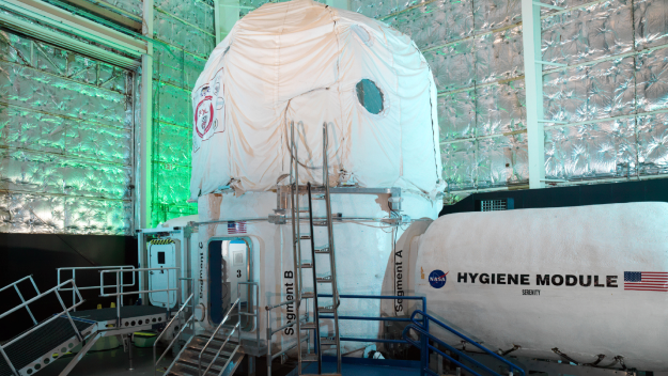
HERA is a unique 650-square-foot habitat designed to serve as an analog for isolation, confinement, and remote conditions in exploration scenarios.
(BILL STAFFORD AND ROBERT MARKOWITZ / NASA)
The first will be in the habitat previously used in the HERA mission, which will be used as their simulated transit spacecraft, operating in an environment that mimics deep‑space travel. It is a two-story four-port habitat that simulates travel from Earth and includes a workspace, living area, sleeping quarters and a hygiene module.
The second will be the surface habitat phase, which is currently being used by CHAPEA, NASA said. This habitat is one-story and 3D-printed, and will simulate living on another planet. It includes private crew quarters, a communal workspace, recreation room, crop cultivation area, medical room, food preparation area, airlock, two bathrooms and a sandbox for simulated walks on a planetary surface, NASA said.
In this phase, researchers will study the crew’s performance under the resource limits and mission demands crew members could experience on another planetary surface.
NASA TELESCOPE DISCOVERS NEW ‘SUPER-JUPITER’ EXOPLANET NEARLY 40,000 LIGHT-YEARS FROM EARTH
Participants in the mission will help NASA assess and validate hardware, technologies, protocols, requirements and other systems designed to support crew health and performance on long-duration deep space missions, all without leaving Earth, the agency said.
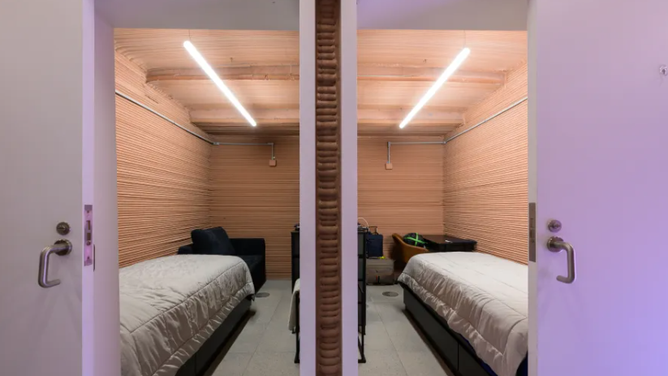
The 1,700-square-foot CHAPEA habitat contains individual living quarters for four volunteer crew members.
(NASA/Bill Stafford / NASA)
So, who can apply? NASA gave a list of qualifications for those expressing interest in applying for the simulated mission.
To qualify, applicants must be:
- A United States citizen or green card holder.
- Between 30 and 55 years old (candidates outside the range may be considered with additional approvals).
- No more than 74 inches (or 6 feet 2 inches) tall.
- Proficient in English.
- Willing to consent to an approximately 14-month long mission, including 12 months in two different confined habitats and two months of pre- and- post-mission training and data collection.
- Willing to participate in a multiday selection activity.
- Able to pass a NASA physical and psychological assessment.
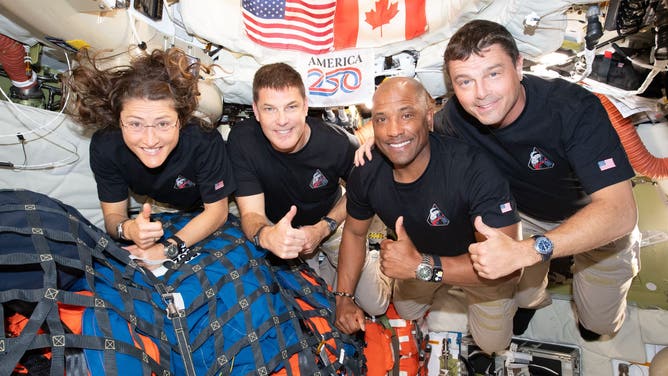
IN SPACE – APRIL 07: (EDITOR’S NOTE: This Handout image was provided by a third-party organization and may not adhere to Getty Images’ editorial policy.) In this handout image provided by NASA, The Artemis II crew – (from left) Mission Specialist Christina Koch, Mission Specialist Jeremy Hansen, Pilot Victor Glover, and Commander Reid Wiseman – pause for a group photo inside the Orion spacecraft on their way home. Following a swing around the far side of the Moon on April 6, 2026, the crew exited the lunar sphere of influence (the point at which the Moon’s gravity has a stronger pull on Orion than the Earth’s) on April 7, and are headed back to Earth for a splashdown in the Pacific Ocean on April 10.
(NASA / Getty Images)
Applicants also must have:
- Strong technical skills.
- No dietary restrictions.
- No history of sleepwalking or taking sleeping aids.
- Astronaut-like qualifications, such as:A bachelor’s degree from an accredited institution in engineering, biological science, physical science, or mathematics. Quality of academic preparation is important.An advanced degree in a STEM field is preferred and may be substituted for experience: a master’s degree equals one year of experience, and a doctoral degree equals three years of experience.Military experience may count as equivalent years of experience.
- A bachelor’s degree from an accredited institution in engineering, biological science, physical science, or mathematics. Quality of academic preparation is important.
- An advanced degree in a STEM field is preferred and may be substituted for experience: a master’s degree equals one year of experience, and a doctoral degree equals three years of experience.
- Military experience may count as equivalent years of experience.
NASA said the research volunteers will be reimbursed.