The most recent fireball that lit up the night sky across several states in the U.S. was captured by one of NASA’s meteor cameras on Sunday.
NASA’s TESS (Transiting Exoplanet Survey Satellite) identified a large new exoplanet orbiting far from its host star thanks to ripples in the space-time continuum.
The newly discovered planet is 1.6 times the size of Jupiter and called Gaia23bra b. It was initially identified by astronomers in 2023 when it was picked up by the European Space Agency’s now-retired Gaia Telescope.
Researchers later looked back through archived TESS data and realized TESS had caught it too, despite it being 150 light-years outside TESS’ typical search radius, NASA said.
JULY SKYWATCHING GUIDE: FROM PLANETARY CONJUNCTIONS TO CLOSE ENCOUNTERS IN SPACE
Typically, TESS finds star-hugging transitioning planets. So a discovery like this is very rare for TESS because of Gaia23bra b’s size and orbital distance from its host star, NASA said.
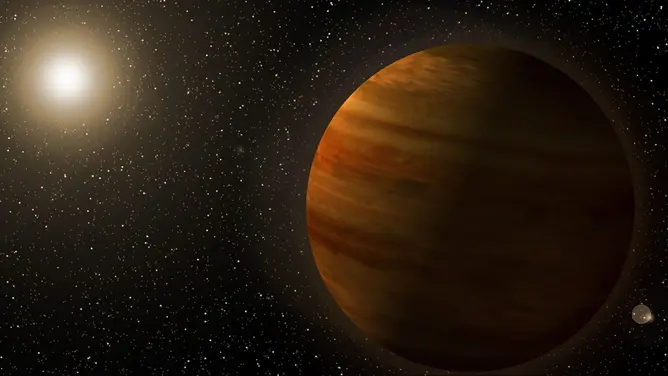
This artist’s concept visualizes Gaia23bra b, the first microlensing planet orbiting a distant star found by NASA’s TESS (Transiting Exoplanet Survey Satellite). This super-Jupiter orbits an orange dwarf star at a distance similar to Jupiter’s distance from the Sun.
(NASA’s Goddard Space Flight Center / NASA)
“Gaia’s observations were too sparse to pick up on the planet,” said Mallory Harris, a Ph.D. candidate at the University of New Mexico, who led a study about TESS’ discovery of the planet. “The TESS spacecraft happened to be monitoring the same area of the sky during the event, and its denser time coverage showed extra features in the light curve caused by a planet.”
The study, published July 1 in The Astrophysical Journal Letters, revealed that Gaia23bra b orbits an orange dwarf star that’s about 80% of the Sun’s mass and is nearly 40,000 light-years away from Earth.
VIBRANT DISCOVERY: UNIQUE, SALTY CLOUDS FOUND ON ICONIC ‘PINK PLANET’
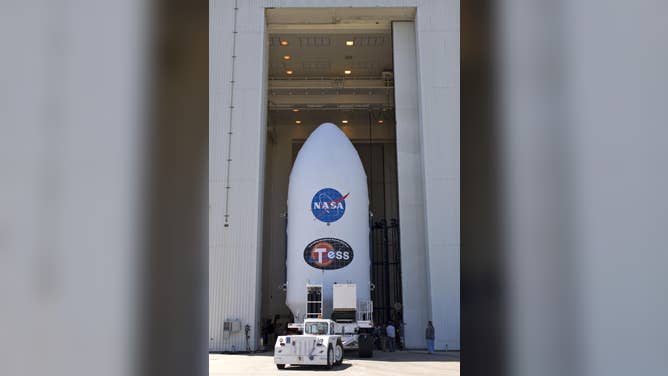
The payload fairing for NASA’s Transiting Exoplanet Survey Satellite (TESS) is moved inside the Payload Hazardous Servicing Facility at the agency’s Kennedy Space Center in Florida. Inside the facility
(NASA)
“When TESS launched, no one expected it to ever be capable of finding this kind of planet,” said Diana Dragomir, a professor at the University of New Mexico in Albuquerque and co-author of the paper describing the results. “The discovery implies that there are probably other so-called microlensing planets hiding in TESS’s data that we hadn’t previously thought to look for.”
Out of more than 6,000 known exoplanets, about three-fourths were discovered using the transit method, TESS’s typical planet-hunting technique, NASA said.
SCIENTISTS DISCOVER NEW METHOD OF DEFENSE AGAINST SOLAR STORMS TO HELP PROTECT EARTH
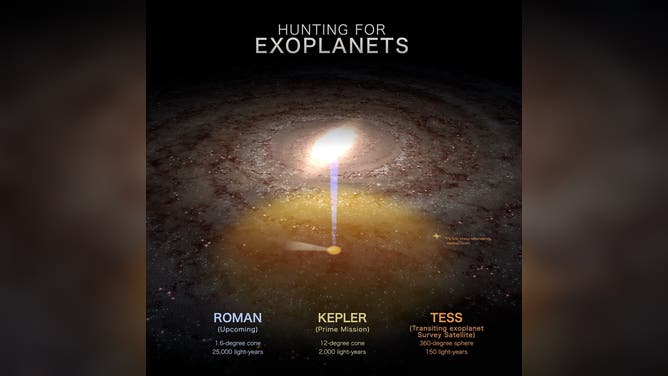
This graphic highlights the search areas of three planet-hunting missions: NASA’s upcoming Nancy Grace Roman Space Telescope, the retired Kepler Space Telescope, and NASA’s TESS (Transiting Exoplanet Survey Satellite). While TESS discovers transiting planets within a 150-light-year radius of Earth, it recently detected a planet about 40,000 light-years away (marked by the star symbol) via another method, called microlensing.
(NASA’s Goddard Space Flight Center / NASA)
“Astronomers monitor hordes of stars, watching for ones that periodically dim as orbiting planets cross in front of them — an event called a transit,” the space agency said.
NASA said microlensing has revealed less than 5% of known exoplanets.
NASA WANTS TO LIGHT THE FIRST FIRE ON THE MOON. HERE’S WHY
Microlensing is a light-bending phenomenon that occurs when two stars align closely from our vantage point. Light from the more distant star curves as it travels through the warped space-time caused by the nearer star’s mass, NASA said.
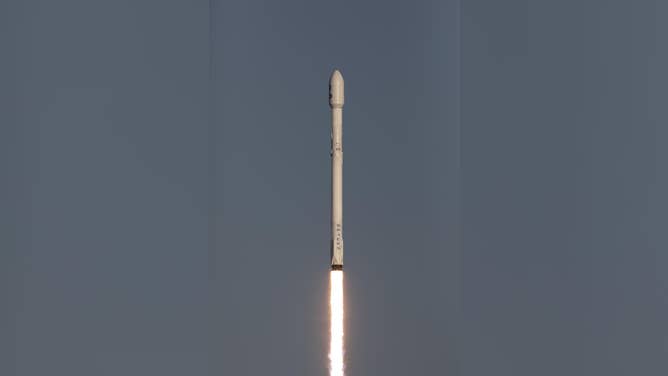
A SpaceX Falcon 9 rocket lifts off from Space Launch Complex 40 at Cape Canaveral Air Force Station in Florida on April 18, 2018, carrying NASA’s Transiting Exoplanet Survey Satellite (TESS).
(NASA/Kim Shiflett / NASA)
Microlensing isn’t well suited to finding huge planets that are orbiting close to its star, because their gravitational signals would blur together.
NASA’S NEW NANCY GRACE ROMAN SPACE TELESCOPE SET TO LAUNCH MONTHS AHEAD OF SCHEDULE
NASA said this microlensing is a preview of what NASA’s Nancy Grace Roman Space Telescope will do when it launches later this year.
Roman will observe the center of the Milky Way galaxy for one of its core surveys, revealing an estimated 1,000 microlensing planets and around 100,000 transiting planets, NASA said.