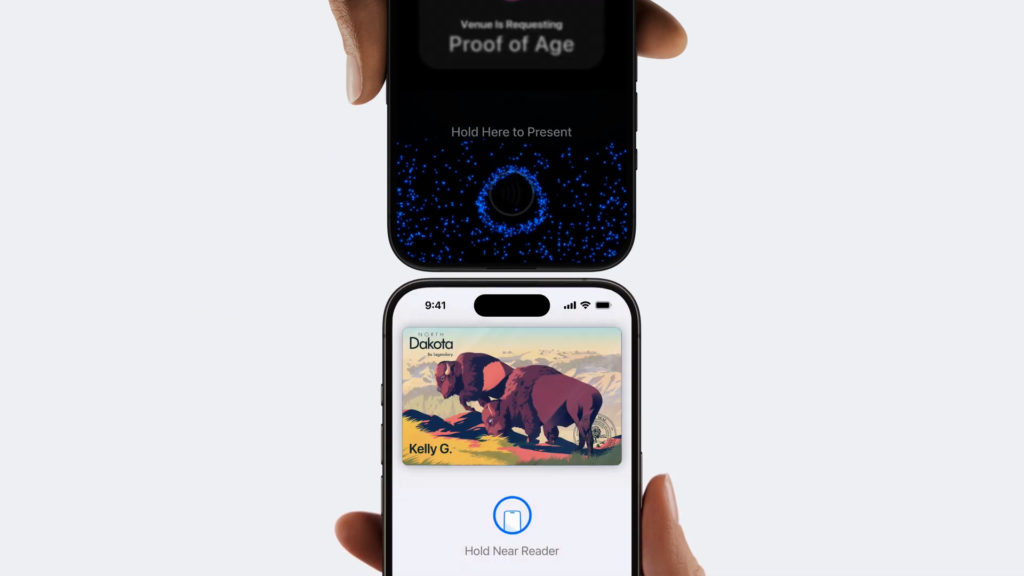
State by state, plastic driver’s licenses are getting a digital upgrade.
Twenty states and Puerto Rico now offer a form of a digital driver’s license, also known as a mobile driver’s license (mDL). Some states allow you to add it directly to your mobile wallet like a credit card, depending on your phone manufacturer. Others offer a state-created mobile app that stores your credential.
More than 250 airports in the U.S. already accept a mobile driver’s license to board a domestic flight, according to the Transportation Security Administration. Nationwide, mobile wallets on Apple, Google and Samsung phones can hold a digital U.S. passport for domestic travel, too.
Here’s what you need to know if you’re considering adding your driver’s license or passport to your mobile wallet.
Benefits of digital IDs
The idea is simple: When you need to provide identification, like at an airport, a doctor’s office or while getting a speeding ticket, you can tap your phone on a reader or present a QR code to be scanned.
“You would never hand over your phone,” said Ian Grossman, president and CEO of the American Association of Motor Vehicle Administrators (AAMVA), a trade organization that provides state DMVs with best practice guidance as well as software and tech infrastructure. “The whole point of it is to electronically transmit the information.”
In fact, not handing over a physical ID could actually help limit the information you share, he said. Take, for example, buying a bottle of wine at a liquor store.
With a digital driver’s license, you could tap to share just your age and a photo, keeping your driver’s license number, address and other personally identifiable information private.
“All they need to know is you are of legal age to make that purchase. They don’t need to know your name. They don’t need to know your address,” Grossman said.
And, if you’ve ever lost your wallet, or left your ID in a TSA security bin at an airport, it’s much easier for a stranger to pick up a plastic ID than access that information on a properly secured phone, with measures that could include facial ID, fingerprint scanning, passwords and remote deactivation.
“Even if they’re able to do all that, what you have time to do is get to any browser anywhere, log into your online DMV account and say, ‘I’ve lost that device, pull that credential off of that phone,'” Grossman said.
Data collection raises concerns
The push toward mobile driver’s licenses comes as Americans express falling trust in government and a growing desire for greater tech regulation.
Privacy advocates like Jay Stanley, a senior policy analyst for the American Civil Liberties Union, are raising concerns about how data from mobile IDs could be misused by the third parties or the government.
“The standard for digital ID that a lot of the states, although not all of them, are adopting, would actually let the government track you,” Stanley said.
What does that mean? While tapping your phone to prove your identity may seem simple for the user, that transaction involves serious technical considerations.
For example, does the act of identity verification happen locally between phone and reader, or is a third-party server involved? And, could an external entity, such as a state or federal government, access data showing where the ID was presented?
Stanley and the ACLU have warned about the potential for abuse in that last scenario, called “phone home” or server retrieval capabilities.
AAMVA’s best practices for state DMVs now prohibit “phone home” architecture. States that allow server retrieval would be blocked from using AAMVA’s digital ID systems, Grossman said.
“That’s where we’ve built into the standards. We have prohibited the ability to, what we would say, call back to the agency,” Grossman said.
While that pressures states to not build systems that “phone home,” the ability to do so exists within digital ID technology by design. Thus, the responsibility falls on elected officials not to use the feature or on legislatures to create stronger guardrails through new laws.
“We have seen a couple states that have put in place some very good protections in their laws, like New Jersey and Illinois,” Stanley said.
Utah also has a good model, Stanley added. In March, Utah Gov. Spencer Cox signed new legislation enabling a “State-Endorsed Digital Identity” framework. The bill included a ban on the use of “phone home” protocols for its state digital IDs, prohibiting the state from tracking “the presentation of a state-endorsed digital identity.”
It also included the United States’ first “digital identity bill of rights,” and codified a “duty of loyalty” requiring the government, digital wallet providers, identification verifiers and other related parties to act in the best interest of the individual.
Stanley said other states need to be proactive in establishing these protections in law before it’s too late.
“The states are sleepwalking into building a version that’s not privacy protected, and we’re going to get stuck with that as a standard for potentially generations,” Stanley said.
A potential boon for surveillance pricing
Another concern for a world of frictionless identification: Mobile driver’s licenses could be another tool for surveillance pricing, where retailers offer custom prices based on a profile they’ve built from your data.
WATCH: How online retailers are using AI to adjust prices by mining your personal data
Currently, online user verification can be a clunky procedure, usually involving someone taking and uploading a photo of their physical ID.
Online verification has grown in recent years. For instance, more than half of U.S. states now require users to verify themselves with a government-issued ID to watch adult content online. However, that practice has not spread to mainstream consumer sites, such as grocery stores, clothing retailers or travel websites.
This has allowed us some degree of anonymity.
“They’re not going to ask you to go through some big rigmarole to watch a YouTube video,” Stanley said. But in the future, certain websites and stores might have more incentive to ask for identification.
That could spill over to in-store shopping experiences too, Stanley said. Stores could ask customers to tap their phones to see exclusive offers. While that may seem beneficial, it would also provide corporations with new and extremely specific information about shoppers.
“As digital IDs become standardized and accepted, they make it impossible for you to escape the store or the website or others from knowing who you are. And that makes surveillance pricing much easier for them,” Stanley said.
WATCH: How to beat AI-driven custom pricing
But Grossman believes consumers are in control of where they agree to be identified.
“I think overall, the consumer will drive that demand and they will decide where they want to accept to be identified versus where they’re gonna look for another alternative where they want to stay anonymous,” Grossman said.
What’s next?
While many states have allowed mobile driver’s licenses, others, like Texas and Minnesota, have rejected them for now.
Grossman said that widespread adoption is coming.
“We believe that with that convenience comes increased security protection and a better way of doing business, but nobody is forcing anybody to do it,” Grossman said.
Stanley argues the right to opt in or out of digital driver’s licenses should be codified in law.
“One of the things that we have called for as a policy measure is what we call a right to paper, like you should have a right to continue to use your plastic license or paper license if you want to,” Stanley said.
“It has a real potential that we’re going to wake up one day, we’re all going to be forced to get these things, and they’re going to become like a virtual ankle bracelet that’s used to track us in a way we cannot escape.”