
If you thought you could outrun a spider, think again.
Scientists have identified the fastest spider ever recorded, and it could easily catch you.
As part of a new study, they assembled the largest dataset of spider running performance ever by combining new lab measurements with previously published research.
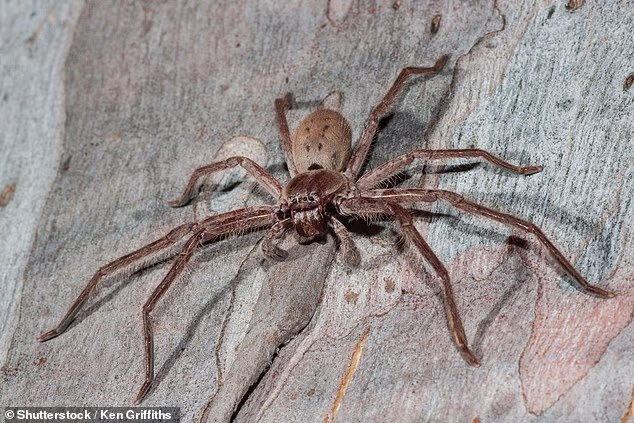
Out of 258 species, they found the speed champion was the brown huntsman spider, which can reach top speeds of up to 3.59 metres per second (8mph).
While that is below that of a human in a full–out sprint, don’t be too reassured – because in real life, you’re unlikely to have enough time or space to accelerate.
So if you startled one of these spiders at close range, it could probably catch up before you’d had a chance to hit full stride.
‘Across 258 species… running speed increased substantially with body mass,’ the researchers wrote in a preprint study published on bioRxiv.
‘(This was) from a minimum of 0.018 metres per second measured for the money spider to a maximum of 3.59 metres per second recorded for the huntsman spider.’
The brown huntsman spider (pictured) was the fastest in the study, reaching speeds of 3.59 metres per second (8 mph)

A huntsman spider during a speed test, which saw it come top of the table compared to other species
To measure running speeds, the researchers created a lab setup involving a camera and grid paper to see which spiders scampered between two points the quickest.
Overall, they found spiders that fall into the category of ‘ground active hunters’ ran the quickest – and tended to move faster than expected for their size.
This group, which includes the huntsman, jumping and wolf spiders, actively chase down or ambush prey on the ground rather than spinning webs to catch meals.
They are usually fast, have strong legs and use excellent vision or vibrations to locate food.
While the fastest in the study is a species native to Queensland, Australia, the UK is home to a range of these ground hunters, including the grey wolf spider and the great fox spider.
Huntsman spiders have also been known to arrive in the UK through accidental imports from countries like Australia.
The slowest spider in the study, the money spider, is fairly common throughout the British Isles but is tiny – only around 1.5mm in length.
Its top speed is the equivalent of just 0.04 miles per hour – giving you plenty of time to run away if you see one.

The researchers assembled the largest dataset of spider running performance ever by combining new lab measurements with previously published research

The slowest spider in the study, the money spider, is fairly common throughout the British Isles but is tiny – measuring around 1.5mm in length
Overall, the team found that larger spiders tended to be faster, but certain species were exceptions.
The tiny orange goblin spider weighs about 30,000 times less than the record–breaking huntsman, yet was only 18 times slower.
David Labonte, a team member at Imperial College London, says speed is, in principle, entirely determined by physics.
However, he said it is different lifestyles – such as the need to chase down prey or escape predators – that drive the evolution of the extraordinary adaptations needed to reach those speeds.
The huntsman spider could achieve such high speeds because its legs are ‘relatively large’ for spiders, but not too big that its legs get over–burdened by a heavy body, the team explained.
Leanda Mason at Edith Cowan University in Perth, Australia, said long legs appear to be a spider’s ‘speed gear’.
‘The huntsman supplies the record–book hook, but the deeper discovery is that spider speed is shaped by leg architecture and evolutionary history, not simply by size or whether a spider spins a web,’ she told the New Scientist.
After accounting for both body size and shared ancestry, the team’s conclusion is that fast running is associated with relatively longer legs but not with leg slenderness.

They discovered that spiders which fall into the category of ‘ground active hunters’ ran the quickest
The UK’s most venomous spider is the noble false widow, whose bite can cause allergic reactions and infections.
According to St John’s Ambulance, allergic reactions can lead to difficulty breathing, swelling of the tongue, confusion, and collapse.
There have also been numerous cases of people experiencing severe reactions to supposed spider bites.
In some cases, this has led to people losing parts of their fingers or hands after being bitten.


