

Astrophotographer Andrew McCarthy joins FOX Weather to showcase some of the iconic photos from the historic Artemis II mission. McCarthy details his collaboration with Commander Reid Wiseman and how he enhances these images to show features invisible to the naked eye.
Skywatchers are going to want to keep an eye on the sky across the U.S. on Tuesday evening.
The moon and Saturn conjunction will commence, dazzling the night sky and being visible to the naked eye.
THE BEST CELESTIAL EVENTS IN 2026 YOU WON’T WANT TO MISS
According to experts at InTheSky.org, Americans in popular locations such as New York City will be able to view both the planet and the moon without a telescope, with the pair rising at around 12:35 a.m. EDT.
WEEHAWKEN, NJ – JUNE 29: The full Strawberry Moon rises behind the skyline of midtown Manhattan and the Empire State Building in New York City as people watch from a park on June 29, 2026, in Weehawken, New Jersey.
(Gary Hershorn / Getty Images)
“The pair will be too widely separated to fit within the field of view of a telescope or pair of binoculars,” the website said.
The FOX Forecast Center is taking a look at the best locations to view the celestial event with the least cloud coverage in the evening.
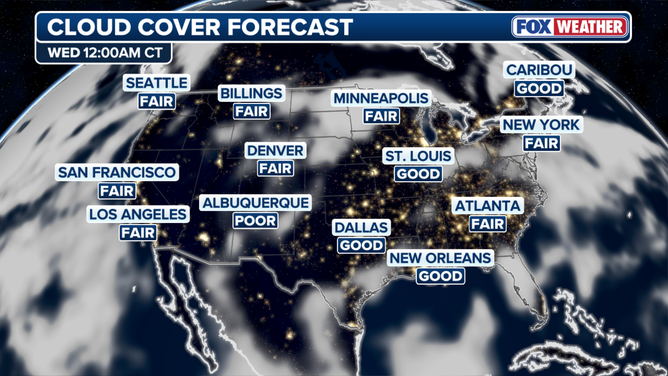
Cloud coverage throughout the U.S. Tuesday evening.
(FOX Weather)
The best viewing of the celestial event will be between 1 a.m. and dawn, before it fades away with the break of sunlight.
According to NASA, a conjunction is when objects in the sky look closer even though they’re actually far apart.
NASA WANTS TO LIGHT THE FIRST FIRE ON THE MOON. HERE’S WHY
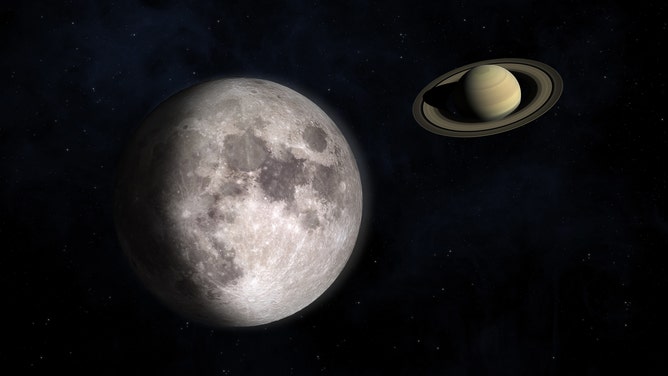
Conjunction Moon and Saturn. Meeting of the Saturn and Moon. Earth and planets of solar system. Elements of this image furnished by NASA. ______ Url(s): https://solarsystem.nasa.gov/resources/843/rare-full-moon-on-christmas-day/ https://science.nasa.gov/missions/cassini/a-valentine-from-cassini-with-love/ Adobe Photoshop CC 2023. Knoll light factory. Adobe After Effects CC 2021.
(buradaki / Getty Images)
In this instance, the moon and Saturn appear close together in the night sky, even though they are actually millions of miles apart.
JULY SKYWATCHING GUIDE: FROM PLANETARY CONJUNCTIONS TO CLOSE ENCOUNTERS IN SPACE
This comes as a plethora of other celestial events will take place this month, with the next ones occurring on June 11 and 12 for the dawn alignment of the moon, Mars, Saturn and Uranus.


