Experts warn of an impending health crisis, with thousands sleeping in crowded temporary shelters.
Published On 7 Jul 2026
More than 3,500 people have died after a pair of earthquakes struck Venezuela last week, while nearly 18,000 people remain unhoused.
The death toll from Venezuela’s twin earthquakes now sits at 3,535, with lawmaker Jorge Rodriguez saying on Monday that the latest official tally showed 16,740 people injured and 17,854 left without housing. At least 12,800 people were staying in 80 shelters across Caracas and La Guaira, the coastal regions most directly impacted by the earthquake.
Recommended Stories
list of 3 itemsend of list
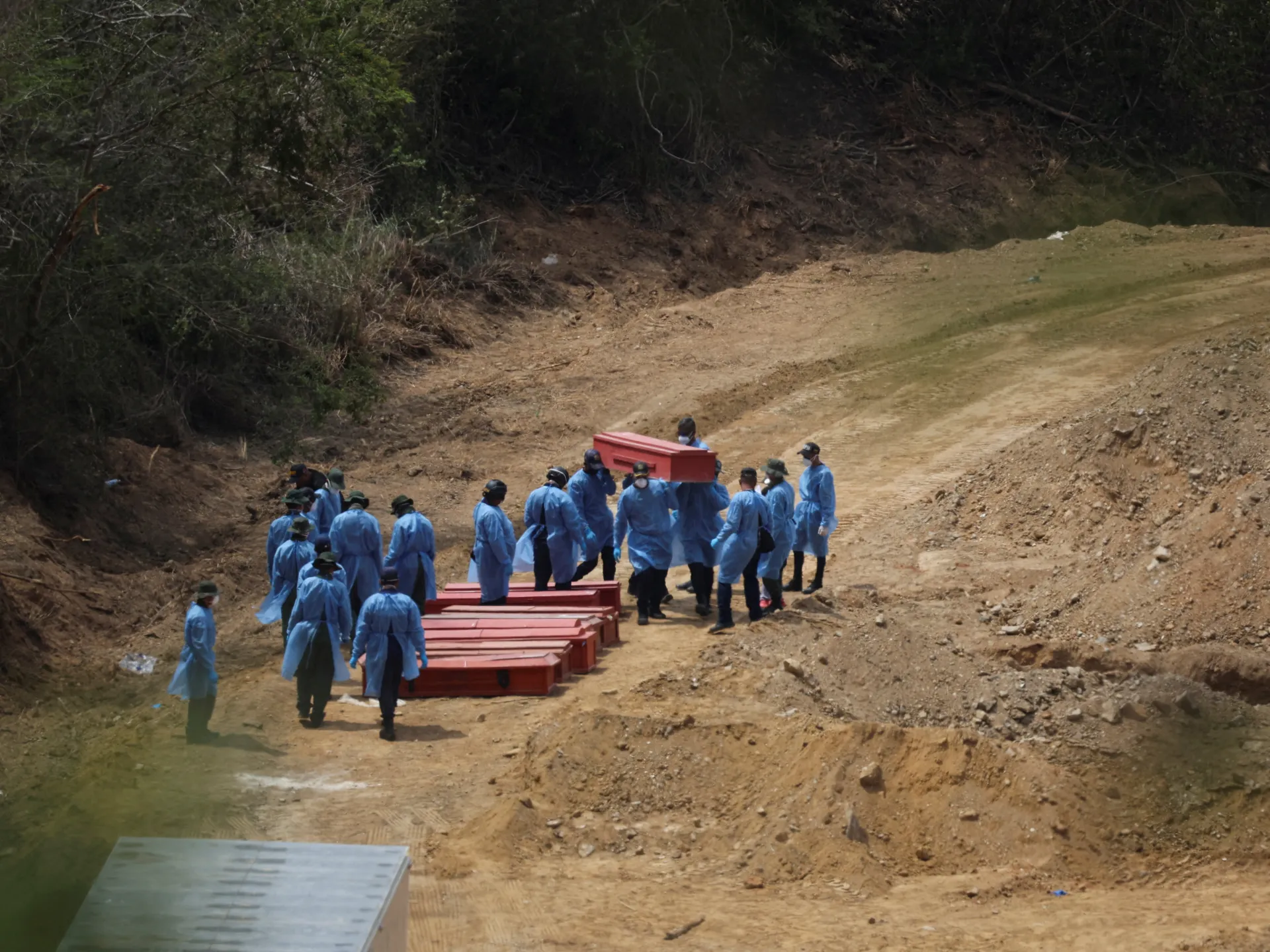
In La Guaira on Monday, witnesses told the Reuters news agency that they saw trucks and forensic workers transporting coffins while machinery dug trenches in an open area marked by white crosses where authorities were burying bodies.
![A drone view of coffins on the day of the burial of earthquake victims, in the aftermath of the June 24 earthquakes, at La Esperanza Cemetery, in La Guaira, Venezuela [Adriano Machado/Reuters]](https://www.aljazeera.com/wp-content/uploads/2026/07/2026-07-06T233931Z_369746753_RC2C8MAD32HA_RTRMADP_3_VENEZUELA-QUAKE-1783383988.jpg?w=770&resize=770%2C433&quality=80)
The June 24 earthquakes, which measured magnitudes 7.2 and 7.5, struck within seconds of each other in and around Caracas and La Guaira.
An estimated 60,000 buildings were damaged or destroyed.
Experts have also warned of a widening health crisis as thousands of displaced Venezuelans sleep in crowded temporary shelters or outside without access to clean water. Thousands have untreated injuries and infectious diseases, with the country’s healthcare system struggling to cope.
“The issue we foresee just around the corner is the infections that patients who have been exposed to the disaster for the longest time might bring,” Eugenio Cova, the head of the trauma unit at Hospital Jose Gregorio Hernandez in Caracas, said last week.
“We’ve already gone through a period of complex trauma, which will continue to occur, but now, it’s complicated by infections,” Cova said.
Reports of health concerns are already on the rise.
“There’s been lots of reports among the population here with diarrhoea and other diseases,” said Al Jazeera’s correspondent Teresa Bo, reporting last week from a shelter site in the region of La Guaira.
“They’re asking, for example, for portable toilets, and also help from the government to try to reorganise this place to try to prevent overcrowding, but also the spread of disease,” Bo said.
Frustration about the government’s rescue and recovery efforts has led to everyday citizens taking charge to find survivors and distribute aid.
Carolina Jimenez, the president of the Washington Office on Latin America (WOLA), a research and advocacy group, told Al Jazeera that the result has been growing anger towards the state.
“In a government in any other country, the first responder should be the state,” she said last week. “In the case of Venezuela, the state has been the last responder.”
In places like Catia la Mar, north of Caracas, authorities still haven’t arrived or are lacking.
“[The] response has come from citizens, from civil society, from humanitarian workers, from volunteers – but not from the government,” Jimenez said.