As the US celebrates its 250th birthday this year, all eyes are on the future when it comes the wild scientific breakthroughs that could be just years away from reality.
From space travel to our neighboring planets to fusion energy that makes fossil fuels a thing of the past, America is already looking ahead to the next 250 years and what could be possible, with scientists taking the first steps into an uncharted frontier.
Advances in the world of cybersecurity are expected to face major challenges as hackers gain access to futuristic AI weapons, while the first fully functional quantum computer may be only years away from solving impossible calculations in seconds.
Tech experts have also claimed that humanity will perfect the merging of machines with man, helping to give people superpowers and individuals with crippling injuries the use of their bodies again.
Many of the fields scientists and engineers are working to perfect today were still thought of as science-fiction during America’s bicentennial just 50 years ago, including the smartphone, the internet and reusable rocket engines.
Now, the same has been said of computers capable of finding a drug formula to cure Alzheimer’s, faster-than-light travel through space and the discovery of life on another planet.
Professor Avi Loeb, a Harvard scientist and member of the US government’s UAP Science Advisory Council, recently said: ‘If humanity gets through the next century without a civilizational catastrophe, we will have the opportunity to become an interstellar species.’
As America celebrates 250 years since the nation’s founding, the Daily Mail asked Loeb and others to speculate on what the US may look like by its 500th anniversary.
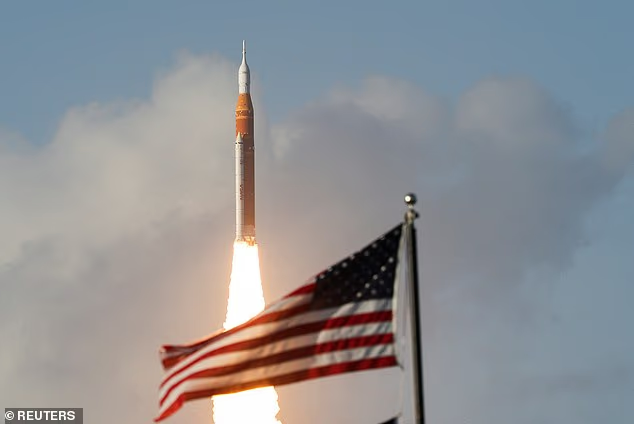
NASA’s Artemis II was the first manned mission to reach the moon since Apollo 17 in 1972

Scientists at MIT have been working to build clean, fusion reactor technology, which could revolutionize the energy industry (Stock Image)
The breakthroughs that could come in the next 25 years
The 21st century appears to be on the verge of a technological tsunami, with breakthroughs that extend lifespans, expand America’s reach throughout the solar system and provide the world with endless, clean power within three decades.
By 2030, NASA and the White House have already announced their intentions to place a permanent settlement on the moon and send the first ever manned mission to Mars.
The first steps of that plan unfolded just months ago as Artemis II successfully circled the moon and returned safely to Earth. A similar mission will test a new lunar lander in 2027, and astronauts are expected to set foot on the lunar surface in 2028.
On Earth, nuclear fusion could soon change the human race forever, as scientists edge closer to creating the first fusion power plants by the 2030s.
Fusion is the process that powers the sun and stars, where lighter atomic elements such as hydrogen fuse into heavier ones, like helium, releasing enormous amounts of energy. It could provide nearly limitless, low-carbon baseload electricity with minimal radioactive waste compared to current nuclear power plants.
The US Department of Energy has already released a roadmap to fusion energy, supporting the development of this power in the private sector by the mid-2030s.
As for the machines that keep all these innovations running, major tech giants think they are only a few years away from creating the world’s first ultra-fast quantum computers.
A quantum computer is a new kind of machine that uses the strange rules of quantum physics, where particles of light can exist in multiple states at once, unlike regular computers which rely on bits of information to either exist as a 1 or 0 in the machine.

Currently, a quantum computer (Pictured) that could process millions of qubits would need to be incredibly large, which is why your smartphone still uses traditional computer technology
Being able to operate in both states at the same time allows these still experimental computers to process information infinitely faster than today’s most powerful supercomputers.
That kind of power opens up the possibility of finishing calculations scientists have been working on for years or decades. Scientists have hoped this will unlock complex drug formulas, curing currently untreatable diseases.
IBM and Google have both aimed to create the first useful quantum machines that can run reliably without constant errors by 2029.
However, not every advancement is expected to be a positive. Cyber warfare expert James Knight told the Daily Mail that ‘Agentic AI,’ which are AI-fueled hacking programs, could devastate digital targets with the next 25 years.
The veteran cybersecurity guru from DigitalWarfare.com explained that these quickly evolving weapons can autonomously plan, act and adjust in order to do the most damage to businesses and everyday people at the speed of a computer.
Knight said: ‘Human-speed defense against machine-speed offense is not a fair contest.’

Contact lenses that enable wearers to see huge distances or even to beam computer information directly into their eyes could be on sale by 2030 (AI-generated Image)

In his recent book, The Singularity is Nearer, Ray Kurzweil predicted that in the years after 2029, human life will change radically
Within the next three decades, robotic exoskeletons may soon allow people to lift heavy objects with ease or regain the use of their limbs if they are paralyzed.
At the same time, AI-powered wearables, such as smart glasses and earbuds, could provide real-time information and immersive augmented reality experiences.
Tech pioneers like former Google engineer Ray Kurzweil believe these innovations are early steps toward the merging of humans and machines, with brain-computer interfaces offering direct access to digital intelligence.
Kurzweil, a self-proclaimed futurist, has claimed that the foundation of human immortality will begin in 2030, with man set to merge with machines by 2045.
One of the upcoming breakthroughs, according to Kurzweil, will be the development of microscopic nanobots that operate within the bloodstream, maintaining health without the need for constant medical monitoring.
In his latest book, The Singularity Is Nearer, Kurzweil forecasts a dramatic transformation in human life after 2029, with essential goods becoming more affordable and people beginning to merge with machines through technologies like brain-computer interfaces, similar to Elon Musk’s Neuralink.
He also pointed to recent advances in artificial intelligence, including tools like ChatGPT, as evidence that his 2005 predictions are on track, stating that ‘the trajectory is clear.’


Five decades ago, the idea of a smartphone was science fiction, as seen on Star Trek (Left). Today, it is one of the most common pieces of technology available on the planet (Right)
The breakthroughs that could come in the next 250 years
As the US heads towards its next 250 years, the wild advancements of the coming decades may lead to a complete reimagining of the human race by the 23rd century.
By 2276, Loeb told the Daily Mail in a statement that the goal of the US, and the rest of the human race, should be to use our advancing space technology to colonize space – mainly to avoid a extinction-level event on Earth.
Loeb said: ‘Venturing to space provide the insurance policy that transforms humanity from a fragile transient into a potentially enduring entity.’
In 250 years, routine travel to other planets and self-sustaining colonies on Mars and beyond will likely be the result of the Artemis missions this decade.
To reach other solar systems, however, will take a mode of travel that scientists still debate if it is even possible to achieve: faster-than-light travel.
Also known as warp speed, as it was famously referred to on Star Trek, most mainstream physicists believe traveling faster than the speed of light is impossible.
However, Mexican physicist Miguel Alcubierre came up with a theoretical idea in 1994 which proposed a ‘warp bubble’ that could allow a spaceship to travel faster than light by contracting spacetime in front of it and expanding spacetime behind it.
The so-called ‘Alcubierre drive’ would therefore move the ship through space and time without the craft actually moving faster than light locally – like riding through an invisible expressway in the fabric of the universe.

In 250 years, humans would reach the same era as the classic science fiction TV series Star Trek. In that show, humans had discovered the means to travel faster than the speed of light
As scientists like Loeb, and tech moguls like Musk, seeing the US moving beyond this planet and this solar system opens up the possibility of finally discovering life on other planets.
In 2026, the US continues to maintain that alien life does not exist and no UFOs have ever visited Earth.
By 2276, the US may end up being the extraterrestrials visiting other worlds throughout the cosmos if all of these breakthroughs come together to create the means to travel almost instantaneously between solar systems.