In the 1950s, the Italian industrialist Enrico Mattei was credited with coining what might have been the first stock market catchphrase when he described the energy giants of that era, including Standard Oil and Texaco, as the “Seven Sisters.”
For better or worse, he unleashed stockbrokers and creatively frustrated Wall Street analysts to devise their own nicknames for companies in vogue. There were the “Nifty Fifty,” steady large-cap stocks of the 1960s and ’70s, like Kodak; the “Four Horsemen” (Cisco, Dell, Intel and Microsoft) of the first dot-com boom; “FAANG” stocks of the social media age, including Facebook, Amazon and Apple; and more recently the “Magnificent Seven” — Nvidia, Apple, Microsoft, Alphabet, Amazon, Meta and Tesla — companies that grew to dominate major market indexes in the years after Covid.
Now, a fruit is dangling into the lexicon.
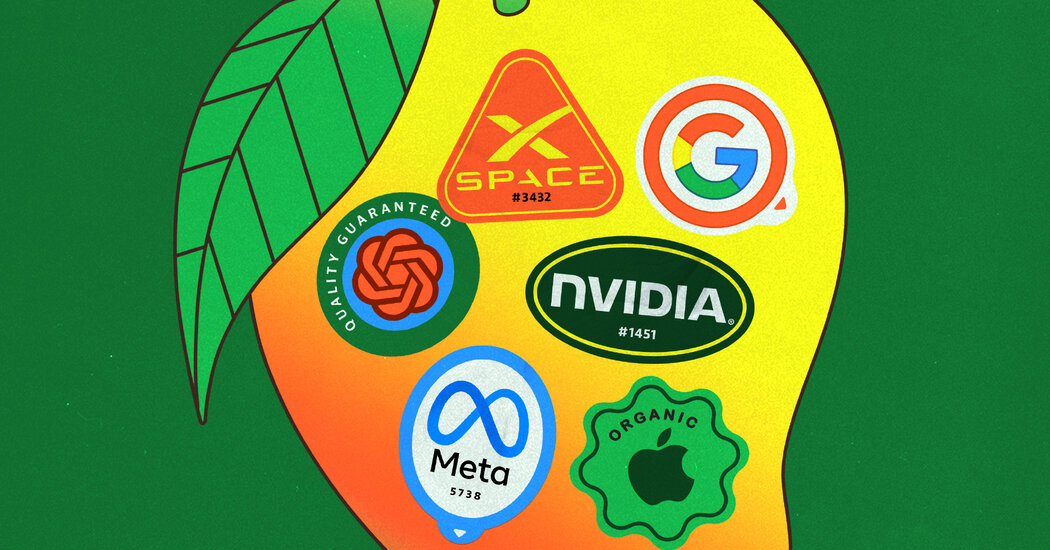
“MANGOS” is shorthand for a six-company cluster said to be at the center of the artificial intelligence wave: Meta, Anthropic, Nvidia, Google, OpenAI and SpaceX. Investors hope this new cohort will grow exponentially and drive the stock market higher.
How it’s pronounced
/maŋ-gōz/
The group is on everyone’s lips, cited all over business news and on social media. That’s partly because SpaceX made history last month with the largest initial public offering, defying skeptics to trade above $2 trillion. Much of that valuation was thanks to enthusiasm from relatively small “retail” investors who put their faith in the company’s chief executive, Elon Musk.
Over the past month, more than a dozen mutual funds have been formed to bet on or against the MANGOS. Never mind that two of the six companies, Anthropic and OpenAI, aren’t even publicly traded yet. (The funds will use options and other instruments to roughly track the performance of those private companies.)
It’s a bit unclear who first came up with the term. A Bank of America research analyst, Vivek Arya, has used it occasionally over the past two years, but to describe a different set of chip stocks, he confirmed through a representative. (Only the N for Nvidia is the same.)
The current iteration of the acronym was popularized more recently by a software engineer’s June 8 post on X. It was shared widely by venture capitalists and tech investors, and talked up incessantly on business television.
But are these stocks already proving to have a short shelf life? Since that post, the A.I. hype machine has hit the skids. Amid worries of overinvestment in data centers, mounting debt and expensive computer processing, as well as general concern that competition will drive down the price of A.I. products, shares of Meta, Nvidia and Alphabet (Google’s parent) were all down last month. SpaceX has fallen drastically from its highs, and OpenAI is leaning toward postponing its I.P.O. until next year.
For the MANGOS to stay firm, the companies will need to demonstrate staying power. And there’s no guarantee that any of them, let alone all, will stick around and thrive, no matter what happens with artificial intelligence.
“The data is clear,” said Derek Horstmeyer, a professor of finance at George Mason University. “Once something is a coined term, it’s already run its course.”
Just look at Mr. Mattei’s phrase. Though the oil market is bigger than ever, only one of his “Seven Sisters,” Royal Gulf Shell, still operates as an independent company with part of its original name.