A controversial plan to fight climate change by dimming the sun could choke the airlines with clouds of sulphuric acid, scientists have warned.
As human-caused climate change continues to accelerate, some researchers are now considering dramatic geoengineering solutions to hold off the worst effects.
One of the most popular solutions involves injecting tiny aerosol particles into the stratosphere to reflect heat from the sun back into space.
However, researchers now warn that this could expose passengers and crew on commercial airlines to ‘hazardous’ levels of toxic chemicals.
Most proposals for ‘stratospheric aerosol injection’ (SAI) involve releasing sulphur dioxide gas, which transforms into reflective sulphate particles in the atmosphere.
Commercial airlines typically route air through a compressor in the engine, through an environmental control system, and into the cabin.
But when sulphur dioxide is sucked up through this system, it reacts to form choking sulphuric acid.
Lead author Professor Alan Robock, of Rutgers University, told the Daily Mail that this could be hazardous for passengers and crew members who fly routinely.
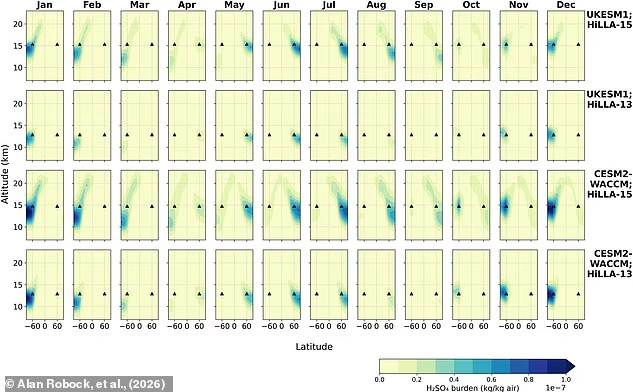
Scientists warn that a controversial method to dim the sun by injecting aerosols into the atmosphere could choke aircraft flying over the poles with sulphuric acid. Pictured: Predicted concentrations of sulphuric acid
Scientists often describe the problem of climate change as an energy imbalance in Earth’s climate system.
As greenhouse gases build up in the atmosphere, more energy remains trapped than can escape out to space, causing the planet to warm.
Since greenhouse gas emissions have risen to their highest levels on record, some scientists don’t think we have time to balance the equation by reducing the amount of heat the atmosphere traps.
Instead, some scientists have suggested we should start looking at ways of reducing the amount of energy coming into the system in the first place.
Professor Robock explains: ‘One of the proposed climate intervention schemes is to emulate large volcanic eruptions by producing a cloud of sulphuric acid droplets in the stratosphere to reflect sunlight and cool Earth.
‘Because there is no rain in the stratosphere, the atmospheric layer above the troposphere where we live, the droplets would last 50 times longer than surface pollution.’
However, the technique remains extremely controversial since scientists are unsure what the side effects could be.
A recent study conducted by Columbia Climate School found that Stratospheric Aerosol Injection could wreak havoc on global weather patterns.
If the aerosols were released in the polar regions, they would likely disrupt tropical monsoon systems, which could have an effect on sea levels, they found.
Modelling suggests that releasing around 12 million tonnes of sulphur dioxide into the atmosphere above the equator would be enough to cool the planet between 0.6°C and 1°C (1.08-1.8°F).
That would ensure the world stays below the 1.5°C (2.7°F) of warming required by the Paris Agreement, which would avoid the worst consequences of the climate crisis.
The problem is that these aerosols would need to be injected eight to nine miles (13 to 15 km) above the ground, far higher than any commercial aeroplane can fly.
The alternative proposal is to use Boeing 777s to inject a similar amount of sulphur at much higher latitudes around the poles where the stratosphere dips lower to the ground.
‘But that is the same place where aeroplanes fly on routes from North America to Europe and Asia,’ says Professor Robock.
This creates a risk that commercial aircraft could suddenly find themselves flying through clouds of sulphur dioxide and filling their cabins with sulphuric acid.
Since the aerosols would be sprayed in long streaks, there would be big differences in how concentrated the gases would be.

A geoengineering technique called Stratospheric Aerosol Injection (SAI) could be used to cap global warming at 1°C (1.8°F) or 1.5 (2.7°F)
In some places, Professor Robock calculates that concentrations would be around seven micrograms per cubic meter.
That is less than you would find in the ground-level air in some of the world’s largest cities.
However, other regions would see sulphuric acid concentrations up to 50 micrograms per cubic meter, which is above levels determined by the EU to be hazardous.
Inhaling sulphuric acid can trigger irritation of the throat and lungs and trigger asthma attacks in some people.
Higher concentrations can lead to more severe respiratory issues, such as a tightening of the airways that makes it harder to breathe.
Studies also suggest that repeated long-term exposure can increase the risk of stroke.
This creates a potentially serious health risk for cabin crew and pilots making routine polar flights.
However, although sulphuric acid is corrosive, experts don’t think there is any risk of damage being done to the plane itself.

Experts warn that using SAI could expose crew and passengers aboard commercial airlines (pictured) to concentrations of sulphuric acid deemed hazardous by the EU
According to Professor Robock, this could potentially rule out SAI being used at high altitudes.
He says: ‘We need more research to determine if there are safe levels, which would probably be lower than the currently proposed injection rates, and which would produce less cooling.’
But some scientists are not convinced that we need to entirely rule out SAI just yet.
Dr Wake Smith, a climate researcher at Harvard University, argues that risk warrants further study but should not be considered a major concern.
Dr Smith told the Daily Mail: ‘Should we ultimately conclude that this may present a hazard, cabin air filters could be reconfigured to filter out SO2 [sulphur dioxide], which they are not currently designed to do.
‘This presents a risk to further study and potentially manage but will not become a hazard for the flying public.
‘This is therefore not a reason to remove SAI from consideration within the climate toolbox.’
WHAT ARE THE SIDE EFFECTS OF GEOENGINEERING STRATEGIES?
Scientists have proposed all sorts of solutions to fight climate change, including a number of controversial geoengineering strategies.
Among the many include:
Afforestation: This technique would irrigate deserts, such as those in Australia and North Africa, to plant millions of trees that could absorb carbon dioxide.
Drawback: This vegetation would also draw in sunlight that the deserts currently reflect back into space, and so contribute to global warming.
Scientists have proposed all sorts of solutions to fight climate change. File photo
Artificial ocean upwelling: Engineers would use long pipes to pump cold, nutrient-rich water upward to cool ocean-surface waters.
Drawback: If this process ever stopped it could cause oceans to rebalance their heat levels and rapidly change the climate.
Ocean alkalinisation: This involves heaping lime into the ocean to chemically increase the absorption of carbon dioxide.
Drawback: Study suggests it will have of little use in reducing global temperatures.
Ocean iron fertilisation: The method involves dumping iron into the oceans to improve the growth of photosynthetic organisms that can absorb carbon dioxide.
Drawback: Study suggests it will have of little use in reducing global temperatures.
Solar radiation management: This would reduce the amount of sunlight Earth receives, by shooting reflective sulphate-based aerosols into the atmosphere.
Drawback: Carbon dioxide would still build up in the atmosphere.