How do you pronounce ‘happy’, ‘baby’, ‘chilly’, or ‘city’? According to a new study, the answer could say a lot about your social class.
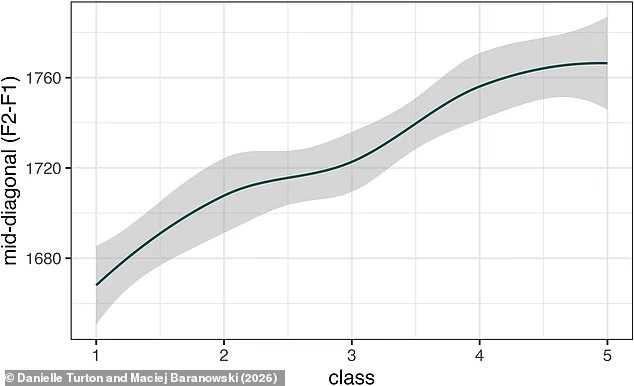
Scientists found that people who pronounce these words with an open ‘eh’ sound, as in ‘happeh’, are more likely to be from working-class backgrounds.
Meanwhile, middle-class people tend to say ‘happee’, with higher social classes using a ‘tenser’ vowel sound overall.
These results, published in the journal Language Variation and Change, come from a study of Mancunian accents based on recordings of over 100 people.
What the researchers found remarkable is that this linguistic difference has remained incredibly stable across multiple generations.
Despite Manchester going through massive social changes over the last few decades, the ‘happeh’ vs ‘happee’ divide remains as strong as ever.
Teenagers as young as 16 pronounce the so-called ‘happy vowel’ differently based on their class in just the same way as their grandparents do, regardless of gender.
Lead researcher Dr Maciej Baranowski, from the University of Manchester, says: ‘Our research in Manchester demonstrates how everyday speech can reflect long-standing social patterns.’
Scientists say that how you pronounce ‘happy’ could reveal your social class, with posher people using a ‘tenser’ vowel (illustrated)

Scientists say that Mancunians, such as Liam and Noel Gallagher, who pronounce ‘happy’ to sound like ‘happeh’ are more likely to be working class
While these accent differences were remarkably stable, the researchers did find some differences along ethnic lines.
Mancunians from a British Pakistani background were more likely to say ‘happee’ despite being working class, whereas their white and black Caribbean counterparts would say ‘happeh’.
Another surprising feature of the Mancunian accent is that speakers from Manchester barely seem to notice it.
Most speakers generally become more middle class in formal speech, such as reading words from a list, using the tenser ‘-ee’ sound.
The notable exception were people from the lowest social class group, who persisted with their ‘happeh’ pronunciation regardless.
The researchers point out that there is no sign of any stigma associated with the working class ‘-eh’ pronunciation.
Likewise, anecdotal evidence suggests that most speakers don’t notice the difference in their own speech.
This suggests that the accent could be something which forms below the level of people’s awareness, despite being incredibly obvious to outsiders.

Meanwhile, middle-class Mancunians, such as Professor Brian Cox, pronounce ‘happy’ as ‘happee’

This trend was extremely stable across generations, with teenagers following the same accent patterns as their 80-year-old grandparents
Dr Baranowski, for example, who didn’t grow up in Manchester, thought that the soft ‘-eh’ was the most striking part of the Mancunian accent when he moved to the city.
However, his Mancunian co-author Dr Danielle Turton, of Lancaster University, says she was totally unaware of the difference until she became a trained linguist.
Similarly, the researchers noticed that people from working-class backgrounds in Manchester don’t change their accents based on context.
This may not be too much of an issue for Mancunians, as research suggests that the Manchester accent is the easiest regional accent to understand.
This comes as research shows that your accent can have a big impact on how others see you, and your prospects later in life.
Accents begin developing early in childhood, and are largely set in stone by the age of 14.
However, studies have shown that people often judge others harshly based on how they sound.
For example, a study last year by researchers from the University of Cambridge found that people with Cardiff accents are perceived as kind and friendly, while Scousers are seen as likely to cheat on their partners.

From the approachable Geordie twang to the instantly recognisable Edinburgh lilt, the UK is home to some of the most distinctive accents in the world. Now, experts have revealed which accents are the most difficult to understand
Likewise, researchers from Harvard Business School have uncovered an ‘accent penalty’ in settings where attention determines reach and influence.
For the study, the team analysed more than 5,000 high–profile public TED Talks delivered in English across a range of topics.
Their analysis showed a ‘clear pattern’ in which speakers with non-standard accents consistently received less engagement, in the form of views and likes.
This suggests that having a strong regional accent could be hindering your job prospects.