
NASA shared new details about its Moon Base strategy, outlining plans to establish a long-term human presence near the Moon’s south pole. The agency unveiled new lunar rover contracts, upcoming cargo missions, and future infrastructure projects designed to support sustained operations on the lunar surface. NASA officials said the initiative represents a shift from simply visiting the Moon to building permanent systems for long-term lunar exploration.
NASA officials and partners are trying to make history by repositioning the Swift telescope, which is actively sinking into Earth’s atmosphere, and they plan to launch as early as Tuesday.
A mission to raise NASA’s Neil Gehrels Swift Observatory higher in space is set for launch on Tuesday, at 6:23 a.m. EDT, using a robotic satellite called LINK, built by Katalyst Space, which was awarded the contract in September 2025.
NOT JUST HURRICANES: TROPICAL STORMS IN HISTORY THAT PACKED A PUNCH WITH HISTORIC, DEADLY FLOODING
LINK, a robotic servicing satellite, will launch into orbit from aboard the Northrop Grumman Pegasus XL rocket, according to NASA.
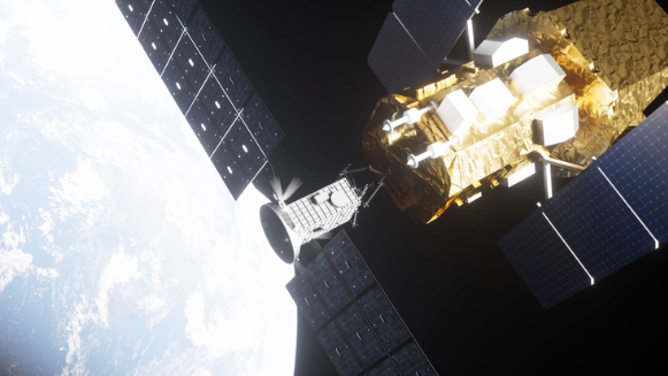
The LINK satellite is tasked with grappling and slowly raising Swift’s altitude over the next several months, preventing it from falling back into Earth’s atmosphere.
Photo of NASA’s Swift satellite.
This is because our planet’s atmosphere creates drag on all spacecraft low in Earth’s atmosphere, gradually reducing their altitude (unless they have propulsion systems to counteract the effect).
NASA said a recent bout of solar storms magnified this effect on Swift, which began to sink faster than anticipated.
NASA ANNOUNCES ARTEMIS III ASTRONAUTS IN NEXT PHASE OF MISSION TO RETURN HUMANS TO THE MOON
NASA officials recognized the unique opportunity to advance the satellite service industry by repositioning it to its original orbital position and evaluating other vital functions.

This picture shows a regions captured by a telescope aboard the Swift satellite of a region 200,00 light years wide.
(NASA/Swift/Stefan Immler (GSFC) and Erin Grand (UMCP))
LINK will perform this mission using its robotic arms and eventually raise the satellite to at least 185 miles above Earth’s atmosphere, but the greater objective is to reach nearly 370 miles.
The LINK spacecraft weighs around 880 pounds and stands at about five feet tall, around a third of Swift’s overall size.
SEE IT: DOZENS OF ACTIVE DUST DEVILS CAUGHT ON CAMERA SWIRLING ON MARS SURFACE
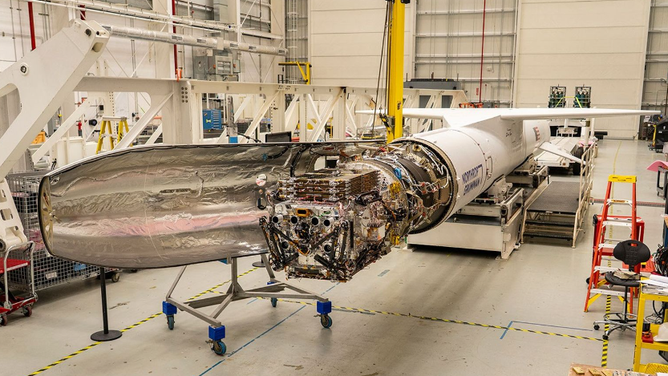
Katalyst Space’s LINK robotic servicing spacecraft.
(NASA/Ron Beard)
This is a small, but vital step toward the overall goal of human interplanetary travel.
“If we’re going to build an enduring presence beyond Earth, we need the capability to manipulate our environment in space,” Ghonhee Lee, CEO of Katalyst, said. “That means deploying robotic spacecraft that can reposition, repair, refuel and refit satellites after launch.”
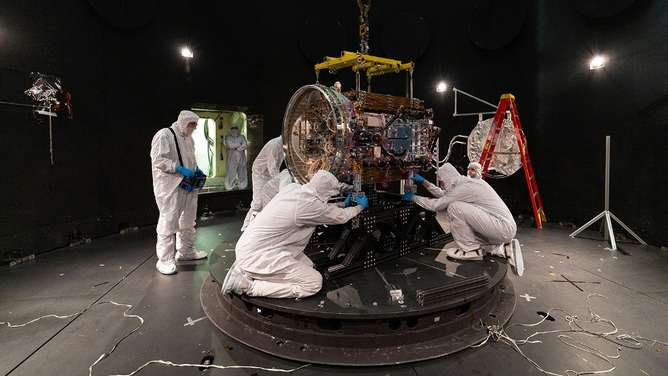
Katalyst engineers work on the LINK satellite.
(NASA/Sophia Roberts)
THE BEST CELESTIAL EVENTS IN 2026 YOU WON’T WANT TO MISS
The Neil Gehrels Swift Observatory is an astrophysics multi-tool capable of quickly observing a wide range of cosmic objects in visible, ultraviolet, X-ray and gamma-ray light, according to NASA.
Through this mission, NASA and Katalyst will demonstrate a cost-effective alternative to extending satellite lifespans.


