Parents may insist that they treat all their children equally, but a new study suggests that sons and daughters are raised in strikingly different ways.
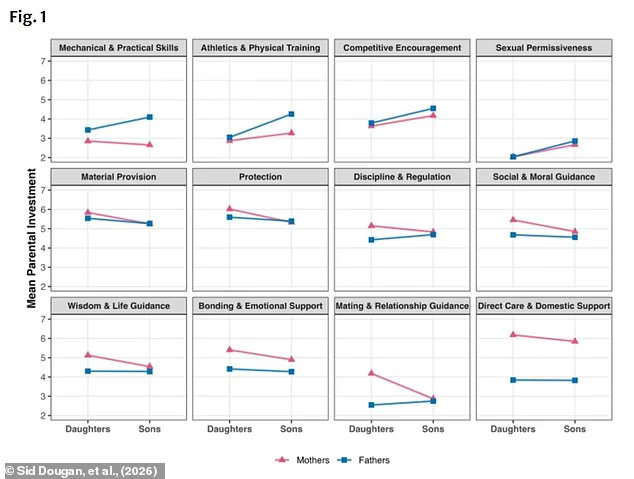
Researchers found that daughters are given more advice on dating and relationships, as well as getting more protection and financial support.
Sons, meanwhile, are encouraged to be competitive, get help with sports and athletics, and are allowed more sexual freedom.
The study also found mothers and fathers tend to have different roles, with dads preferring to spend his time practising sports and teaching practical or mechanical skills.
On the other hand, mothers spent more time giving out emotional support, relationship advice, and wisdom or life guidance.
However, this doesn’t mean that parents love or care for one child more than the other.
Instead, the researchers say that these are habits we have inherited from our ancestors, which evolved when boys and girls faced very different challenges.
To give their kids the best chance of success, mothers and fathers learned to invest differently depending on whether they were raising a son or a daughter.
Scientists say that sons and daughters really are treated differently by their parents. Girls are more likely to receive relationship advice, protection and financial support from their parents
While previous studies have looked for differences between the care that sons and daughters receive, these have generally found that the genders receive roughly the same amount of overall care.
However, the researchers argue that the difference isn’t in the amount of parenting that boys and girls get, but the type of effort their parents make with them.
To capture a broader view of parenting, Sid Dougan, from the University of Texas at Austin, and his co-authors gave 105 adults a survey asking them about different types of care they might have received as children.
The result, published in the journal Human Nature, is a measurement of 73 types of behaviour grouped into 13 broad categories.
This revealed that there really were gender differences in how sons and daughters are raised.
Depending on whether their child was a boy or a girl, parents also tended to change up their parenting style along gender lines.
Mothers were more focused on giving relationship and dating advice to their daughters, while fathers invested more time into teaching their sons sports and practical skills.
A few things were still equal between the genders, however, with both sons and daughters getting the same amount of education and career support.

Boys, meanwhile, are more often encouraged to be competitive, play sports and are given greater sexual freedom as they grow up (stock image)
According to the researchers, these gender biases are the product of the different challenges men and women faced in our evolutionary past.
Mr Dougan, a PhD student, told the Daily Mail: ‘Women and men have faced many of the same adaptive challenges over human evolutionary history, but they have also faced some challenges that have fallen much more heavily on one sex than the other.
‘Success or failure in overcoming these challenges often had major consequences for survival and reproductive success.’
This would explain why sons got more investment in athletics and were encouraged to be competitive by both their mums and dads.
‘Throughout our evolutionary history, men’s reproductive success depended more heavily on physical competition, status, hunting, and warfare,’ explains Mr Dougan.
‘According to my hypothesis, parents who helped prepare their sons for these challenges would have been more likely to pass on their genes, so natural selection would have favoured psychological mechanisms that motivate these patterns of investment.’
Women, on the other hand, faced a greater evolutionary cost for choosing the wrong partner.
As in the animal kingdom, in the distant past men could have children with multiple women while females could only mate with one male at a time.

Mothers tended to give daughters a lot more relationship and dating advice than their sons. While fathers tended to invest much more time teaching their sons to play sports than their daughters
Mr Dougan says: ‘I hypothesise that parents who invested more in helping daughters navigate these challenges would therefore have been more successful over evolutionary time.’
Over time, this could also lead to changes in behaviour between men and women later in life.
That doesn’t necessarily mean there will be big differences in personality, but it could affect how prepared men and women are for certain types of challenge.
‘Parents are an important source of the knowledge, skills, and experience that prepare offspring for adulthood,’ says Mr Dougan.
‘However, more research is needed to determine whether these differences directly shape behaviour in adulthood.’
The researchers acknowledge that their study was conducted on a relatively small sample of people who were almost entirely from white, suburban, American households.
Going forward, Mr Dougan plans to repeat the study with a larger cohort and in small-scale hunter-gatherer societies to see whether these trends still exist.