Whether you’re Jeff Bezos or Ernst Blofeld, every billionaire needs their secret lair.
And when the ultra-rich need to lay out some plans for their impregnable stronghold, Philip Pauley is the one they turn to.
This architect of the apocalypse is ‘building underground worlds’ before the next disaster strikes, which could support life for years underground.
Mr Pauley says that his clients include ‘governments, military, and high-net-worth individuals’ who all want to find a way to outwit the end of the world.
These ‘closed-loop’ systems can be ‘aircraft-hangar-sized’ and fitted with private rooms, communal areas, and leisure facilities.
But don’t expect the top one per cent to wait out the end of days in drab surroundings, as Mr Pauley describes the fittings as ‘opulent and homely’.
With a ‘money as no barrier’ budget, these custom bunkers often reach levels of luxury best compared to a ‘private jet’.
However, surviving in style isn’t cheap, with clients reportedly paying ‘hundreds of millions’ for construction before fitting out their new pad ‘under a shroud of secrecy’.
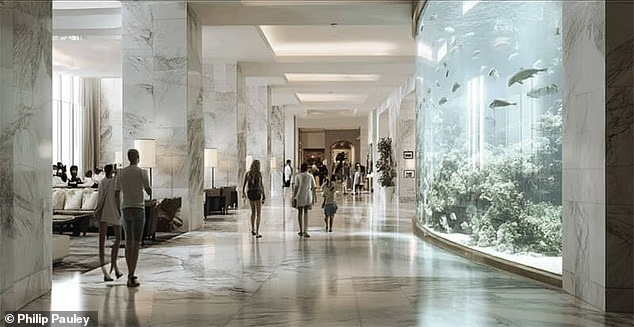
British architect Philip Pauley claims to have designed doomsday bunkers for high-net-worth individuals, including luxury features like fish tanks and artificial windows
Mr Pauley is a self-described ‘Operational Resilience Architect’ who founded Pauley Interactive, an immersive technology consultancy.
Through Pauley Interactive, he has advised the U.S. Chief of Naval Operations Strategic Studies Group and partnered with BAE Systems, one of the world’s largest defence contractors.
While his work has mainly focused on augmented reality systems, Mr Pauley says that his current focus is ‘preparing for the worst-case scenario’.
In practice, that means designing self-sufficient underground compounds built to outlast the end of the world.
While their new owners are staying quiet about these developments, Mr Pauley claims you might be surprised to learn just how much building is going on underground.
‘There’s a lot of activity going on,’ he told the Daily Mail, ‘It’s moving it forward at pace for a select group.’
‘There are loads of people doing doomsday bunkers for a range of different people.’
However, in Mr Pauley’s view, most people building bunkers aren’t thinking big enough.

Mr Pauley is a self-described ‘Operational Resilience Architect’ who founded Pauley Interactive, an immersive technology consultancy
‘They’re relatively small scale, apart from a couple of US Military ones, and they’re only meant to help people survive for three months maximum,’ he said.
‘I can’t say much [about the details], but it is still at a level where people are thinking in terms of months rather than years.’
At the very most, Mr Pauley estimates that these ‘open-loop’ systems could last for up to a single year at full capacity – not long enough by far in his opinion.
Rather than thinking about survival in terms of months, he believes the disaster facing us requires thinking on the scale of years.
‘It’s not doom-mongering, it’s preparing,’ Mr Pauley insists.
‘There are thousands of asteroids that are being monitored, but, quite frankly, no one knows the trajectory of all these things.’
‘If a sizeable asteroid hits, you would need to potentially be underground for 10 years or more. So it’s a full decade or longer for the surface to be anywhere near survivable.’
Then, of course, there is the threat of thermonuclear war or ‘any sort of major World War III event‘ – not to mention the possibility of a ‘mutant pandemic’ or catastrophic climate change.

Mr Pauley says that most bunker ideas, such as his ‘survival container’ idea, don’t provide a long-term solution. He says that we should be building bunkers capable of supporting a ‘human seed bank’ for years
Mr Pauley says: ‘We don’t seem to have the willpower to be able to stop climate change at the moment, and now we’ve got worries about whole ocean currents collapsing.
‘At some stage, the worry is that the whole food system might collapse and then we’ll end up with some sort of Mars-type environment here on Earth.’
However, building a bunker that can survive for years requires a very different ‘closed-loop’ approach.
Even the International Space Station, which is about as close to a sealed habitat as we have, is only ‘partially-closed’ as it still needs food supplies to be brought in and waste taken out.
Mr Pauley’s eventual goal is to develop systems that ‘replicate the biomes of Earth, remaining completely self-contained for years at a time.
While that still requires some major technological advances, current state-of-the-art bunkers are getting closer.
In order to minimise the psychological damage of being trapped underground for years, the structures are made to be as light and airy as possible.
A luxury bunker would include ‘crisp white spaces, trees, greenery, LEDs that mimic daylight and nighttime and artificial windowless views’.

Surviving in style isn’t cheap, with clients reportedly paying ‘hundreds of millions’ for construction before fitting out their new pad ‘under a shroud of secrecy’
To stretch the food supplies longer, hydroponic and aquaponics farms, as well as ‘giant fish tanks’ for edible fish, will be beside all the usual CO2 scrubbers and recycling systems.
But that doesn’t necessarily mean that the food supplies will be vast or luxurious.
He says: ‘You need to turn vegetarian, quite frankly. Because, apart from the fish, they haven’t got any livestock.’
Realistically, the diet of anyone in one of these underground worlds would be quite heavy in insect protein and fungi-based mycoprotein, like Quorn.
Currently, Mr Pauley says that these survival structures are restricted to the military and the ultra-rich.
However, in the future, that is something he would like to change.
‘I feel a bit like Noah half the time,’ he says
‘The Earth is not getting any more stable, is it? We’re all in the same boat, and we can see the direction of travel, so we should be thinking about longer-term solutions to safeguard ourselves.’
Even Mr Pauley admits it might not be possible to build a bunker big enough to hold the whole of humanity, or even the whole of the UK.
His more modest goal is to ensure a ‘seed’ of humanity is saved should disaster strike.
‘A seed can remain inactive for tens of years, but when the conditions are right, it will spring back to life,’ he says.
‘It’s about creating a human seed bank for those worst-case scenarios’.