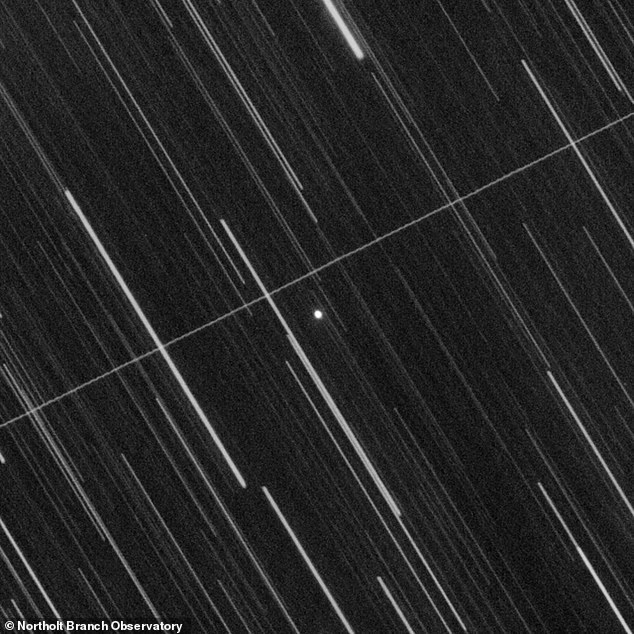
A huge asteroid measuring a mile across will zoom past Earth in an exceptionally close pass tomorrow.
The space rock, measuring twice the size of the Burj Khalifa, will pass so close to Earth that it will be visible with large binoculars or a small telescope.
At its closest point at 12:14 BST on Saturday, the asteroid will pass within 1,590,000 miles (2,560,000 km) of Earth.
While it is a near miss in astronomical terms, that is over six times the distance between the Earth and the moon.
Astronomers say that the asteroid, named 1997 NC1, poses no threat to Earth and there is no chance of a dangerous collision.
However, it will present a rare treat for stargazers, who should be able to see light bouncing off the rock’s surface as it whizzes by at 5.6 miles (9 km) per second.
According to the European Space Agency (ESA), people in the Northern Hemisphere will be able to see 1997 NC1 as it approaches Earth and passes Earth.
Meanwhile, those in the Southern Hemisphere will get a good look at this alien visitor once it has safely passed Earth’s orbit.
A mile-long asteroid will zoom past Earth tomorrow night, passing so close that it will be visible to anyone with a decent pair of binoculars. Pictured: The asteroid 1997 NC1 as seen from the Northolt Branch Observatory, on the night of June 25

A mile-long asteroid will zoom past Earth tomorrow night, passing so close that it will be visible to anyone with a decent pair of binoculars. Pictured: The asteroid’s location at 4:00 am BST
Based on the light reflected by 1997 NC1, astronomers estimate that it is between 750 and 1,650 metres across.
However, ESA also suggests that it could prove to be more reflective and smaller than currently thought.
Yet this still makes 1997 NC1 roughly 60 times bigger than the Chelyabinsk meteor, which exploded in the atmosphere over Russia and injured 1,491 people in 2013.
If an object this large were to collide with Earth, it would be considered a ‘city killer’, with the potential to cause catastrophic damage.
Luckily for us, the world’s space agencies have been carefully tracking this object since it was discovered in 1997, and any chance of an impact has been ruled out.
Guy Wells, founder of Northolt Branch Observatories, told the Daily Mail: ‘Whilst this is a fairly large near-Earth asteroid, there’s absolutely no need for concern.’
What that leaves is an amazing opportunity to learn more about asteroids drifting through the solar system and to see a real extraterrestrial object with your own eyes.
Juan Luis Cano, of the ESA’s Planetary Defence Office, says: ‘A close approach to Earth by an object this size only occurs every few years.’

The asteroid, named 1997 NC1, will pass within 1,590,000 miles (2,560,000 kilometres) of Earth on Saturday
NASA scientists are already planning to use the 34-metre-wide Deep Space Station 26 radio telescope to scan the rock’s surface.
This will help create a 3D model of the rock, revealing whether it is a loose pile of rubble that would break up in the atmosphere or a more dangerous solid rock.
But the astronomy action isn’t limited to the professionals, as anyone with a decent pair of binoculars will be able to see 1997 NC1 as it passes.
Dr Ed Bloomer, Senior Astronomer at Royal Observatory Greenwich, told the Daily Mail: ‘Factoring in the local horizon and sunset, between about 10:30 and 11:30 is the best window of opportunity for UK residents.
‘Tonight, as the sun sets, it is near the constellation Bootes towards the West and will race eastwards over the next few hours towards Aquarius before dropping below the horizon.’
However, Dr Bloomer cautions that even a one-mile-long asteroid is quite small in astronomical terms, so it will be ‘intrinsically very challenging to see properly.’
To give yourself the best chance, you can use a sky map app such as Stellarium to help track down the moving object.
Additionally, it is always advisable to try to avoid light pollution by heading to a dark, quiet area and give your eyes at least 20 minutes to adjust.

The best way to find the 1997 NC1 will be to use a sky map app such as Stellarium (pictured), which will help to find the moving object

Unfortunately, the weather forecast for Saturday night predicts fairly heavy cloud cover that will make it difficult to see the asteroid
Unfortunately, this space rock’s arrival is poorly timed with the phases of the moon, as the moon will be waxing gibbous and approximately 94 per cent illuminated.
This will add a lot of additional light to the sky that will make the faint glow from 1997 NC1 much harder to spot.
Likewise, the weather looks far from ideal for stargazing, with the Met Office forecasting fairly heavy cloud cover settling in over Scotland and the east of England.
However, the passing asteroid will be visible tonight, although not as brightly, when weather conditions look to be clearer.
And if you don’t have any equipment, there’s no need to miss out.
The Virtual Telescope Project will be livestreaming their observations of 1997 NC1’s close encounter from their professional telescopes.
You can find those streams and more information about how to watch by following this link.
There will be two streams while the asteroid is at its brightest, both starting at 23:00 BST tonight and tomorrow night.