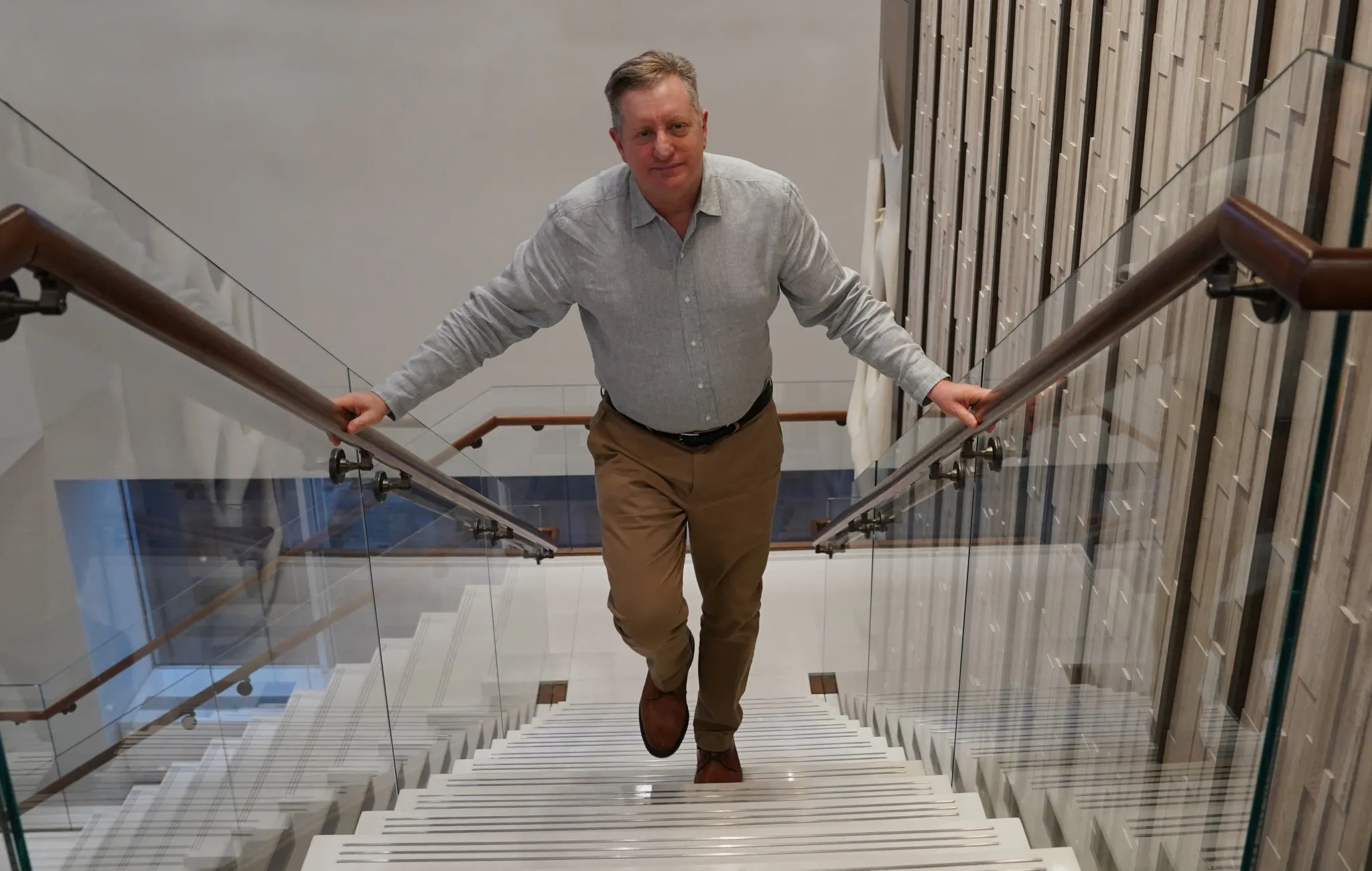
Steve Eisman has a simple way to explain why SpaceX is the most absurd stock in America: its revenues are roughly equal to those of the company that makes Froot Loops. The difference? Nobody is valuing Kellogg’s at 100x revenue.
If you’ll recall, Eisman identified that a housing bubble was building in 2006 and 2007, fueled by an explosion in the issuance of “teaser-rate,” sub-prime mortgages, and that a crash was imminent. He famously seized the moment by shorting the home-loan market big time, a move that greatly profited both the trader and his firm FrontPoint Partners, a subsidiary of Morgan Stanley. Michael Lewis made Eisman a Wall Street legend by chronicling his exploits in his 2010 bestseller The Big Short. In the 2015 film version, Steve Carrell played the famously cranky, contrarian (re-named “Mark Baum”), while Marisa Tomei portrayed his wife and co-skeptic, former J.P. Morgan analyst Valerie Feigen (“Cynthia Baum”). Today, Eisman hosts the weekly podcast “The Real Eisman Playbook,” a program I highly recommend as much for its rollicking mockery of the group think that dominates the sell-side stock community as its sharp insights on economic trends and knack at nailing the basics that over time, drive outstanding returns to investors.
In a half-hour phone call, Eisman skewered the latest case where he reckons that hype and hysteria are fogging minds—and it’s hardly surprising that his new target’s none other than the SpaceX phenomenon. “SpaceX has the revenues of Kellogg’s, which makes Froot Loops, which I love, but no one is going out of their way to buy Froot Loops,” he declares. (The Ferrero Group of Italy bought Kellogg’s cereal business; Ferrero’s 2025 revenues of $21 billion are indeed close to SpaceX’s $19 billion.) “SpaceX stock’s being valued at over 100 times revenue, whereas no company of any size has ever had that kind of valuation. By comparison, Palantir is at 50x.” Eisman relates that Elon Musk plans to make money from ventures that only exit in the fictional world. “I grew up reading a lot of sci-fi, a ton of it, I’ve read it all,” says Eisman. “Musk and Silicon Valley grew up on it, too. The difference is, Musk and the SpaceX crew take it seriously!”
Eisman notes that a particular source of riches SpaceX hopes to pluck from the planets especially caught his attention, since it’s central to the plot of a sci-fi streamer he loves. “In the SpaceX S-1, where they talk about things SpaceX will eventually do, one of them is asteroid mining. Literally, there is really a great, wonderful sci-fi show on Apple TV called ‘For All Mankind,’ and asteroid mining plays an important part on the show. (Indeed page 71 of the SpaceX S-1 contains the following: “We plan to pursue asteroid mining operations to extract metals and other critical resources from near-Earth and main-belt asteroids, providing abundant raw materials for space-based industries.”)
It also puzzles Eisman that Musk is building an enterprise that straddles at least two industries, and may well add another, when the corporate world’s moving in the opposite direction. “Why make the company into a massive conglomerate, when conglomerates are totally out of favor? The world is de-conglomerate-izing. People want pure play, and they’re in rockets, Starlink and AI.” The prospect that SpaceX will buy Tesla, Musk’s second largest holding, is especially appalling to Eisman. “Tesla’s been a horrible failure for the past several years,” he avows. “Every year Musk says we’ll have self-driving cars and robotaxis, which he doesn’t do, and all we know is that earnings go down year after year. Musk is a cult, so people keep saying ‘wait till next year.’”
Eisman holds a dim view of the hyper-scalers’ future in AI
Eisman points to a part of the S-1 that’s effectively a manifesto wagering SpaceX’s future on AI. In fact, its chief AI product sports a brand name that Eisman fondly recalls from his teenage sci-fi enchantment. “Robert Heinlein invented the word ‘grok’ in his novel ‘Stranger in a Strange Land’ [1961] about a Martian who comes earth,” says Eisman. “In the book, ‘grok’ means ‘deep understanding.’” In contrast to its lofty moniker, Grok the product’s a lightweight, claims Eisman. “The S-1 says that SpaceX total addressable market is $28.5 trillion, and the irony is that over 90% of that TAM is AI, which is all about Grok,” he intones. “Grok is a third-tier product. I’ve heard reports that even the engineers in Musk’s own space division won’t use it because it sucks.”
Overall, he says, the outlook for the hyperscalers is darkening fast. “We’ve seen a sea change in their AI story, and not for the better,” he declares. “That’s because of two vectors. The first is that for the hyperscalers, AI is becoming increasingly capital intensive. Last year, Alphabet spent $80 billion on AI and funded it from cash flow. This year, it will spend $180 to $190 billion and raised $85 billion in stock. Now, they all have to raise funding through stock offerings because the table stakes get bigger and bigger.” He adds that post-IPO, SpaceX will need to keep tapping the capital markets since its recurring cash flow doesn’t come close to meeting its hunger for AI-driven capex.
“The other vector is that there are no ‘moats’ in AI,” he contends. “Someone moves to ChatGPT then to Gemini then to Claude. Even if AI is the greatest thing since the invention of the printing press, there are no moats to shield the providers. You don’t want to be the hyperscalers selling this highly competitive product where you have to cut prices to win customers. You want to be the suppliers selling them the picks and shovels, the chips and networking gear the hyper-scalers buy to make their products. Those products are highly customized and protected.” For Eisman, it’s far better to be a Nvidia, Arista or Cisco riding the capex boom than a Meta, Oracle, Microsoft or Alphabet battling a field of fellow behemoths in the brutal arena where the enterprise and retail solutions are easily swappable.
Eisman stresses that he’s not advising anyone to short SpaceX. “I have no opinion on what will happen to SpaceX,” he says. “From a fundamental perspective, it’s ridiculous But a lot of things can be ridiculous for a long time.” For this dourest of doubters, Musk’s claims for the feats ahead can only happen in the SpaceX founder’s head, or in the sci-fi fantasies Eisman grew up on.