Europeans seem to have gotten over their antipathy toward Elon Musk.
A year ago, Tesla sales in Europe were in free fall after Mr. Musk, the automaker’s chief executive, appeared to turn off car buyers with his vocal support for right-wing politicians in Britain and Europe and his role as President Trump’s cost-cutting czar.
But in recent months Tesla’s sales across Europe have rebounded sharply amid a broader surge in electric vehicle sales, which now account for more than a fifth of new car purchases on the continent.
Tesla’s vehicle sales rose 77 percent from January through May compared with a year earlier, the European Automobile Manufacturers’ Association said this week. In May, Tesla sold 22,000 cars in Europe. That’s more than Ford, Nissan or Honda, even when including their fossil-fuel models.
Many people seem to have put aside their personal feelings about Mr. Musk after Tesla cut prices for its entry-level models to levels that are competitive with comparable gasoline or diesel vehicles and inexpensive cars from China. In some countries, Tesla’s Model Y sport utility vehicles can be leased for less than 300 euros, or about $340, a month.
“Once you go down the pricing scale, people pay less attention to ethics or morality,” said Matthias Schmidt, an independent analyst in Berlin who tracks electric vehicles sales. “Tesla’s product has become so appealing from a price perspective, it’s almost too good to refuse.”
Tesla did not respond to a request for comment.
When Mr. Musk became a part of the Trump administration last year, Hansjoerg Quilitzsch, a retired IBM employee who lives in southwestern Germany, stuck a bumper sticker on his Tesla Model Y that read, “I bought this before Elon went crazy.”
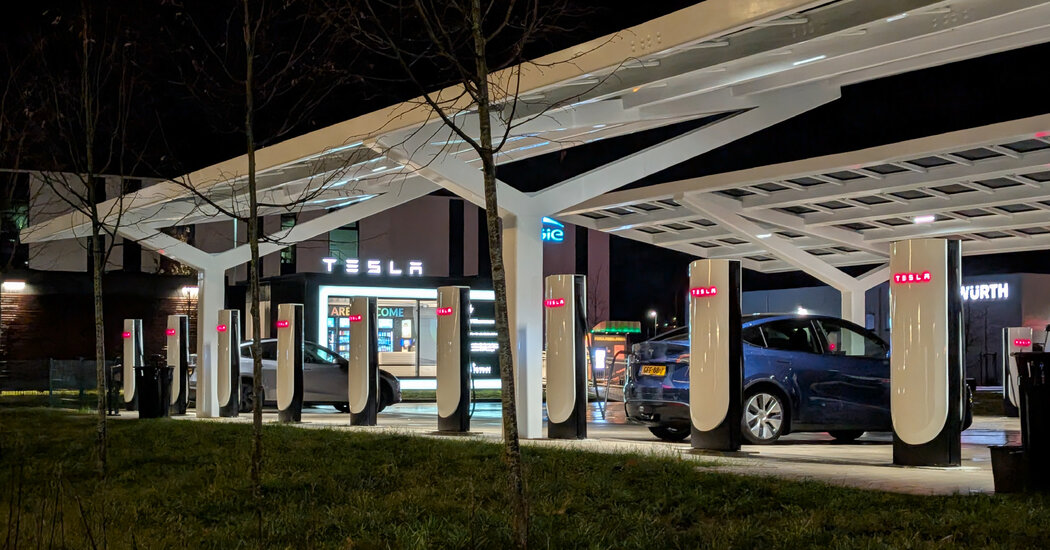
But Mr. Quilitzsch said that he would lease a new Model Y when his current contract expired next year. He uses Tesla’s extensive charging network on the long drive to visit his daughter in Barcelona, he said, and believes the company’s technology is superior to other automakers’ products.
“They’re five years ahead of everybody,” Mr. Quilitzsch said in a telephone interview.
Tesla’s rebound in Europe suggests that the company could slow, or even reverse, a decline in its global car sales, which hit their highest annual level in 2023.
Tesla’s sales in the United States continue to slide after Congress eliminated tax breaks last year that effectively raised the cost of electric models by $7,500. Cox Automotive, a research firm, estimates that Tesla sold 20 percent fewer cars in the United States during the second quarter of this year compared with a year earlier. The company is expected to report its global sales figures for the quarter on July 2.
Mr. Musk is still unpopular in Europe. And he continues to make statements on X, his social media site, that are at odds with the beliefs of many of the environmentally conscious liberals who are most likely to buy electric vehicles.
This week, for example, he claimed on X that the U.S. Agency for International Development, the foreign aid organization that he dismantled last year while running the Department of Government Efficiency, was responsible for the Covid pandemic. That view is not shared by experts who have studied the origins of the pandemic.
Mr. Musk was defending himself against accusations that the cuts he oversaw led to the deaths of hundreds of thousands of children who no longer had access to vital medicines and health care that had been financed by the U.S. aid agency.
Geraldine Heaton, a retired pharmacist who lives in a suburb of Dublin, said she felt “a certain shame in driving a Tesla because of his DOGE involvement and his general view of the world.”
“But I love my Model 3 and that overrides my dislike of the man,” she said.
Sean O’Connor, the managing director of a creative design agency in Amsterdam, said he was reluctant to buy a Tesla because of Mr. Musk. But after test driving electric vehicles from five European brands, Mr. O’Connor concluded that “the Model Y is head and shoulders above the rest.”
Many people pointed out that Tesla was hardly the only car company with baggage. Henry Ford held and spread antisemitic views. Volkswagen was founded by the Nazis. Chinese cars are built with support from an authoritarian government.
“I oppose Chinese politics, and I would rather support a Western brand,” said Mantas Vrubliauskas, a resident of Riga, Latvia, who bought a Tesla Model 3 sedan in October even though he said he had a negative view of Mr. Musk.
Many people argued that for all of Mr. Musk’s right-wing rhetoric and affinity for conspiracy theories, his products have been good for the environment.
Philipp Till, a medical doctor who works in Salzburg, Austria, said that he found Mr. Musk’s right-wing views “disgusting,” especially as a citizen of a country with a Nazi past.
But Mr. Till bought a used Tesla Model S for his long daily commute because “I had a bad conscience burning lots of diesel,” he said.
“His visions,” Mr. Till said of Mr. Musk, “accelerated the shift to electric driving.”
There are signs Tesla’s sales in Europe will continue to increase, said Mr. Schmidt, the analyst. The wait time for delivery of a Tesla has stretched to three months based on data available on the company’s website, suggesting that demand remains strong.
The company will also benefit from the broad and growing interest in electric vehicles in Europe. Such models account for 20 percent of new car sales, compared with just 6 percent in the United States.
Mr. Schmidt expects electric vehicles’ share to rise to 25 percent by the end of the year, overtaking sales of cars that run solely on gasoline. Higher fuel prices caused by the war in Iran are just beginning to have an impact on sales numbers.
Tesla also benefits from having a factory near Berlin that produces the Model Y.
The European Union imposes tariffs on cars imported from China based on how much government support manufacturers are believed to receive. SAIC Motor, which sells cars under the MG brand, is subject to a 35 percent tariff in addition to the standard 10 percent levy on imports.
European manufacturing also allows Tesla to exploit government electric vehicle incentives that are unavailable to imported cars. In France, incentives help lower the lease payment on a Model Y to €289 a month, with an upfront payment of €1,900, according to Mr. Schmidt.
That has helped make the Model Y the best-selling electric vehicle in France, despite competition from new models like the 5 hatchback from the French automaker Renault.
Tesla is expanding production at the Berlin factory in another indication of strong demand.
Beginning in July, the company will be able to produce 6,200 Model Y sport utility vehicles a week, up from 5,000 at the beginning of the year, Andre Thierig, senior director of manufacturing at the plant, said on LinkedIn. Later this year, the plant will expand further to be able to produce 7,500 vehicles a week, he said. Tesla is also expanding battery production in Berlin.
(Tesla Model 3 sedans sold in Europe are usually imported from the company’s factory in Shanghai and are subject to a total tariff of 18 percent.)
Volkswagen and its Audi, Porsche, Skoda and SEAT brands collectively sell more electric vehicles in Europe than Tesla. But Tesla sits at second place even though it sells just two models, the 3 and the Y.
Tesla has often been criticized for failing to offer more models. But its limited lineup has simplified manufacturing and is a big reason Tesla can sell cars for less than other automakers, Mr. Schmidt said.
Perhaps the clearest example of Tesla’s resilience is Norway, a country where almost all new cars sold are electric and buyers are especially savvy. There, Tesla is the largest seller of cars, with more than 20 percent of the market, nearly twice as much as No. 2 Toyota.
Vigdis Haugland Asbjornsen, president of Tesla Owners Club Norway, said that the company’s offer of loans with interest rates of 2 percent has helped sales. But so has its reputation with Norwegians.
“You know someone with a Tesla,” she said by email, “and you learn that they love to drive their car.”