Amna Nawaz:
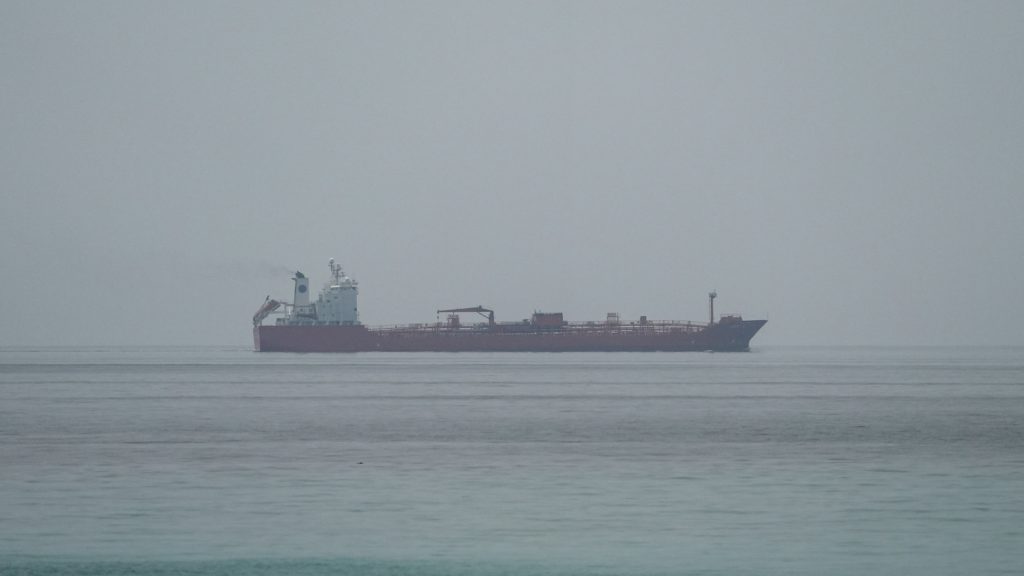
Today, a U.S. official confirmed to the “News Hour” that Iran fired a drone that hit a container ship in the Strait of Hormuz and traffic through the strait has largely stopped. The strike came as Secretary of State Marco Rubio visited the Persian Gulf to try and reassure the American allies there that any agreement with Iran will protect their security.
Nick Schifrin reports.
Nick Schifrin:
Today, the world’s most important oil choke point is once again closed, hundreds of ships had a standstill in the strait after a U.S. official confirms that, off the coast of Oman, an Islamic Revolutionary Guard Corps drone struck a Singapore-flagged cargo ship.
The ships sustained damage, but kept sailing and there were no casualties, except for the momentum to open the strait. The U.N. says, before today, more than 50 ships left the strait this week under a new U.N.-Oman mechanism.
But, today, the U.N. Maritime Organization Secretary-General Arsenio Dominguez said in a statement: “I have decided to temporarily pause its implementation in order to reconfirm that the necessary safety guarantees continued to be in place.”
Earlier today, Iranian state media warned that ships must coordinate with Iran and use a route through the strait closest to Iran’s coast in orange, instead of a route pushed by the U.S., Oman and the U.N. near Oman’s coast in yellow.
Marco Rubio, U.S. Secretary of State: If ships are moving as they should be moving, then that’s what we’re going to judge and that’s what we’re going to react to.
Nick Schifrin:
Earlier today, Secretary of State Marco Rubio warned that the U.S. would never accept Iran closing the strait. He’s in Bahrain visiting the Gulf Cooperation Council…
Man:
Today, we see a glimmer of hope.
Nick Schifrin:
… to try and reassure the U.S.’ Gulf allies that the U.S.-Iran negotiations will protect their security after they bore the brunt of Iran’s wartime assaults.
Marco Rubio:
There is no part of this deal that’s undertaken that in any way undermines the security, the stability, or the prosperity of any of our partners in the Gulf region.
Nick Schifrin:
And, tonight, the Gulf Cooperation Council released a joint statement with the United States emphasizing the importance of the strait reopening without any Iranian tolls and calling for restrictions on Iran’s missiles and proxies. But those are two issues not addressed by the U.S.-Iran memorandum of understanding.
To discuss today’s drone strike and whether the Gulf and the region are reassured by Secretary Rubio’s trip, I’m joined by Hussein Ibish of the Arab Gulf States Institute.
Hussein Ibish, thanks very much. Welcome back to the “News Hour.”
Let’s start with this drone strike that we saw in the strait. Is this Iran reminding everyone of its leverage as these negotiations proceed?
Hussein Ibish, Senior Resident Scholar, Arab Gulf States Institute:
That’s exactly what it is. It’s a pure power flex. It’s a message saying, hey, how easy it is for us to hit a ship? We can do it in a way where we don’t sink the ship and we don’t kill anybody, but we do strike it. Ha, ha.
What more could we do if we wanted? It’s really easy. It’s drones. It’s cheap. We have got — we can produce them for $10,000, $20,000 each and just keep chugging them out. So you’re at our mercy. That’s the Iranian message here. And it’s really very disconcerting to see them doing that at a time when they are supposed to be lifting restrictions on shipping in the Strait of Hormuz, rather than reinforcing a sense of fear and intimidation, which is what they’re doing.
Nick Schifrin:
And it’s not only reinforcing fear intimidation when it comes to what I just asked about, just its own leverage, but does it also reinforce the concerns that Gulf Arab allies of the United States already had about how these talks are proceeding?
Hussein Ibish:
Very much so.
Look, they feel they were against the war. They felt they would be hit. They felt it would go badly. They didn’t think it was thought through. They didn’t trust Trump’s judgment, honestly, and they have been proven right on all of those points so far.
Now they’re looking at a situation where Iran is strategically strengthened in many ways, even though it’s been battered to some extent militarily. Strategically, it’s in a better place. It’s really learned to use its power in the Strait of Hormuz and potentially through the Houthis in Yemen, their allies, of the Bab-el-Mandeb Strait, which could cut off the Red Sea and the Suez Canal as well.
So they are really looking very strong at the moment. And there’s a deeper fear here, which is not just it the U.S. is unreliable, that the U.S. may come or go or something. There’s even a sneaking suspicion that the U.S. might be looking to kind of switch partners here and do a deal with Iran and really kind of abandon them completely.
And that — they were afraid of that when Obama did the JCPOA nuclear deal in 2016, and they’re afraid of that now. I don’t think it’s going to happen because Iran is not a status quo power, and the U.S. is. So I don’t see how we could partner with them. But that’s a Gulf fear as well. So they’re afraid of everything right now.
Nick Schifrin:
And I have certainly asked U.S. officials exactly that, and they say what you just said. It’s they’re not likely to, in their mind, at least Trump administration officials’ mind, repeat the errors of the Obama JCPOA.
But, to your point, Rubio is in the region trying to provide reassurance. He said today that any deal would not undermine the security, stability, or prosperity of any of our partners. Does that message provide reassurance?
Hussein Ibish:
No. No, because it already has. And the war has. The war was mainly visited on these Gulf countries. Over half of the strikes from Iran, well over half, were on the UAE alone.
And every single country, even Iran-friendly Oman, was hit by Iran multiple times. Kuwait’s new airport was badly damaged. And every country took a real hit. Even the whole sort of conceptual model behind Dubai’s rise in global prominence has been attacked by this threat of violence.
So it’s all very, very bad for them. And they — look, they just don’t trust the intentions of the Trump administration. They don’t trust the judgment the consistency, the steadfastness, and the fundamental reliability of this administration.
And I don’t think anything that they have seen since the MOU was signed, or in the MOU, or from J.D. Vance, or from the president has really calmed their nerves. They are very rattled.
Nick Schifrin:
But, as you know, when I talk to some of these Gulf officials, they acknowledge some of these concerns, but they also say, look, we get it, we understand, you have to deal with a little bit of ups and downs of President Trump. Ultimately, we are still — our eggs are still in the American basket. We have no other choice. We don’t want to go elsewhere.
And while we’re dealing with Israel, at the very least, we want to work with the U.S. to create a better region. They still don’t have anywhere else to go, right?
Hussein Ibish:
Oh, I think that’s absolutely right. Yes, they don’t.
There is no other country that could provide them the military hardware and training that we do, the kind of support that at least theoretically is there. There is an argument that the liberation of Kuwait in 1991 and 1990 was sort of the exception that proves the rule, the one time we really did come to their aid.
But I think they need to keep the U.S. government onside. They need to protect their relationship with Washington. So they’re not going to come out and tell you bluntly what I just said. But what I’m telling you is also true. You are absolutely right. They’re not going anywhere. They want to work on fixing relations with the United States.
It’s a number one priority. But, right now, they are dismayed, disheartened, and highly, highly anxious because of everything that’s happened. They did not want this war, because they could foresee all of this and more, and it’s all coming true in a very kind of living your nightmare scenario.
Nick Schifrin:
Hussein Ibish of the Arab Gulf States Initiative, thank you very much.
Hussein Ibish:
Oh, thank you, yes.