If your senior pooch is starting to take shorter strides, it could be an early warning sign of dementia.
That’s according to a new study, which found dogs suffering from cognitive decline tend to take shorter steps with their front legs.
A team from North Carolina State University followed 88 senior and geriatric dogs who had been enrolled in a study on ageing.
Every six months they underwent a series of comprehensive tests including those that checked cognition and gait.
Analysis revealed stride length decreased when they also started to experience the early signs of dementia.
The experts said noting changes in your pet’s gait could prompt owners to seek veterinary help earlier – and make life easier for dogs with early symptoms.
‘If owners notice that their dog’s front leg stride is becoming shorter they should visit their vet, for there are possible alternative causes such as arthritic pain or neck issues that can be treated,’ lead author Dr Natasha Olby, from North Carolina State University, said.
‘If a diagnosis of cognitive decline is made, there are likewise several lifestyle interventions than can be made, even if there is currently no cure.’
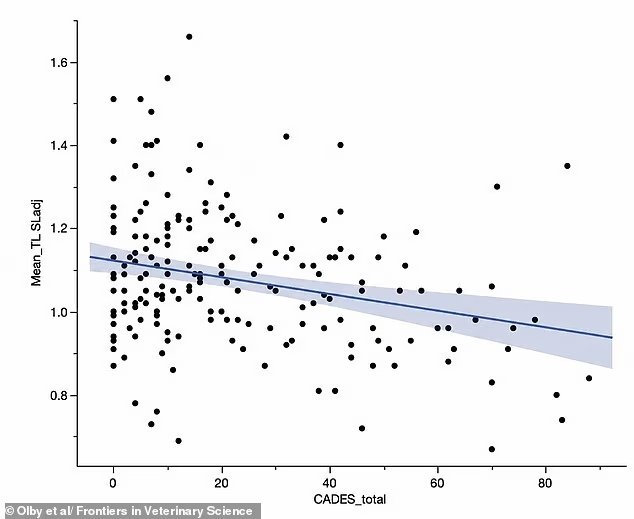
The study revealed that stride length in older dogs decreased as their cognitive decline increased
In humans, the onset of dementia often comes with a change in gait.
Years before they display any loss in memory, patients may start to walk more slowly with shorter, uneven and sometimes shuffling steps.
These changes are thought to be driven by a deterioration in the function of the brain’s frontal cortex and the cerebellum, which are responsible for planning and monitoring movement.
The researchers said their findings indicate a similar change happens in dogs.
‘Here we show that the length of front leg stride taken by dogs decreases with age, but even more importantly, decreases with cognitive impairment,’ Dr Olby said.
‘In fact, we found that the effect of cognitive decline is larger than the effect of age by itself.’
As part of the study, owners were asked to fill out questionnaires about their dog’s health and behaviour, including the Canine Dementia Scale (CADES) to measure cognitive impairment.
This scores dogs on issues such as struggling to navigate, displaying uncharacteristic behaviour and nighttime restlessness.

The experts said noting changes in your pet’s gait could prompt owners to seek veterinary help earlier – and make life easier for dogs in the early stages of symptoms (stock image)
For the study, front leg stride was measured across a five-metre long walkway.
While their stride length did tend to decrease across visits, as the dogs got older, the team were able to link this to worsening CADES scores.
Their back legs, however, did not appear to be affected.
‘It is fascinating to see that cognitive decline affects front legs and hind legs differently,’ Dr Olby said.
‘In dogs, the hind legs are important for moving forwards, while the front legs also change direction and initiate braking.’
The study, published in the journal Frontiers in Veterinary Science, concludes: ‘These findings support the use of thoracic limb stride length as an objective, scalable functional mobility measure that reflects changes associated with cognitive decline and may be a useful tool for research and clinical monitoring of age in dogs.
‘Incorporating stride-length assessment into routine geriatric evaluations may improve the detection and monitoring of functional decline in older dogs and support more informed discussions of quality of life and management strategies.’