The powerful heatwave gripping the UK and Europe could make a dent in your income, a new study has warned.
Researchers from Climate Analytics analysed the economic costs incurred when extreme heat strikes.
According to their results, combined heat–and–drought events reduce average household incomes across Europe by almost three per cent.
And looking ahead, things are only set to get worse.
If global temperatures rise by just 2.7°C by 2100, the average European household will see its income plummet by a whopping 27 per cent.
Jessie Schleypen, lead author of the study, said: ‘The massive heatwave now sweeping across Europe is already threatening people’s health, livelihoods and ability to work.
‘Where extreme heat coincides with drought, the damage can be much greater.
‘Our research shows that these compound events amplify economic losses experienced directly by European households, and they will become more frequent as global warming increases.’
Combined heat–and–drought events reduce average household incomes across Europe by almost three per cent

The powerful heatwave gripping the UK and Europe could make a dent on your income, a new study has warned
As heatwaves become more frequent, the researchers set out to understand the impact this might have on people’s incomes.
The team combined European household level survey data from 2004 to 2022 with high resolution temperature and drought data to investigate the change in household income and risk of poverty due to heatwaves, droughts, and compound dry–and–hot extremes.
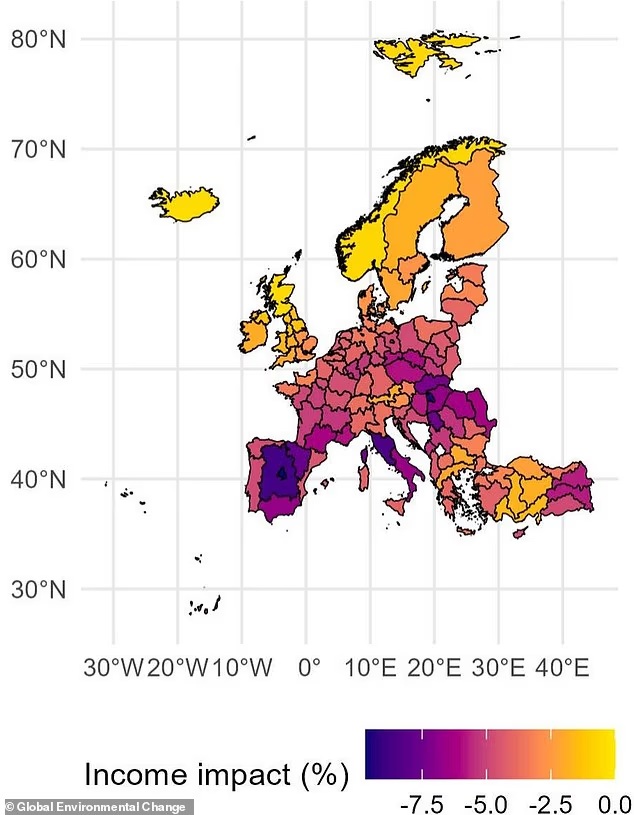
The results revealed how a heatwave in Europe would reduce household incomes by 0.7 per cent on average, while a drought would reduce them by 1.8 per cent.
However, when combined, these weather events cause average incomes to drop by nearly three per cent.
As for why this is the case, the researchers highlight several factors driving the decline in incomes.
This includes worsening health conditions and reduction in labour productivity, decline in food production and water–related critical services such as transport and energy generation.
The study, published in Global Environmental Change, also revealed that these effects are not felt evenly – with wealthier people less impacted.
Ms Schleypen said: ‘The poorest 20% will be affected the most, with incomes dropping 2% more than the rest of the population (4% vs 1.1–1.8%), further widening income inequality.’

Their results show that if global temperatures rise by 1.5°C, 60 million people in Europe will face poverty. Meanwhile, if we experience 2.7°C of warming, 127 million would be affected
In addition, the results vary massively by region.
During heatwaves and droughts between 2004 and 2022, incomes in Madrid dropped by a whopping 10 per cent, ahead of Central Hungary (9.4 per cent drop) and Central Spain (8.8 per cent).
As part of the study, the researchers also modelled how these figures will change in the future.
Their results show that if global temperatures rise by 1.5°C, 60 million people in Europe will face poverty.
Meanwhile, if we experience 2.7°C of warming, 127 million would be affected.
Greece, Spain, Romania, Bulgaria and Cyprus are likely to be among the most affected countries, according to the researchers.
At 2.7°C of global warming, Spanish household incomes would fall by more than a third, while Greek household incomes would be cut in half.
‘As heat and drought conditions worsen with climate change, so too will the economic impact on Europe’s most vulnerable,’ Ms Schleypen added.
The news comes as Britain braces for what could become the hottest day ever recorded in the UK.
A rare red extreme heat warning covering a vast swathe of England and Wales came into force this morning for just the second time.
The Met Office has said that the exceptional conditions pose a risk to life not just for vulnerable people, but across the wider population.
In an ominous warning, forecasters have said they expect the 50–year June temperature record of 35.6°C to get ‘absolutely smashed’.