While the United States and Iran haggle over reopening the Strait of Hormuz and restoring oil exports from the Persian Gulf, China, the world’s largest oil importer, is not expected to quickly ramp up purchases from the region.
If normal traffic through the strait fully resumes in the coming weeks, numerous tankers carrying oil bound for China that have been stranded in the Persian Gulf during the war would be on the move again. Their eventual arrival at Chinese ports is likely to produce a temporary surge in deliveries.
China finds itself in a very different position from much of the world, which is emerging from the war in Iran with depleted oil supplies.
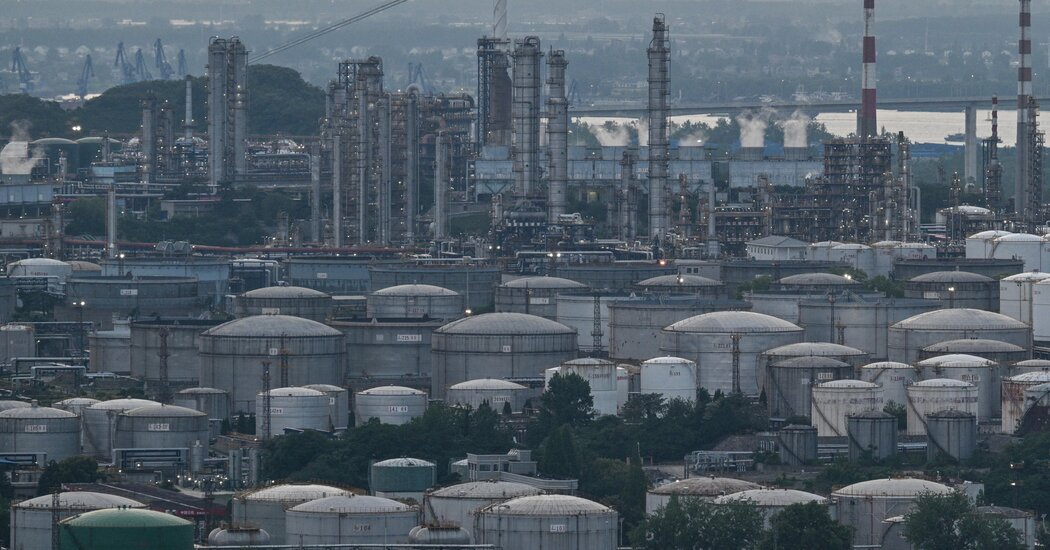
The crude stockpiles held by the country’s state-owned energy companies remain nearly full. Beijing appears not to have tapped its vast strategic reserves, and storage tanks at Chinese refineries are brimming with gasoline, diesel and other refined products.
China cut its daily oil imports by roughly a third during the war. The pullback, driven largely by higher prices, helped ease some of the upward pressure on global oil markets caused by the almost complete closure of the Strait of Hormuz.
China was able to reduce imports so sharply in part because it had been buying more oil than it needed before the war. For years, it accumulated inventories whenever prices were low as part of a broader push to strengthen national self-reliance and improve its ability to withstand supply disruptions.
China also imported additional oil to reduce its trade surplus. In recent years, Beijing has increasingly parked excess foreign exchange earnings in stockpiles of commodities such as oil rather than overseas bank deposits or Treasury bonds, after watching Western governments freeze Russia’s foreign assets following its invasion of Ukraine four years ago.
Few analysts expect China to quickly return to its previous pace of imports, particularly as world oil prices still have not fallen back to their levels before the Iran war.
“I would expect China’s oil companies to continue to be price sensitive and to increase their purchases gradually,” said Philip Andrews-Speed, a longtime China oil specialist at the Oxford Institute for Energy Studies.
Chinese companies kept their refineries running throughout the war by drawing on their extensive corporate stockpiles of crude. But demand in China for gasoline, diesel, jet fuel and other refined products appears to have weakened as prices rose and households and businesses became cautious about fuel consumption. Sales of gasoline-powered cars plunged in April and May.
At the same time, the Chinese government halted most exports of refined products this spring to ensure adequate domestic supplies. The move contributed to severe shortages elsewhere in Asia, particularly in developing countries with limited refining capacity. China overtook the United States in 2024 to become the world’s largest oil refiner and is typically a major supplier of refined fuels to neighboring countries.
The combination of weak domestic demand and the export halt has left storage tanks so full of gasoline, diesel, jet fuel and other products that oil companies have little incentive to buy and process additional crude, analysts said.
“I don’t expect China’s crude imports to structurally recover to prewar levels anytime soon,” said Muyu Xu, a senior oil analyst at the data service Kpler.
Imports could increase if Beijing suddenly decided to allow unrestricted exports of refined products that are now in short supply elsewhere. But China has long taken a cautious approach to energy policy. Uncertainty also lingers over how quickly any mines that Iran may have laid in the strait can be cleared and whether the U.S.-Iranian agreement will hold. The accord’s main provisions last only 60 days.
“The central risk of conflict in the region is not removed,” said David Broadstock, a partner and oil analyst at the Lantau Group, an East Asian energy consulting firm.
China’s Ministry of Foreign Affairs has welcomed the agreement and the possible reopening of the Strait of Hormuz while offering little indication of how Beijing might adjust its energy policies. “Early resumption of safe and free passage through the strait serves the interests of all parties,” Lin Jian, a ministry spokesman, said at a briefing on June 16.
The closure of the Strait of Hormuz had disrupted much of China’s oil supply not only from Iran but also from other Persian Gulf producers, including Saudi Arabia and Kuwait.
Yet the terms of the 60-day agreement between Washington and Tehran also remove much of the incentive for China’s small independent refiners to keep buying large volumes of Iranian oil.
The agreement calls for the United States to work with other countries and the United Nations to remove international sanctions on Iranian oil exports. If that happens, China’s refiners could lose the discounts of $3 to $10 per barrel they have enjoyed by purchasing Iranian crude despite international sanctions.
Those discounts generated savings worth several hundred million dollars a month for Chinese refiners. Before the closure of the strait, China was buying over 90 percent of Iran’s oil exports, or more than 1.5 million barrels a day, according to estimates by Kpler.
Oil sales to China have accounted for 6 percent or more of the economies of Iran and Russia in recent years. Western governments have long argued that those purchases have helped Iran finance proxy forces in Lebanon, Iraq, Syria and Yemen and enabled Russia to fund its war in Ukraine.
Beijing, however, maintains that it is not bound by many Western restrictions on Iranian and Russian oil because they were not approved by the United Nations. Russia and China have repeatedly used their positions as permanent members on the U.N. Security Council to block such measures, contending that trade and engagement are more effective than sanctions in addressing issues like Iran’s nuclear program.
Xinyun Wu contributed research.