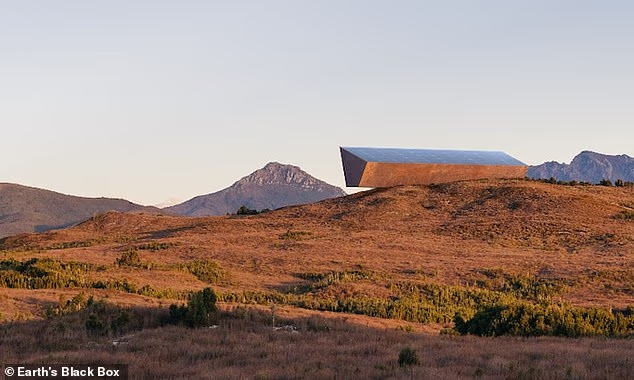
A bizarre structure dubbed ‘Earth’s Black Box’ will be built in a remote Tasmanian airfield as a silent witness to humanity’s destruction.
Its design is inspired by aeroplane flight recorders – reinforced boxes that store data in the case of a crash.
Just like these real ‘black boxes’, Earth’s Black Box will patiently record every step humanity takes towards a deadly disaster.
The site’s heavily protected data storage will gather information from space agencies, weather stations, and universities to provide an ‘unbiased account’ for future generations.
When completed, the structure will be a 52 feet (16 metres) long, 13 feet (four metres) tall, near–indestructible recording device.
Rouser Lab, the agency behind the project, says the box’s steel walls will be able to withstand every disaster, including cyclones, earthquakes, fires, floods or attacks.
Built on 500–million–year–old granite on Tasmania’s west coast, Rouser Lab says the box will be in the most politically and geologically stable place on Earth.
And with 36 solar panels encased in glass alongside thermo–electric power generation, Earth’s Black Box will be recording long after the last humans are gone.
A bizarre structure dubbed ‘Earth’s Black Box’ will be built as a silent witness to humanity’s destruction in a remote Tasmanian airfield. Pictured: Artist’s rendering
Earth’s Black Box was announced in 2021 to coincide with the COP26 climate talks in Glasgow.
At the time, digital hard drives were used to record data from the talks that would later be transferred into the final structure.
However, the project has been seemingly dead in the water for the last five years.
Now, at long last, Rouser Lab has confirmed that construction is underway on the Black Box.
The agency says that the finished project will be installed just outside of Queenstown, Tasmania, by December this year.
Jonathan Kneebone, the artistic director of Earth’s Black Box, told The Guardian: ‘It will be approximately five years to the day that we are finally able to install the work.
‘In those five years, we have been evolving the design, data storage systems, source materials, web platform – as well as developing funding models to sustain the project into the future.’
Mr Kneebone did not provide an estimate for how much it will cost to build and operate Earth’s Black Box.

When completed, the structure will be a 52 feet (16 metres) long, 13 feet (four metres) tall, near–indestructible recording device
When it is finally completed, the structure should begin recording and storing a vast array of datasets on the progress of climate change.
These will include measurements of temperature, sea levels, atmospheric CO2, as well as details of humanity’s response, including energy consumption and social data.
To give this information context, Rouser Lab says that the device will also record speeches, media stories, academic articles and social media relating to climate change.
The creators’ plan for Earth’s Black Box will ‘provide an unbiased account of the events that lead to the demise of the planet, hold accountability for future generations, and inspire urgent action.’
Rouser Lab adds: ‘How the story ends is completely up to us. Only one thing is certain, your actions, inactions, and interactions are now being recorded.’
However, they’re still working out how humans would be able to access its data following a catastrophic climate apocalypse – or if anyone would be alive to do so.
It’s possible that a small group of humanity’s survivors could learn more about the fall of civilisation due to catastrophic fires, flooding and drought.
The long overdue announcement of a construction date puts an end to speculation that the entire project was nothing more than an elaborate publicity stunt.

Its creators say that the thick steel walls will be able to withstand cyclones, earthquakes, fire, flood or attack

The structure will gather and store climate data into the future, acting like the flight recorder in an aeroplane that provides an unbiased account of an unfolding disaster
The University of Tasmania was originally affiliated with the project, but dropped out over the intervening years and requested to be removed from the website.
This left behind a collaboration of advertising agencies, creative networks, and architects without any professional scientific guidance.
Rouser Lab also began raising funds for another far–fetched project, this time aiming to build a ‘techno–obelisk’ that would constantly transmit an ‘SOS’ radio signal into space.
But Mr Kneebone now says the project is being coordinated by the Earth’s Black Box Foundation, a registered charity dedicated to the idea, and should soon reach fruition.
Once construction is complete, the foundation will upload Earth’s Black Box with all the climate data that has been collected in the last few years, and recording will begin.
Shane Pitt, mayor of the West Coast council in Tasmania, said that the project had been ‘a long time coming’.
Adding: ‘It certainly is something we can see as a tourist attraction.’