A lunar occultation of Venus took place on the afternoon of Wednesday, June 17. Stunning timelapse footage by Rob Wright shows the moon disappearing behind the dark side of the crescent moon before reappearing a few instances later.
A rare, daytime lunar occultation unfolded this week as Venus briefly disappeared behind the moon in a celestial event visible across much of North America.
Stunning timelapse video captured the celestial event on June 17, when the moon passed directly in front of Venus, temporarily hiding the planet from view.
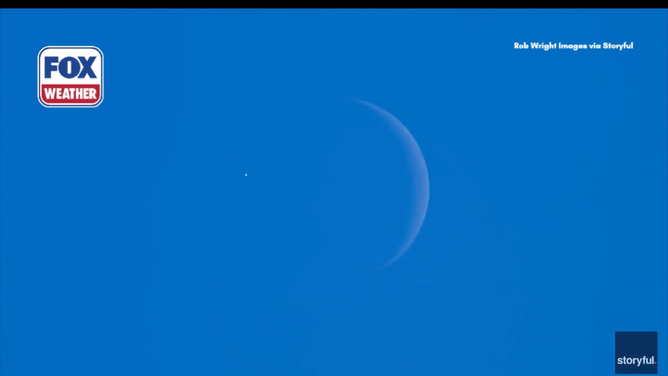
Venus is visible for a final moment before slipping behind the Moon during a lunar occultation.
(Rob Wright Images via Storyful)
The show was visible in daylight across much of the contiguous United States, southern Canada, northern Mexico, and parts of the Caribbean and South America.
A lunar occultation occurs when the Moon passes directly between Earth and a planet or star along its path through the sky, causing the distant object to temporarily disappear behind the moon.
Unlike many astronomical events, this occultation occurred during daylight hours for many observers, making it an unusual skywatching opportunity.
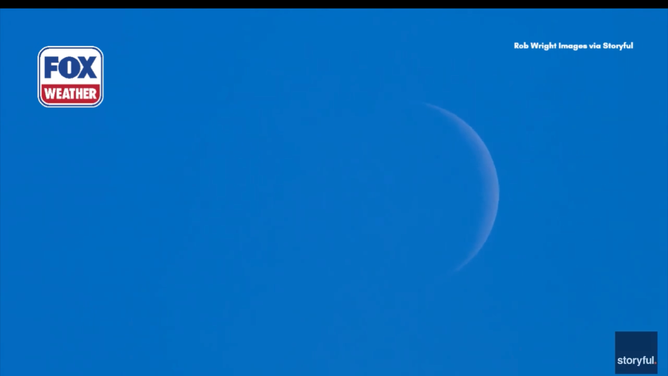
Venus is concealed behind the Moon during a lunar occultation, though the planet is not visible in this still image.
(Rob Wright Images via Storyful)
Video captures the brief moment the tiny shining spec of Venus disappears behind the dark side of the crescent moon, before reappearing back in view.
Lunar occultations occur regularly, but it’s far less common for the moon to pass directly in front of a bright planet like Venus, Mars, Jupiter or Saturn.
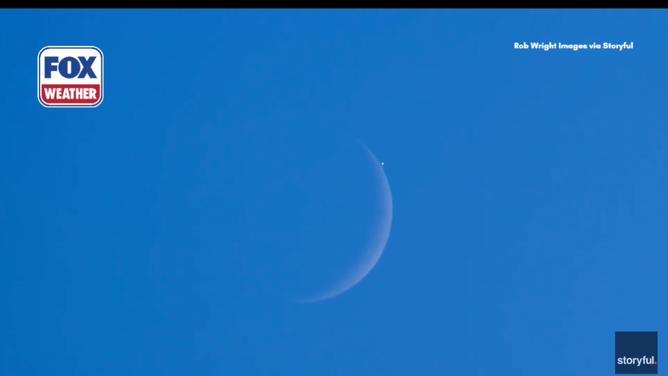
Venus emerges from behind the Moon following a lunar occultation.
(Rob Wright Images via Storyful)
The moon moves eastward across the sky at about 2,300 mph relative to the background stars, allowing it to periodically pass in front of stars and, more rarely, planets like Venus.
Even though Venus is roughly 240 times farther from Earth than the moon, the moon appears much larger in our sky, allowing it to completely cover the planet during a lunar occultation.