NEXT STOP, SPACE 🚀: Artemis II is roaring into space on a mission to make history after liftoff from Kennedy Space Center in Florida. This is humanity’s return to deep space, and a the beginning of a bold journey around the Moon. Stay locked with FOX Weather for every second of this historic mission.
The race between humans and machines may extend far beyond Earth.
As advances in artificial intelligence and robotics accelerate, humanoid robots could be capable of exploring other worlds within the next decade.
That raises a fascinating question: Who will walk on Mars first: a human or a humanoid robot?
NASA’S ARTEMIS PROGRAM: PAVING THE WAY FOR HUMANKIND’S RETURN TO THE MOON AND BEYOND
NASA has ambitious plans to return astronauts to the moon through its Artemis program as a stepping stone toward eventual crewed missions to Mars.
While sending humans to Mars remains a long-term goal, robotic explorers could pave the way as technology develops to participate in future missions.
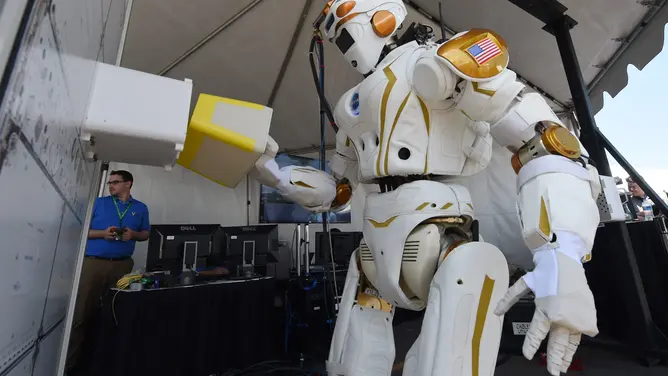
The humanoid robot named ‘Valkyrie’ designed by NASA is on display during the finals of the DARPA Robotics Challenge at the Fairplex complex in Pomona, California.
(MARK RALSTON/AFP via Getty Images / Getty Images)
Prediction markets are offering insight into how the public views that race. Traders are actively betting on whether a humanoid robot will set foot on Mars before a human astronaut.
Let’s take a look at how trading on prediction markets has varied and changed.
In addition to the ambitious goals of NASA, private companies like SpaceX aim to push the boundary on what we thought was possible: including going back to the moon to construct a base and, eventually, venturing to Mars.
SPACE RACE: WILL BLUE ORIGIN LAND ON THE MOON BEFORE SPACEX?
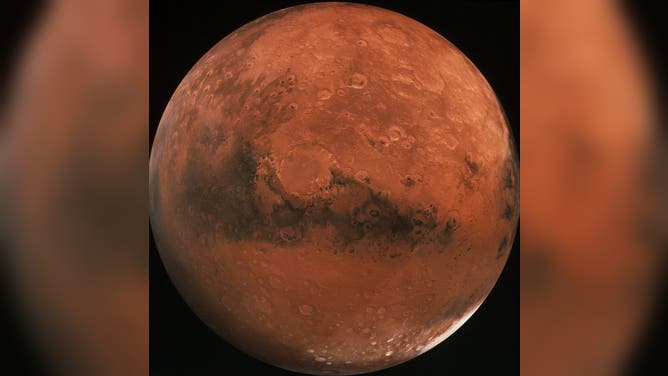
Close-up color photograph of Mars. Impact craters are visible on the surface of the planet.
(CORBIS/Corbis via Getty Images / Getty Images)
Humanoid robots are a rapidly evolving class of machines built to mimic the human body and operate effectively in human-designed spaces.
While Mars isn’t specifically a human-designed area, it has yet to be strolled upon by humans or humanoid robots.
NASA SHIFTS FROM VISITING THE MOON TO BUILDING ON IT
NASA is already exploring the role that humanoid robots could play in the future of space exploration. The agency’s most advanced humanoid robot, Valkyrie, is a six-foot-tall bipedal machine developed at Johnson Space Center.
Designed to operate in environments that are dangerous for humans, Valkyrie can perform tasks such as climbing stairs, opening doors, using tools and manipulating equipment.
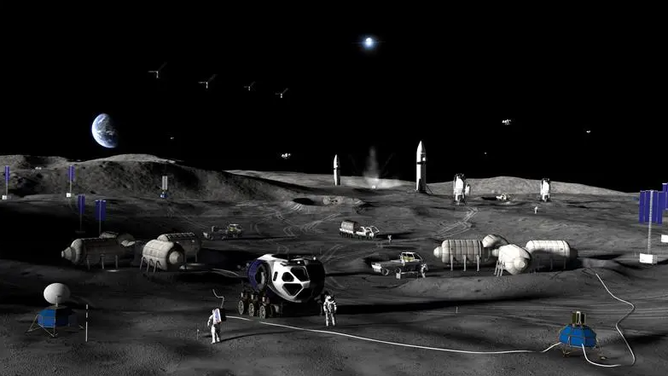
Artistic concept of Phase 3 of NASA’s Moon Base.
(NASA)
NASA has also connected Valkyrie’s development to its Artemis-era ambitions. According to the agency, lessons learned from operating humanoid robots today could help create future robotic workers capable of supporting long-term lunar habitats and, eventually, Mars missions.
Such robots could construct infrastructure, perform maintenance and prepare living and working spaces before human crews arrive.
Whether the first footsteps on Mars belong to a human explorer or a humanoid robot remains an open question. Either would represent a historic achievement, particularly if it occurs before 2035.