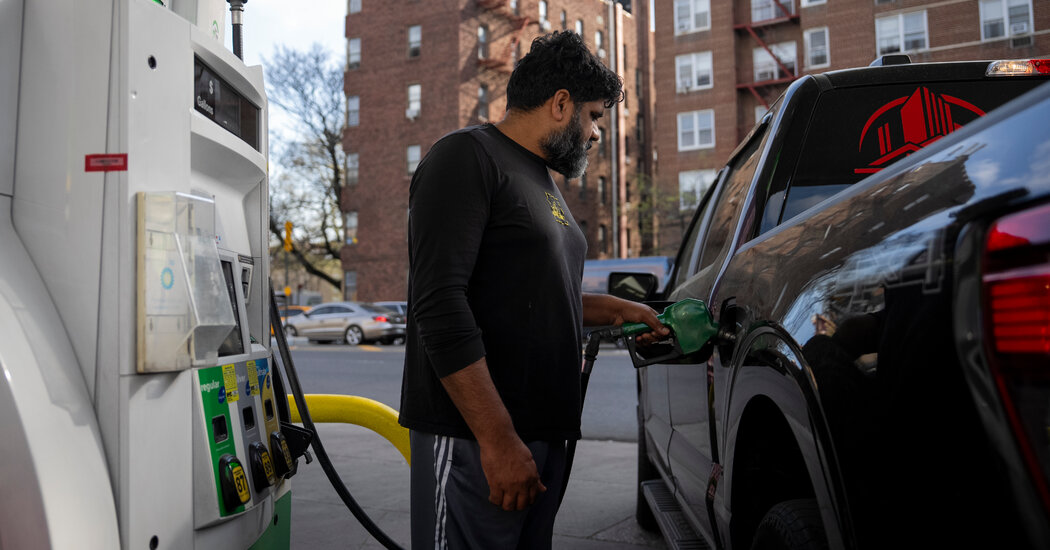
The average price of U.S. gasoline fell below $4 a gallon on Thursday for the first time in months, after Iran and the United States signed a preliminary agreement to cease hostilities for 60 days and reopen the Strait of Hormuz.
The national average for a gallon of regular gasoline fell to a fraction of a penny below $4, down from $4.03 the day before, according to the AAA motor club.
Still, gas prices hovered just below $3 a gallon before the first U.S.-Israeli strikes on Iran in late February. They spiked to around $4.50 a gallon in May, as throttled energy supplies from the Middle East pushed up the price of crude oil, a crucial ingredient in gasoline.
Prime Minister Shehbaz Sharif of Pakistan, which helped mediate the deal, said in a post on X that the memorandum of understanding had been signed electronically by the U.S. and Iranian presidents. As a result, the agreement to begin reopening the strait and lifting the U.S. naval blockade would “enter into force with immediate effect,” he wrote.
Rising fuel costs have strained household budgets and pushed up prices across the economy. At one point in the early days of the war, oil prices spiked to nearly $120 a barrel — the highest level since Russia’s invasion of Ukraine in 2022 — contributing to a sharp increase at the pump.
Oil prices have fallen about 10 percent this week alone. Even so, gas prices remain about a third higher than before the start of the war.
“We’re getting close to the numbers we were before the war started,” President Trump said on Monday in France at the annual Group of 7 summit.
Other fuel prices are also beginning to ease. Diesel cost $5.13 a gallon on Thursday, down from more than $5.60 a gallon a month ago, offering relief to truckers, farmers and other big users of the fuel.
High gas prices have bled into Americans’ lives beyond the pump, including travel. For example, airfares were up nearly 27 percent in May, owing in part to surging jet fuel costs.
Economists caution that it takes time for lower oil prices to be reflected fully in the cost of gasoline. Regional differences remain significant, driven by variations in state taxes, distribution costs and refining capacity. Drivers in parts of the Great Plains and the South have been among the first to see prices drop below $4, with some areas approaching $3.50 per gallon. On the West Coast, however, prices remain well above $4 a gallon.
Aruni Soni contributed reporting.