NASA shared new details about its Moon Base strategy, outlining plans to establish a long-term human presence near the Moon’s south pole. The agency unveiled new lunar rover contracts, upcoming cargo missions, and future infrastructure projects designed to support sustained operations on the lunar surface. NASA officials said the initiative represents a shift from simply visiting the Moon to building permanent systems for long-term lunar exploration.
As the preparations for the Artemis III lunar mission are underway, the space race begins for who will be the first to land on the moon for the first time since 1972.
Space lovers are keeping a close eye on the unofficial race between Blue Origin and SpaceX, as both companies prepare for lunar missions.
AFTER AN EXPLOSIVE TEST FAILURE, BLUE ORIGIN EYES NEXT NEW GLENN LAUNCH
Prediction markets at Kalshi are expecting a 43.9% chance that Blue Origin will land on the moon before SpaceX does.
It is worth noting that these odds change daily, for better or worse.
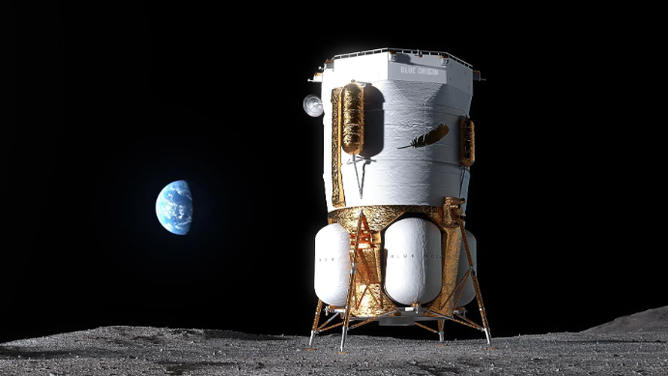
Blue Origin will use the Blue Moon Ark 1 (MK1), a single-launch cargo lander that will transport supplies and deliver up to three metric tons anywhere on the lunar surface, according to Blue Origin.
NASA ANNOUNCES ARTEMIS III ASTRONAUTS IN NEXT PHASE OF MISSION TO RETURN HUMANS TO THE MOON
Blue Moon Mark 1 (MK1) cargo transport.
This is much different from SpaceX, which uses reusable, two-stage rockets to transport supplies and eventually astronauts.
JUNE SKYWATCHING GUIDE: FROM PLANET CONJUNCTIONS TO NEW MOONS, HERE IS WHAT TO LOOK UP FOR
This will allow experts to gather data, prove their worthiness for future crewed missions and establish a permanent presence on the moon.
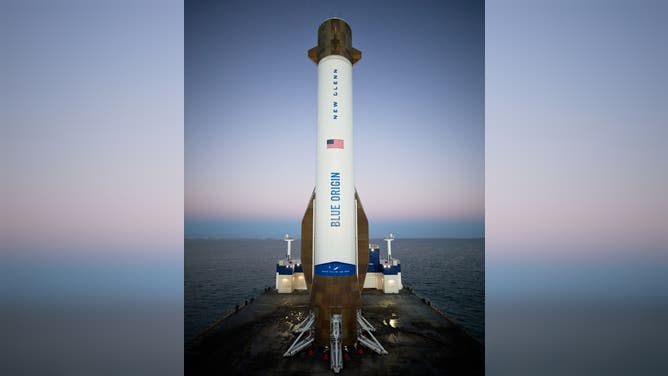
Jacklyn arrives to Port Canaveral with the fully reusable New Glenn booster. (November 18, 2025)
(Blue Origin)
LOOK UP: SKYWATCHERS COULD SEE THE CRESCENT MOON ALIGN WITH THESE 3 PLANETS THIS WEEK
Be sure to follow the unofficial race closely as history will be made in the process.