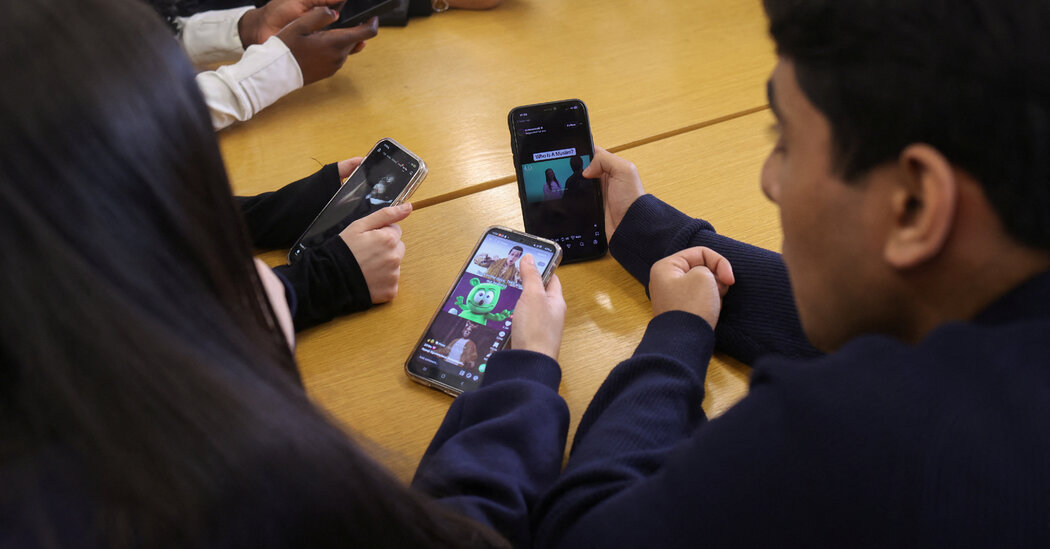
The British government plans to ban access to social media for all children under 16, Prime Minister Keir Starmer said on Monday, after weeks in which the nation debated how it would introduce new protections for children online.
Mr. Starmer said the government would introduce the new regulations in Parliament before Christmas and bring a ban into force in early 2027. The measures will also include restrictions on game platforms and livestreaming apps, with more details expected to be announced next month.
“I am not prepared to compromise on the safety and happiness of our children, and that is why this ban must happen,” Mr. Starmer said at a news conference.
The government has faced growing pressure to act on the issue as public opinion has coalesced around the idea that more should be done to keep children safe online. One YouGov poll in December found that 74 percent of Britons surveyed supported a ban on social media for children under 16.
Mr. Starmer acknowledged that the ban might not be perfect and would not be cost-free, but he added, “Government is always about choices, and it’s clear to me that a full ban is the right choice.”
In March, the government invited public input on the issue, drawing more than 116,000 responses from parents, young people, industry groups and experts.
The government said that 90 percent of parents who responded backed a minimum age of 16 for access to social media and that 85 percent said the risks of social media outweighed the benefits.
The measures will follow a similar model to that of Australia, where a ban was introduced in December, and will apply to platforms like Snapchat, TikTok, YouTube, Instagram, Facebook and X, the government said. Messaging apps like WhatsApp and Signal will not be included in the restrictions.
The government said that it also planned to block children under 16 from livestreaming and from communicating with strangers on a wider range of online services, including game sites, and that it would be “looking in more detail at overnight curfews and breaks in infinite scrolling” for people under 18.
Not all parents favor a ban, and some experts have pointed out that most young people with social media accounts in Australia have continued to use the platforms. Others have criticized the announcement as rushed, coming as Mr. Starmer faces threats to his leadership from within his Labour Party after steep losses in local elections in May.
Ian Russell, a longtime campaigner for online safety, criticized Mr. Starmer for introducing what he called a “politically expedient blanket ban” rather than forcing social media platforms to remove harmful content. Mr. Russell’s daughter Molly Russell was 14 when she took her own life in 2017 after viewing content relating to suicide and self-harm.
But for many parents in Britain, the measures were a welcome step in addressing their concerns about the harmful effects of online content on their children, as well as fears that childhood has been fundamentally changed by unrestricted access to those platforms.
Justine Roberts, the founder of Mumsnet, an online forum for parents, said in a statement that the announcement was “a huge moment for children’s online safety, and for every parent who has felt powerless in the face of addictive technology designed to keep children scrolling.”
Smartphone Free Childhood, a British charity set up by three parents in 2024, called the social media ban a “hugely significant moment for children and families across the U.K.”
“For years, parents have been fighting a losing battle against some of the most powerful companies in the world as smartphones and social media have become an ever bigger part of childhood,” said Joe Ryrie, one of the charity’s founders, in a statement. “Today feels like a turning point.”
There is little data available to understand the consequences of Australia’s ban, academics have stressed, but six months in, early indications are that it has largely failed at keeping young teenagers off the platforms. Still, some Australian parents say, the real impact of the law may not be felt for years, when younger children who are not yet on social media may stay off because of the regulations.
Experts in online safety have warned that Britain’s ban could be ineffective in halting potential harms while also failing to take into account some of the positive impacts of social media on young people. Many acknowledge that it could still have a longer-term deterrent effect.
The tech industry is unlikely to respond positively. The Computer and Communications Industry Association, an international industry group, said in a statement that a ban would prevent teenagers from using platforms that offered benefits as well.
“Blanket restrictions will stifle access to age-appropriate experiences with proper parental controls, encouraging children to seek out riskier unregulated alternatives,” said Matthew Sinclair, a senior director of the group in Britain.
Meta, the parent company of Facebook, Instagram and WhatsApp, echoed that criticism and said in a statement that it had already introduced features aimed at keeping teens safe online.
The company also said that any restrictions “must be underpinned by an age verification system on devices so people aren’t asked to hand over ID to dozens of individual services to prove their age.”
YouTube said in a statement that it had “invested in expert-led, age-appropriate experiences and default protections for teens for over a decade” and would “continue to do so.” It described its platform as “a vital resource for young people, educators and parents.”
A number of other countries, including many in Europe, have been considering regulations to limit children’s access to social media.
Speaking at a meeting of Group of 7 nations in Evian, France, on Monday, Ursula von der Leyen, the president of the European Union’s executive arm, spoke about how nations were exploring limiting access to platforms.
“The debate is not whether young people should have access to social media,” she said. “The debate is whether social media should have access to our children and teenagers, and when.”
Mr. Starmer acknowledged that the new regulations would not mean that no child ever logged on to social media again, but he said that the potential circumvention of the law was no reason not to introduce restrictions.
“They get around other laws, too, but we don’t say, ‘Oh, look, a teenager managed to get a drink somehow, so let’s not bother banning alcohol sales to children,’” he said. “We don’t do that, that would be utterly ridiculous, and so I just don’t accept that argument.”
Jeanna Smialek contributed reporting from Evian, France, and Adam Satariano and Stephen Castle contributed reporting from London.