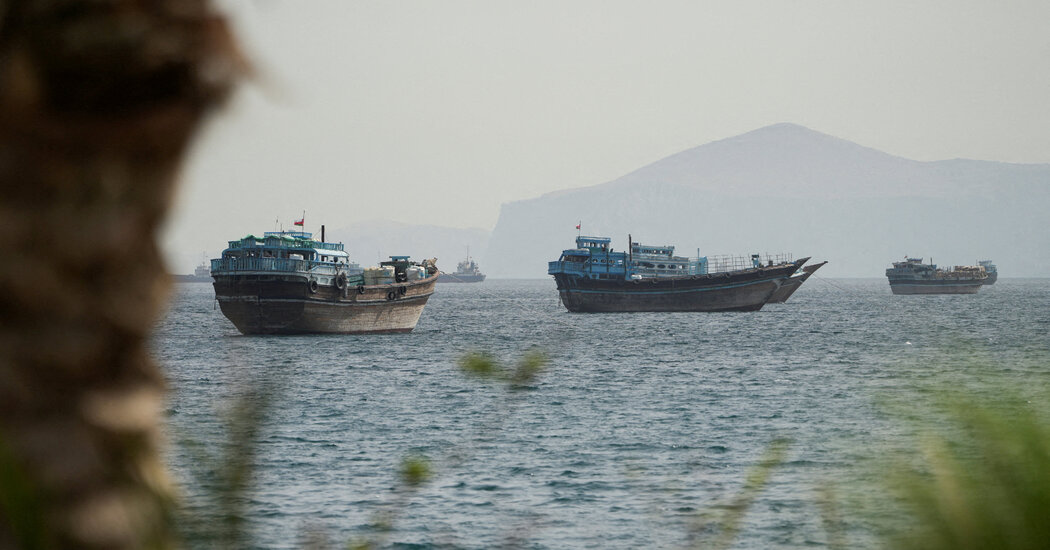
A potential U.S.-Iran agreement to reopen the Strait of Hormuz would offer near-term relief for Asia, the region outside of the Middle East that has borne the brunt of the economic fallout from the monthslong war. Even so, the shock waves of the crisis are likely to ripple through the end of the year, and possibly well beyond.
. Over the past three-and-a-half months, currencies across Asia have plummeted, inflation has surged, and supply-chain bottlenecks have begun to choke industrial production.
The disruptions trace back to Asia’s heavy reliance on energy and other commodities that move through the Strait of Hormuz. More than four-fifths of the petroleum and liquefied natural gas transiting the waterway is typically bound for Asian markets.
On Sunday, President Trump said in a social media post that an interim cease-fire agreement reached by Washington and Tehran would reopen the strait, and that he had authorized “the immediate removal of the United States Naval blockade” on Iranian ports. The deal is scheduled to be signed on Friday.
“Ships of the World, start your engines,” he wrote. “Let the oil flow!”
If an agreement to reopen the strait holds, it will provide an immediate reprieve, freeing hundreds of tankers laden with oil, gas, and fuel byproducts to begin making the monthlong journey back to Asian ports.
Still, industry experts and economists caution that because trade flows have been disrupted for so long, global markets will need considerable time to normalize — meaning elevated inflation and supply-chain strains are likely to linger through the end of the year.
For Asia, “the good news is that once the strait opens, oil and some gas come back,” said Joshua Ngu, vice chairman of Asia Pacific at the energy consultancy Wood Mackenzie. The bad news, he added, is that over the past three-plus months, “every day the strait has remained closed, the economic disruptions have grown exponentially and bled further down the supply chain.”
Those disruptions, Mr. Ngu said, “won’t be solved in a short period of time.”
In Asia on Monday, country leaders celebrated the cease-fire deal. Markets across the region rallied, with benchmark stock indexes in Japan and South Korea both climbing around 5 percent.
Japan’s prime minister, Sanae Takaichi, wrote on X that the agreement was a “major step toward a resolution.” She also said she hoped that “free and safe navigation in the Strait of Hormuz will actually be ensured.”
In a joint statement, Australia’s prime minister, Anthony Albanese, and foreign minister, Penny Wong, said they were pleased that the agreement included steps toward reopening the strait and restoring freedom of navigation.
“While full recovery will take time, restoring this vital trade corridor is essential to easing pressure on energy prices and economies, including in our region,” the statement said.
While Western nations have largely experienced the crisis at the gas pump and through higher jet fuel prices, Asia has been grappling with an acute physical supply shortage for months. Throughout developing Asia, economic growth forecasts have been downgraded as shortages of crude oil and natural gas force countries to ration power.
A return to safe shipping lanes would brighten the outlook significantly for countries heavily dependent on Middle Eastern energy, including Pakistan, Vietnam, and the Philippines — the last of which has declared a national energy emergency and ordered mandatory consumption cuts.
Wealthier economies, including Japan and South Korea, have leaned on their deep pockets and strategic reserves to cushion the initial blow. Even these industrial powerhouses, however, have struggled with soaring oil prices that have weighed on their currencies, and with supply disruptions that only a resumption of trade flows can begin to alleviate.
Economists worry that these pressures will outlast the immediate geopolitical crisis. The turnaround time alone — for ships to clear the strait, reach their final destinations, and return — will take months, a timeline that could easily slip if fears of renewed Iranian aggression or a lack of insurance coverage keep vessels away.
Inflationary pressures tied to disruptions in the flow of oil, gas, and their byproducts are also likely to prove sticky. Liquefied natural gas prices in Asia, for example, are typically indexed to oil prices and operate with a three- to six-month price lag. This means that even if oil prices come down in June, elevated natural gas prices are likely to persist through the end of the year.
“From a price increase perspective, we’ve not even necessarily seen that play through fully,” said Wood Mackenzie’s Mr. Ngu. In gas markets, “the $100 oil price that we saw in March will only fully come through three to six months from then,” he said. As a result, “we are still in a very precarious time.”
Supply-chain snarls are poised to drag on as well.
One of the conflict’s biggest economic casualties has been the global fertilizer supply. Five major exporters — Iran, Saudi Arabia, Qatar, the United Arab Emirates and Bahrain — collectively supply more than one-third of the world’s stocks of urea, the dominant form of nitrogen fertilizer. The disruption has already cut into the peak planting season across much of Southeast Asia, which runs from May to July.
“A disruption of a month or so is manageable, but if it bleeds far into the planting season, the reduction in crop yields raises serious food security issues,” said Albert Park, chief economist at the Asian Development Bank. “The impact will be delayed, meaning we likely won’t see the brunt of the production shortfalls until later in the year.”
Elsewhere, businesses in Japan and South Korea have been contending with a shortage of naphtha, a petrochemical byproduct of crude oil refining used in plastic wrap and food packaging. Limited supply of other commodities, including helium and liquefied petroleum gas, has strained everything from cooking to medical imaging.
For naphtha, restoring supply chains to normal will likely take at least a year after Middle Eastern shipments resume, said Haruhiko Sakaino, an adviser to Japan’s Agency for Natural Resources and Energy. The hurdles start with small businesses that must scramble to ramp production back up. “It won’t be as simple as resuming imports,” he said.
“It’s like capillaries that have been destroyed. They take a long time to recover,” Mr. Sakaino said.