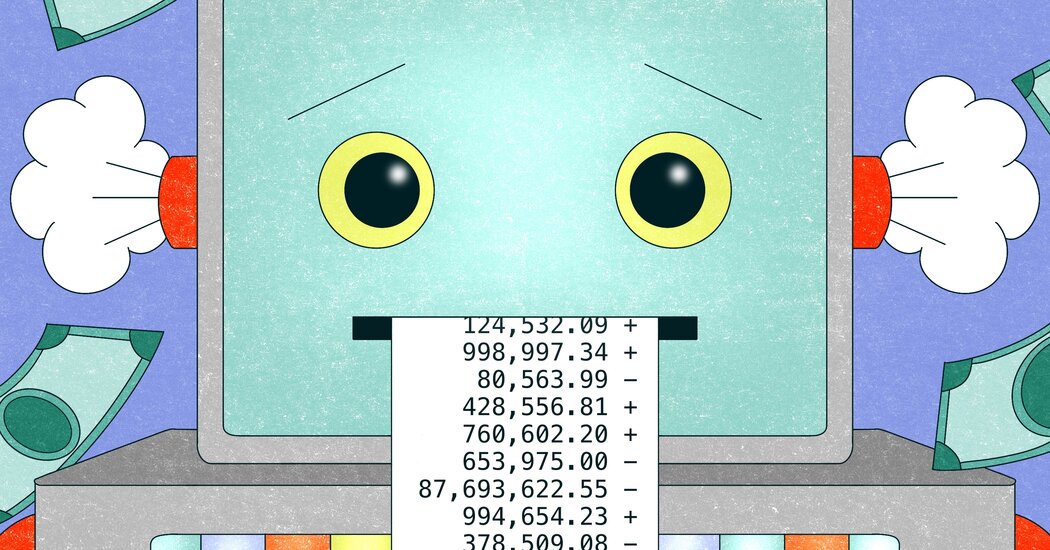
Artificial intelligence is making some people rich and others feel left out. Unsurprisingly, then, proposals to tax A.I. for the benefit of the public are multiplying like the fingers on an A.I.-generated hand. Some make sense. Others, not so much.
Giant initial public offerings have intensified interest in the tax proposals. Trading began this week in SpaceX — now merged with Elon Musk’s xAI — which went public at a valuation of $1.77 trillion. Anthropic filed confidentially for its own I.P.O. on June 1, days after a funding round valued it at $900 billion before the inclusion of new capital. OpenAI, which filed confidentially on June 8, was valued at $730 billion after a funding round this year.
Investors in artificial intelligence are paying a lot for shares because they envision a world in which A.I. systems take over more and more of the work that people do today. If that happens, though, federal taxes on wages and salaries could dry up along with jobs. That’s an existential threat to the government — and by extension, to nonbillionaire taxpayers.
One idea is for ordinary citizens to become participants in the A.I. boom. President Trump said Wednesday he plans to meet with tech executives to discuss their “giving something back to the public,” without specifying how that might happen. “If we do that, the public will become very rich,” he promised.
Senator Bernie Sanders, independent of Vermont, is going further, planning to introduce a bill imposing a one-time tax on leading A.I. companies that would give the public half of their shares, to be placed in a sovereign wealth fund modeled on Alaska’s, which collects oil dividends.
Trouble is, the objectives of the various tax proposals aren’t always clear. If the main concern is that A.I. development is moving too fast, for example, the Sanders and Trump plans are not obviously fit for purpose. They would give the federal government a strong financial interest in promoting the growth of A.I. companies, because it would own a big stake in them.
“What is the goal here? In almost all of these discussions, that’s what it comes down to,” said Lee Lockwood, a University of Virginia economist who has pivoted from studying public finance to working on the policy challenges of advanced A.I.
With that in mind, here are the main ideas on the table.
Take partial ownership of A.I. companies
Sanders proposed the government take a stake in A.I. companies after seeing an article on it by a pair of law professors, Jeremy Bearer-Friend and Sarah Polcz, who have been presenting the concept at conferences for a couple of years. In Britain, a similar plan was floated by Liam Epstein of the University of Cambridge. OpenAI itself proposed a plan in April that would involve the government taking some ownership in A.I. companies, as well as “the broader set of firms adopting and deploying A.I.”
Although Sanders is miles apart from Trump politically, the two politicians are alike in their desire for big government stakes in corporate America. Since Trump’s second term began, the government has taken stakes in more than 20 companies, including Intel, U.S. Steel, Westinghouse, and MP Materials, which mines rare earth minerals.
Trump has been vague so far about how the government would acquire shares in A.I. companies. Sanders has been clear: He wants to get the company shares for free, through a tax. A.I. companies built their knowledge bases from “all our collective knowledge and writing” and the tax is a way for the public to be rewarded for its contributions, Polcz said.
The skeptics’ take: Owning stakes in A.I. companies, whether through taxation or purchase, wouldn’t solve every problem. On one hand, it would allow “the public interest to be weighed” in decision-making, Bearer-Friend and Polcz wrote in The Hill. But in the same piece, they said their proposal “aligns the Treasury with investors who have a stake in preserving the value of their shares.” How are the fund managers supposed to vote when the interests of investors and the public diverge?
Taking a stake in A.I. isn’t going to prevent it from inventing a superbug or setting off a nuclear war. Regulation and supervision are more likely to succeed in that difficult task.
Tax the use of A.I.
A tax on tokens — the units of A.I. processing — would raise money. It would also at least slightly discourage the use of A.I. by making it more expensive. Customers are already complaining that it costs too much, “a huge issue,” OpenAI’s Altman said this month.
Representative Greg Casar, Democrat of Texas and chair of the Congressional Progressive Caucus, calls that drag on A.I. “a feature as much as a bug.” In an essay for The American Prospect, he wrote, “In the long run, an economy with high-wage jobs for more Americans is better for all of us, and in the short run, if we delay layoffs and give workers more time to adapt to a changing economy, that is a good thing.”
Senator Elizabeth Warren, Democrat of Massachusetts, has pushed a levy on energy consumed by data centers. Andrew Yang, the former presidential candidate and Forward Party co-chair, says the government should tax A.I. agents instead of labor.
Some prominent economists sympathize with those politicians in principle, if not the precise implementation. Daron Acemoglu and Simon Johnson, who shared a Nobel in economics in 2024 with James Robinson, wrote in an International Monetary Fund publication the year before that labor is taxed more heavily than automation, discouraging hiring. They said the rates should be equalized.
The skeptics’ take: Economists such as Virginia’s Lockwood tend to say that if you’re going to tax the use of A.I., it’s cleaner to tax it as a final product, not when it’s being used as an input in some company’s production process. So, yes to a tax on somebody using ChatGPT to write a love letter, but no to a tax on somebody using it to build an advertising campaign.
The logic is that it’s economically inefficient to discourage businesses’ use of A.I. It’s more efficient to let them use as much it as they need to maximize their profits, and then tax those profits.
Tax capital broadly
Among economists, the conventional wisdom is that capital and labor need each other. Taxing machines, computers, software and so on hurts workers by depriving them of the tools they need to become more productive and earn more money, the logic goes. But the economist Philip Trammell and the tech podcaster Dwarkesh Patel argued on Substack in December that “a world of advanced robotics and A.I.,” which is coming soon, undermines that conventional wisdom.
They argued that “a global and highly progressive tax on capital (or at least capital income) will then indeed be essentially the only way to prevent inequality from growing extreme.” A tax on capital amounts to a tax on robots, along with all the other machines, buildings and software that companies use.
The skeptics’ take: Brian Albrecht, the chief economist at the International Center for Law & Economics, fired back on Substack earlier this year that economists’ conventional wisdom remains correct as long as the robots haven’t completely taken over. “A compute tax is a REALLY dumb idea,” he headlined a follow-up piece this month.
Tax consumption
If taxing capital isn’t a great idea, and if taxes on labor income dry up because A.I. kills jobs, what’s left? The natural alternative is to tax what people consume.
The United States is actually partway to such a system already. Some of the income that people earn is consumed and some is saved. Because there are big deductions for savings, the federal government is effectively taxing the other part, consumption, more heavily. The next step would be a value-added tax, which almost every other rich country already has. Instead of carving out exceptions for savings, it just taxes consumption outright.
The skeptics’ take: This presumes that A.I. is generating so much value that people consume more than ever while working less than ever. That’s a reasonable presumption for the medium term, but maybe not forever.
A sci-fi scenario
So far we’ve been assuming that A.I. is working in the service of humanity, helping produce more and more goods and services that people need.
What will happen if it starts to invest in itself for its own purposes? The A.I. infrastructure will get more and more massive, but human consumption won’t rise as fast. Korinek and Lockwood argue that, in that case, taxing capital really would make sense.
When Korinek and Lockwood presented their sci-fi scenario at a conference last year, Matthew Weinzierl of Harvard Business School expressed doubt over whether such a powerful A.I. system would even submit to human authority.
Lockwood acknowledged the problem in an interview this week: “An absolutely superhuman intelligence that no one essentially owns or controls, in what sense are we even able to tax them?” he said. “It seems like a far-out thing.”
The skeptics’ take: If we lose control of the A.I., tax policy may be the least of our problems.
A word from Andrew
Good morning. Andrew here. The success of SpaceX’s I.P.O. — the stock is up more than 19 percent since its debut — and the expected public offerings of Anthropic and OpenAI have intensified a new debate: Should A.I. companies face special taxes, and if so, what should those taxes look like? We asked DealBook contributor Peter Coy to examine the leading ideas and their implications. Also: With the N.B.A. Finals underway — Go Knicks! — The Times’ Tania Ganguli spoke with Bob Carney, the league’s senior vice president for digital and social content, about the challenge of building a sports league for an audience that increasingly experiences the game one clip at a time.
IN CASE YOU MISSED IT
SpaceX launches its I.P.O. SpaceX raised around $75 billion from its offering, putting its valuation at $1.77 trillion — and toppling all previous I.P.O. records. It closed its first day of trading up more than 19 percent from its I.P.O. price, making Elon Musk the world’s first trillionaire.
Inflation accelerated to its fastest pace in three years. The Consumer Price Index rose 4.1 percent in May from a year earlier, the Bureau of Labor Statistics reported on Wednesday. It was the third-straight month inflation accelerated as energy prices remained elevated because of the war in Iran. Especially with few signs of trouble in the labor market, the jump in inflation keeps prospects of a fed rate cut low.
Kalshi plans to make some users identify their employers. As politicians face more pressure to rein in the booming prediction market business, the betting platform aims to limit insider trading by asking users to disclose their employer before trading in certain markets. Kalshi will not verify employment unless it flags suspicious activity related to potential inside information.
The moment the Knicks clinched the biggest comeback in N.B.A. Finals history, the N.B.A.’s social media team went into overdrive.
On Instagram alone, it posted 64 times on Wednesday night: different angles of OG Anunoby’s game-winning tip-in, celebrations from around the world and four posts featuring Knicks celebrity fan Mariska Hargitay hugging players and wandering around the court in disbelief.
It was a demonstration of a social media strategy two decades in the making. Even before Wednesday night’s stunner, the first three games of the N.B.A. finals generated five billion social media views, the most ever through the first three games of the finals. Wednesday night’s coverage has generated three billion social media views so far, the most ever for one game.
Bob Carney, the league’s senior vice president of digital and social content, has seen the evolution. He took a few minutes between news conferences this week, his 24th time working the N.B.A. finals, to talk with Tania Ganguli about how the league has positioned itself for the enormous engagement numbers it’s seeing now as it heads into Game 5 tonight. The interview has been condensed and edited.
How have you seen the task of telling the league’s story change?
It’s always the same types of stories, it’s always about the player’s journey. But the way we tell those stories has changed dramatically. When I first started, the N.B.A. was producing content for NBA TV and nba.com. Then in 2005 it evolved to YouTube. We’ve joined every social media platform since.
What are the biggest algorithmic shifts you’ve seen?
In the early days of social media, it was sort of more is more. Now the best content wins. How can you get the viewer to watch as much of the video as possible or all of it to completion or watch it again? Because those are becoming the loudest signals to the algorithm.
Three-quarters of your social media viewership is international. How does that guide your strategy?Our global and regional social media channels tailor content to different regions for different languages, different cultures, different time zones, especially for fans who aren’t able to watch the games live. At the end of the day, social media is borderless.
News conferences used to be a way for reporters to get answers to questions, but now they are part of the show.
It’s definitely been a focus to make sure that the press conferences are seen by more people. We stream every single home and away press conference from every single game in the N.B.A. app every night. Our team was clipping every single answer. It’s access to our stars. It’s their raw reactions to what everybody just got to watch.
It just resonates.
Are you trying to create memes from those situations?
It’s not a part of a content strategy. We have access to the most incredible visual assets that any content team could ever hope for. I never need to make memes part of the approach.
Pricey seats
The World Cup kicked off this week across North America, but controversy about ticket pricing for soccer’s marquee contest has been raging for months. Tickets to the July 19 final in New Jersey were listed for up to $8,680 on FIFA’s website. That’s about eight times what they cost in 1994, when the U.S. last hosted, even after adjusting for inflation. On the resale market, prices have soared even higher, Christine Zhang reports.
One reason for the sticker shock: FIFA’s use of a dynamic pricing system. In the past, FIFA’s prices were fixed and announced well in advance. For this year’s tournament, FIFA released tickets in phases, allowing prices during each phase to fluctuate based on real or perceived demand. The new system, along with other ticketing snafus, has angered fans facing additional barriers, financial and otherwise, when it comes to travel to the United States., and it has incited an investigation by the attorneys general of New York and New Jersey. Ironically, the organizers might have overestimated demand: Tickets to some matches remained unsold days before they were set to begin.
Thanks for reading! We’ll see you Monday.
We’d like your feedback. Please email thoughts and suggestions to [email protected].
Follow DealBook on Instagram: @nytdealbook