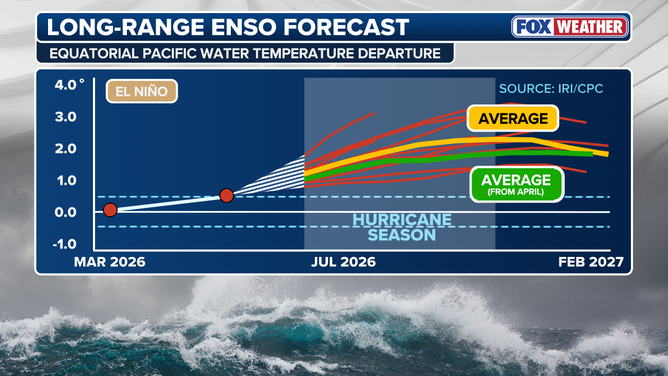
El Niño conditions are officially present across the equatorial Pacific. On Thursday morning, NOAA’s Climate Prediction Center issued an El Niño Advisory, noting it expected to strengthen heading into the winter months.
El Niño conditions developed over the last month across the central and eastern Pacific Ocean, as ocean temperatures continue to be above average, and signs are pointing to a “very strong” El Niño later in the year.
NOAA’s Climate Prediction Center (CPC) expects El Niño to intensify through this upcoming winter.
Model predictions El Niño
(FOX Weather)
The CPC noted that there’s a 63% chance of a “very strong” El Niño from November to January.
If things continue as forecast, the CPC said this could be one of the most powerful El Niño events dating back to 1950.
WHAT ARE EL NIÑO AND LA NIÑA CLIMATE PATTERNS?
The FOX Forecast Center said ocean temperatures are well above the El Niño categorical threshold across the central and eastern Pacific, and El Niño atmospheric conditions are setting up as well with low-level westerly wind anomalies paired with upper-level easterly wind anomalies over the central equatorial Pacific.
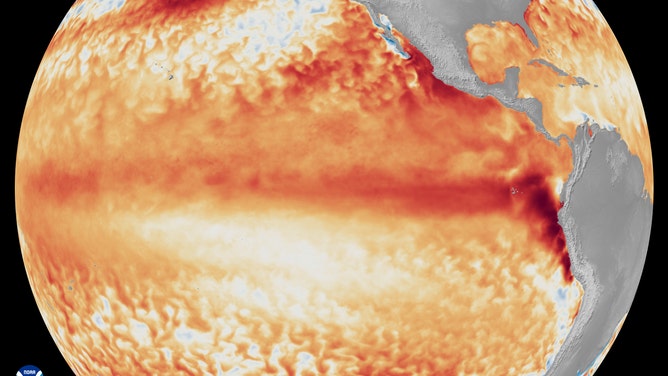
Satellite imagery showing the difference from average sea surface temperatures at the equator in the tropical Pacific Ocean (depicted using various shades of red and orange for warmth) during the first week of June 2026, as compared with the baseline used by NOAA’s Coral Reef Watch.
(NOAA Satellites / NOAA)
Confidence in this upcoming “very strong” El Niño forecast is so high because of the oceanic heat content and the continued expansion of those westerly wind anomalies, the FOX Forecast Center said.
As for what this means for hurricane season? Well, we’re already getting a taste of an active Eastern Pacific, with three named storms so far this season.
EYE OF THE SEASON: THE MOST NOTABLE ATLANTIC HURRICANES DURING EL NIÑO YEARS
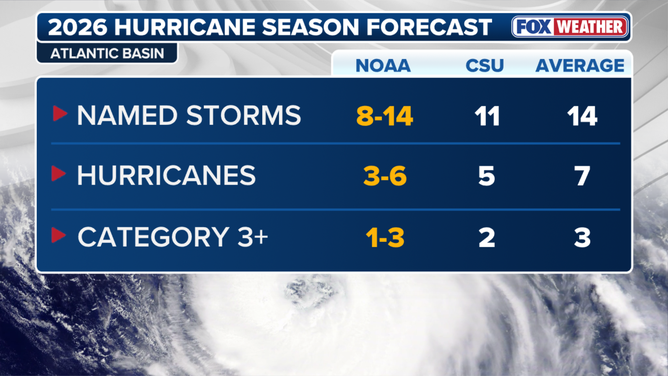
When it comes to the Atlantic, the FOX Forecast Center said this season is likely to be below average.
NOAA vs June CSU hurricane forecast
(FOX Weather)
Current forecasts by NOAA and Colorado State University (CSU) call for 8 to 14 named storms, 3 to 6 hurricanes and 1 to 3 major hurricanes; and 11 named storms, five hurricanes and two major hurricanes, respectively, this season.
The average Atlantic hurricane season boasts 14 named storms, seven hurricanes and three major hurricanes.
However, when fall and winter come around, El Niño is likely to mean above-average rain and thunderstorm activity for the Southern U.S.