Total global migration has nearly tripled in the two decades since 2000, a study has revealed.
Using deep learning, researchers discovered that around 35 million people now relocate to a new country every year.
That is up from approximately 15 million total yearly migrants in 1990 and just 13 million in 2000.
Critically, the researchers say that the rise in migration is now outpacing population growth, showing that the world is becoming more mobile on average.
While net global migration had peaks and falls in the 1990s, the total number of people moving countries has been on a steady rise since the 2000s.
The only exceptions were brief dips during the 2008 financial crisis and the COVID–19 pandemic, which brought global mobility screeching to a halt.
According to this new study, net migration to the UK in 1990 stood at 65,793, with 320,966 people arriving and 255,173 leaving.
By 2023, this number was over 10 times higher, with new arrivals adding 679,821 people to the British population.
In 2023, net migration added 679,821 people to the British population. That is 10 times higher than it was in 1990, according to a new study

Total global migration has nearly tripled in the two decades since 2000, with 35 million people now relocating every year
Although the researchers found that big events such as wars or economic crises can spike or stifle migration, their new study shows that mobility has generally increased overall.
Previous studies tended to use migrant population data published at five–year intervals by the United Nations and at 10–year intervals by the World Bank.
Co–author Professor Guy Able, of the International Institute for Applied Systems Analysis and the University of Hong Kong, says that this created the false impression that ‘the rate of global migration flows was stable’.
‘Our annual data provides a clearer picture, revealing that this rate has actually risen since 2000,’ says Professor Able.
‘This upward trend appears to be driven by long–term demographic shifts and economic development rather than sudden, isolated crises.’
All around the world, this means that more people are moving to seek economic opportunities or flee danger than experts and policy–makers previously anticipated.
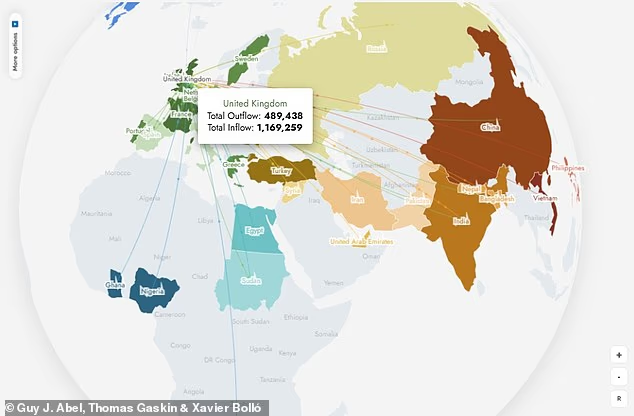
You can explore all the changes in global migration using this interactive tool developed by the researchers.
By far the biggest destination for migrants around the world is the Middle East, with people chiefly arriving from South Asia and the Philippines.

Between 1990 and 2023, the world population has become more mobile as migration outpaces population growth

Since 2010, a total of 19 million people have migrated from India, Pakistan, and Bangladesh to the Gulf States of Saudi Arabia, Qatar, Bahrain and the UAE

Immigration from Bangladesh to Saudi Arabia alone averages around 300,000 people every single year from 2010 onwards. Pictured: A snapshot of Saudi Arabia’s 2023 net migration
Since 2010, a total of 19 million people have migrated from India, Pakistan, and Bangladesh to the Gulf States of Saudi Arabia, Qatar, Bahrain and the UAE.
That is a total of 1.35 million migrants from East Asia every year for the last two decades.
Meanwhile, immigration from Bangladesh to Saudi Arabia alone averages around 300,000 people every single year from 2010 onwards.
For comparison, 13.6 million travelled from Mexico to the US in the three decades between 1990 and 2023.
By contrast, Europe has significantly higher levels of ‘intra–regional migration’, meaning people moving from one European country to another.
Before 2020, total flows within Europe reached around three million people per year, having steadily increased since 2000 with the expansion of the Schengen scheme.
This is an even larger movement of people than in 1991, following the collapse of the Soviet Union, when around 2.02 million people moved around Europe.
The only time that a region has experienced a higher rate of intra–regional migration than Europe was in sub–Saharan Africa during the 1990s.

13.6 million travelled from Mexico to the US in the three decades between 1990 and 2023

Europe is the region with the highest rate of ‘intra–regional’ migration, meaning that people tend to move from one European country to another. Pictured: A snapshot of European migration in 1991 after the collapse of the Soviet Union
During the 1994 Rwandan Genocide, 950,000 Rwandans fled to the neighbouring Democratic Republic of Congo in the largest single–year movement of people since 1990.
The UK has seen a steady increase in net migration since the 1990s, continuing through the 2000s and only slowing during the pandemic.
In 2000, net migration stood at 135,257, with 343,681 people arriving from abroad and 208,424 emigrating.
Net migration continued to climb after the pandemic before reaching its absolute peak in 2023.
However, new data shows that net migration has now begun to fall, reaching 171,000 in 2025.
That is half the number of people added to the population in 2024 and the lowest level since 2012, excluding pandemic years.
Data from the University of Oxford’s Migration Observatory shows that the UK has ‘experienced broadly similar levels of migration compared to other high–income countries’ over the last few years.
In 2024, the ONS estimates that 19 per cent of the UK’s population was foreign–born, which is similar to the level in Spain and Germany and lower than in Australia, Canada, or New Zealand.