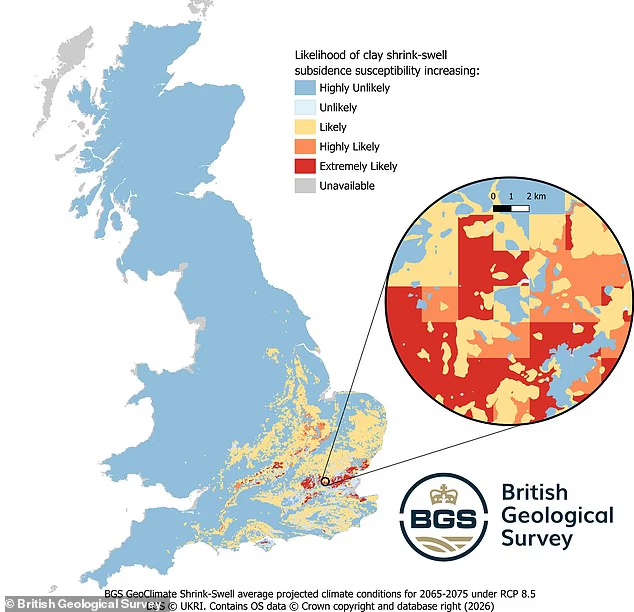
Millions of homes in London, Essex, and Kent are at risk of sinking into the ground, scientists have warned.
Previous studies have already shown that so-called ‘shrink–swell subsidence’ is already a serious threat in the South of England, where wet winters and dry summers cause the ground to flex and shift.
Now, the British Geological Survey (BGS) has warned that even more homes will be put in danger thanks to human–caused climate change.
If the world follows its current emissions trajectory, researchers predict that more than 1.8 million properties in the UK could be affected by 2070.
In London, where the risk of subsidence is most severe, up to 26 per cent of homes could be affected within 45 years.
The most susceptible areas in this ‘medium emissions scenario’ are highly populated parts of the capital, including Camden, Islington and Barnet.
However, even if the world dramatically cuts its fossil fuel consumption, we can still expect housing chaos.
If the world hits green targets consistent with the Paris Agreement, the BGS predicts that 500,000 homes will still be affected by climate–related subsidence by 2070.
The British Geological Survey has predicted that 1.5 million homes could be at risk of subsidence by 2070 due to human–caused climate change
Shrink–swell subsidence occurs when certain types of soil expand as they absorb water during wet weather and then contract as they dry out.
This process causes the ground to shrink underneath the building, dragging the foundations down.
The South of England is particularly vulnerable because houses are built on relatively young clay formations.
Unlike geologically older mudrocks found elsewhere in the country, these clays are still able to absorb and lose moisture according to the weather.
In the future, shifting weather patterns associated with ongoing climate change will increase the risk even further.
Anna Harrison, a scientist at the BGS, told The Guardian: ‘By combining geotechnical information about volume change potential with data about projected rainfall and temperature scenarios for the coming century, we have been able to identify the areas of Great Britain most likely to become susceptible to shrink–swell subsidence.’
The threat is especially significant in London, where underlying geological risk combines with particularly dense housing.
London will also feel the biggest changes in temperature and precipitation as the climate changes, hitting the capital with what Ms Harrison calls a ‘double whammy’.

The most affected areas (yellow and red) are located in London, Essex, and Kent, and a tranche of land from Oxford up to the Wash on England’s east coast
She adds: ‘Dry weather and high temperatures are a major factor in the emergence of shrink–swell subsidence. Looking ahead, these increases in hotter, drier summers and warmer, wetter winters are projected to continue.’
The BGS analysis suggests that more homes will be affected by subsidence over the next four decades, but many homeowners are already feeling the impact.
In 2025, the UK experienced the driest Spring in over 50 years and the warmest on record.
At the same time, there were £153 million worth of subsidence–related insurance claims in the first six months of the year.
Climate–related subsidence can slash a property’s value, and lenders may refuse to offer mortgages until the issues are solved.
Affected properties frequently require expensive engineering work to stabilise the land or underpin the home.
In extreme cases, utility pipes may need to be replaced and nearby trees and vegetation removed.
Homeowners may not notice the signs of change until more significant issues appear, such as diagonal cracks around doors or windows and sloping floors.

Homes affected by subsidence often require expensive engineering work, with the most obvious signs of sinking being the distinctive diagonal cracks. Pictured: A home affected by subsidence in Norfolk

In extreme cases, homes may need to be abandoned or evacuated. Earlier this month, 100 families in Coalsnaughton (pictured) were evacuated due to suspected subsidence
According to the BGS, if your property is built on clay with shrink–swell potential, the best thing to do is to take preventative action.
This could include laying impermeable drives, paths, or hard standing to prevent water from reaching the clay soils beneath your home.
Experts also advise extreme caution when adding or removing trees near the properties.
You should consult an expert before planting a tree near the house, and avoid removing any mature trees that predate the building’s construction.