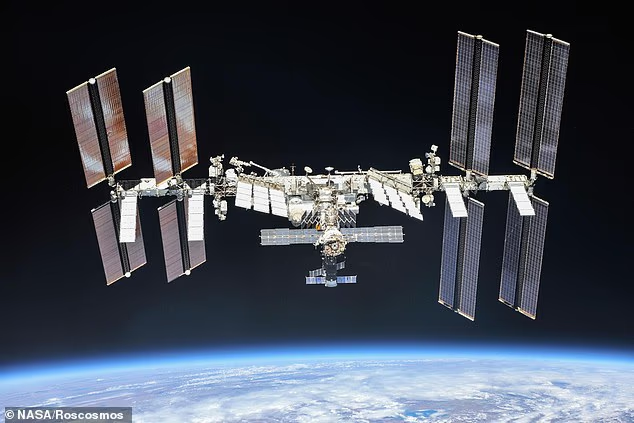
Over 25 years since the first astronauts floated aboard the International Space Station, time is now running out for Earth’s orbiting outpost.
Last week, NASA astronauts were ordered to prepare for an emergency evacuation while Russian cosmonauts attempted to repair a ‘worsening’ leak.
While no escape flights were ultimately necessary, this near miss has sparked concerns that the ISS has reached the end of its useful lifespan.
Now, experts have revealed the step–by–step details of the $1 billion plan to bring the doomed station crashing down to Earth.
Speaking at the ASCEND 2026 aerospace conference, Ryan Landon, director of Operations at NASA Johnson Space Centre, said that the ISS would be allowed to start falling to Earth sometime in 2028.
With a mass of 450,000 kilograms, about the same as 280 family cars, the ISS will slowly fall out of orbit if it isn’t being periodically boosted upwards.
However, simply letting the station’s orbit ‘decay’ naturally would result in an uncontrolled re–entry that would scatter potentially deadly debris across Earth.
This means that NASA will push the station out of orbit, bringing the remaining material down at a remote location in the Pacific Ocean.
After Russian attempts to fix a leak on the International Space Station trigger an evacuation scare, experts have revealed the $1 billion plan to bring the doomed station down to Earth
The ISS and its crew of seven astronauts from around the world orbit at an altitude of 250 miles (400km) above the Earth.
To maintain this relatively low orbit, the station has to move incredibly fast, travelling at speeds of 17,500mph (28,000km/h) and whizzing over our heads 16 times a day.
Normally, the station maintains its speed by using propellant to thrust back up into orbit and avoid tumbling into the thicker layers of the atmosphere.
However, starting from 2028, NASA plans to simply let this process take its natural course.
According to the latest plans published in 2024, the station will still be operational during this time, and on–board activities, including research, will continue as normal.
Left unchecked, this process would eventually bring the station crashing into the atmosphere, where most of the materials would be burned up by friction.
But this type of uncontrolled re–entry is far too risky for an object as large as the ISS.
Dr James Beck, space debris expert and director of UK–based space consultancy Belstead Research, told the Daily Mail: ‘It is certain that parts will reach the surface of the Earth, and most likely quite a lot of parts.

Last week, NASA astronauts were forced to take shelter in their SpaceX Dragon capsule (pictured) in case of a disaster aboard the orbiting station
‘The open question is how many, and whether there can be sufficient control over where this occurs.’
Dr Beck explains that there is an internationally agreed ‘casualty risk limit’ of one in 10,000 for any re–entry.
This limit is typically reached once a spacecraft gets to a mass of around 500 to 1,000 kg, whereas the ISS weighs 450 tonnes.
Dr Beck says: ‘It should be expected that a few hundred objects which could cause casualties on the ground would be produced.’
The space agency can’t limit how much debris reaches the ground, so they need to control exactly where this debris ends up so that no one gets hurt.
This requires boosting the station backwards, slowing it down at a precise point in its orbit so that it eventually falls in an uninhabited area in the Pacific called Point Nemo.
Known as the ‘Spaceship Graveyard’, Point Nemo is the furthest location from any inhabited location anywhere on Earth, which significantly reduces the danger of space debris.
According to NASA’s calculations, the ISS will need to change its speed by about 127 miles per hour (204 km/h), which is a tiny fraction of its total speed.

NASA plans to use a modified Dragon capsule to push the ISS out of orbit (artist’s impression), so that it falls within an uninhabited part of the Pacific Ocean
However, this will consume about nine tonnes of propellant, which is far more than the ISS’s own thrusters can provide.
In 2024, NASA awarded Elon Musk’s SpaceX a contract worth slightly under $1 billion (£749.69 million) to build a ‘tugboat’ capable of delivering that push.
This will be a modified version of the SpaceX Crew Dragon capsule used to deliver astronauts and cargo that will dock with the station before firing up its motor and pushing the ISS down to Earth.
This vehicle will need to carry six times as much propellant and produce three to four times as much power as the current generation of SpaceX spacecraft.
NASA officials now say that the last cargo capsule will depart the ISS around mid–2029, ahead of the official end of operations in 2030.
Once the last crew have gone, the station will continue to fall over several months until it reaches the ‘point of no return’ at an altitude of 175 miles (280 km).
Roughly 18 months before the ISS crashes down in 2031, the modified Dragon capsule will dock with the station and prepare to deliver the finishing blow.
Speaking at a press conference in 2024, Dana Weigel, NASA’s ISS manager, explained that the tug would do this over several stages over 18 months.

NASA estimates it will cost $1bn (£800m) to convert a Dragon capsule (pictured) into a vehicle capable of pushing the ISS out of orbit
Ms Weigel said: ‘At the right time, it will perform a complex series of actions… over several days to deorbit the space station.
‘First, the deorbit vehicle will perform orbit shaping burns to put the station in a low elliptical orbit, and then, eventually, it will perform a final re–entry burn’.
NASA expects that most of the space station will be destroyed, but 40 to 100 tonnes of denser materials could still make it through the atmosphere.
Once the space station hits thicker air at an altitude of around 150 miles (250 km), there is also a risk that the tugboat could lose control of the station and begin to tumble.
In 1979, NASA’s 75–tonne space station, Skylab, tore itself apart as it crashed through the atmosphere during a planned re–entry, sending debris falling over parts of Western Australia.
However, NASA’s assessment found that leaving the ISS in orbit is far more dangerous than attempting to bring it down intentionally.
The agency’s 2024 assessment concluded: ‘The International Space Station requires a controlled re–entry because it is very large, and uncontrolled re–entry would result in very large pieces of debris with a large debris footprint, posing a significant risk to the public worldwide.
‘Ensuring the space station is well maintained continues to be the safest operational approach while also planning for deorbit at the space station’s end of life.’
EXPLAINED: THE $100 BILLION INTERNATIONAL SPACE STATION SITS 250 MILES ABOVE THE EARTH
The International Space Station (ISS) is a $100 billion (£80 billion) science and engineering laboratory that orbits 250 miles (400 km) above Earth.
It has been permanently staffed by rotating crews of astronauts and cosmonauts since November 2000.
Crews have come mainly from the US and Russia, but the Japanese space agency JAXA and European space agency ESA have also sent astronauts.

The International Space Station has been continuously occupied for more than 20 years and has been expended with multiple new modules added and upgrades to systems
Research conducted aboard the ISS often requires one or more of the unusual conditions present in low Earth orbit, such as low-gravity or oxygen.
ISS studies have investigated human research, space medicine, life sciences, physical sciences, astronomy and meteorology.
The US space agency, NASA, spends about $3 billion (£2.4 billion) a year on the space station program, with the remaining funding coming from international partners, including Europe, Russia and Japan.
So far 244 individuals from 19 countries have visited the station, and among them eight private citizens who spent up to $50 million for their visit.
There is an ongoing debate about the future of the station beyond 2025, when it is thought some of the original structure will reach ‘end of life’.
Russia, a major partner in the station, plans to launch its own orbital platform around then, with Axiom Space, a private firm, planning to send its own modules for purely commercial use to the station at the same time.
NASA, ESA, JAXA and the Canadian Space Agency (CSA) are working together to build a space station in orbit around the moon, and Russia and China are working on a similar project, that would also include a base on the surface.