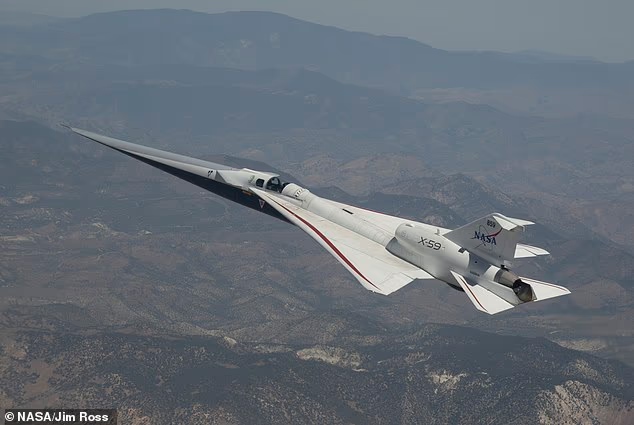
NASA‘s $247 million (£183 million) ‘Son of Concorde’ jet is about to take to the skies for its first supersonic test flight.
Travelling at speeds up to Mach 1.6, or 1,218 miles per hour (1,960 km/h), the jet could cut the trip from London to New York to just four hours.
However, unlike Concorde, NASA’s experimental jet, the X-59, has been designed to replace the deafening crash of a sonic boom with a softer ‘thump‘.
The X-59 has already undergone months of test flights since launching for the first time in October last year.
Now, NASA says it is getting the plane ready to fly at faster speeds and higher altitudes, including its first test flight beyond the speed of sound.
With a new series of tests starting in early June, the space agency plans to fly X-59 at speeds of over 630 miles per hour (1,014 km/h) at an altitude of 43,000 feet.
This will be followed by a ‘mission conditions flight’, during which the jet will hit Mach 1.4, 925 miles per hour (1,490 km/h), at 50,000 feet.
Finally, test pilots will push the jet to its absolute limit, reaching a top speed of Mach 1.6 at 60,000 feet – around twice the height and speed of a commercial airline.
NASA’s experimental supersonic jet, dubbed the ‘Son of Concorde’, will take to the skies in its first faster-than-sound flight in July
The X-59 has been specifically designed to solve a major problem that currently stands in the way of supersonic travel becoming more common.
When a plane flies at sub-sonic speeds, it pushes the air out of the way like a boat moving through water, creating ripples in the form of sound waves.
But when something reaches the speed of sound, it starts to outrun these sound waves, and the ripples bunch up and merge together into a powerful shockwave.
This means that supersonic jets are constantly generating shockwaves, which people on the ground hear as a deafening boom as they sweep past.
Because these booms can be as loud as 110 decibels, similar to a loud rock concert, supersonic flights are generally banned over populated areas.
To solve this problem, NASA has been working to develop ‘Quiet SuperSonic Technology (Quesst)’ that would muffle the boom into a muted ‘thump’.
The jet has been developed by American aerospace firm Lockheed Martin after being awarded the $247.5 million design contract by NASA in 2016.
The X-59 features a radically redesigned geometry in which every feature is designed to diffuse and muffle the sonic boom.

The X-59 jet has been designed to produce a much quieter sonic boom when flying at supersonic speeds, creating a ‘thump’ rather than a bang

Part of the reason that Concorde was eventually discontinued was that the sonic boom produced by breaking the sound barrier could be extremely loud for people on the ground

During the upcoming tests, the experimental aircraft will be chased by a standard supersonic jet equipped with a probe to record the shockwave
The most obvious difference from a normal jet is the thin, tapered nose, which accounts for almost a third of the plane’s entire length and is shaped to break up the shockwave.
The downside of this novel design is that the cockpit is located around halfway down the length of the vehicle and doesn’t have any forward-facing windows.
Instead, the single pilot uses a system of cameras and augmented reality displays, known as the eXternal Vision System, to see out the front.
Reaching these new speed and altitude records is a key milestone for Quesst, since they are NASA’s targets for the X-59 to eventually fly over American communities.
Cathy Bahm, project manager for NASA’s Low Boom Flight Demonstrator, says: ‘Every step of envelope expansion brings us closer to demonstrating the quiet supersonic capability that is at the heart of the Quesst mission.
‘Completing the first mission-conditions flight is especially meaningful – it’s the moment where we begin validating the aircraft in the environment it was designed for.’
While the eventual goal is to produce quiet sonic booms, this upcoming batch of test flights will not be designed to assess the volume of the flight.
The X-59 will be accompanied by a standard supersonic chase plane, which would drown out any useful data with its own, much louder boom.

According to NASA, the sonic thump produced by X-59 passing overhead will be quieter than the sound of a car door shutting 20 feet away

The X-59’s aerodynamic profile has been designed so that it breaks up the shockwave formed by passing the sound barrier and is much quieter in flight. Pictured: The sonic boom from a scale model of the aircraft during wind tunnel tests

Travelling at speeds up to Mach 1.6, or 1,218 miles per hour (1,960 km/h), the X-59 could cut the trip from London to New York to just four hours

The X-59’s long nose accounts for a third of its total length, which means the cockpit doesn’t have room for a forward-facing window. Test pilots instead use a system of cameras and augmented reality displays to see where they are going (pictured)
However, the chasing jet will be equipped with a specialised probe to take initial measurements of the X-59’s shock waves.
Strain gages throughout the aircraft’s body will also gather data on how it handles higher speeds and whether it is structurally safe to fly.
This data will pave the way for a new set of tests later this year, dubbed Quesst Phase 2, in which NASA will begin to check whether it is really producing a quiet supersonic thump as intended.
Ms Bahm says: ‘As we look ahead to the upcoming flights, we’re poised to open the envelope even further – moving boldly toward the mission test point this aircraft was built to achieve.’
The history of Concorde
Concorde was a turbojet-powered supersonic passenger jet that was operated from 1976 until 2003.
It had a maximum speed over twice the speed of sound at Mach 2.04 (1,354mph or 2,180k per hour at cruise altitude) and could seat 92 to 128 passengers.
It was first flown in 1969, but needed further tests to establish it as viable as a commercial aircraft. Concorde entered service in 1976.
It is one of only two supersonic transports to have been operated commercially. The other is the Soviet-built Tupolev Tu-144, which ran as a passenger aircraft only for a few years in the 1970s due to safety issues.

Concorde was the world’s first supersonic airliner and operated for 27 years, but it was grounded in October 2003. Pictured is British Airways Concorde G-BOAB taking off with its landing gear still extended over the Cotswolds town of Fairford, Gloucestershire on July 20, 1996, during the annual RAF Fairford airshow
Concorde was jointly developed and manufactured by Aérospatiale and the British Aircraft Corporation (BAC) under an Anglo-French treaty. Concorde’s name, meaning harmony or union, reflected the cooperation on the project between the UK and France.
Concorde was retired in 2003 due to a general downturn in the commercial aviation industry after its only crash in 2000, the September 11 attacks in 2001, and a decision by Airbus, the successor to Aérospatiale and BAC, to discontinue maintenance support.
It wasn’t the first plane to break the sound barrier, however; that achievement was managed by the Bell X-1, piloted by Chuck Yeager, in October 1947.
The legendary rocket engine-powered aircraft, designed and built in 1945, achieved a speed of 700 miles (1,127 kilometers) per hour.