Saturday, June 6, 2026
No Result
View All Result
LJ News Opinions
  • Home
  • U.S.
  • Politics
  • World News
  • Business
  • Entertainment
  • Sports
  • Technology
  • Health
  • Opinions
  • Home
  • U.S.
  • Politics
  • World News
  • Business
  • Entertainment
  • Sports
  • Technology
  • Health
  • Opinions
No Result
View All Result
LJ News Opinions
No Result
View All Result
Home Technology

Super El Niño is inching closer: A swell of warm water HUNDREDS of miles wide has arrived in the Pacific Ocean, NASA reveals – hinting the rare climate event is imminent

by LJ News Opinions
June 5, 2026
in Technology
0
Share on FacebookShare on Twitter


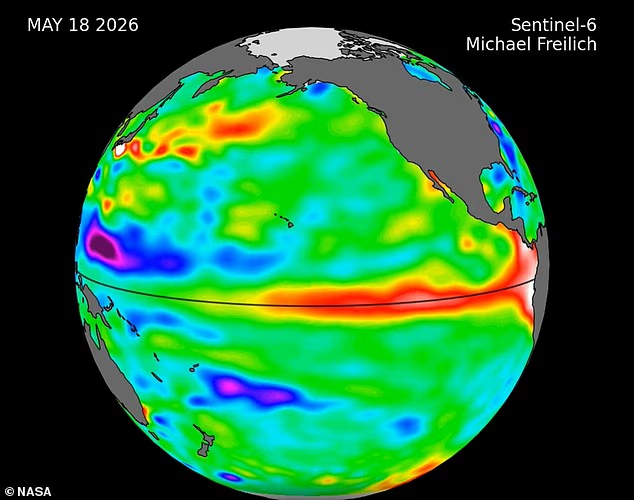
A swell of warm water hundreds of miles wide has arrived in the Pacific Ocean, NASA has revealed. 

Using satellite data, the space agency detected the warm water off the coast of South America. 

Worryingly, experts say this is an ominous sign that a Super El Niño will emerge ‘later in the year’.

‘Waves of higher, warmer water move eastward across the Pacific Ocean a few months before an El Niño emerges. Several have shown up in 2026 satellite data,’ NASA explained.

The El Niño cycle has been going on for hundreds of thousands of years. 

However, current signs point to this year being one of the strongest El Niño patterns ever recorded.

Experts predict extreme heat ‘nearly everywhere’, with the potential for global average temperatures to rise by as much as 3°C (5.4°F) this summer. 

Meanwhile, Super El Niño is expected to wreak havoc on rainfall patterns around the world.

A swell of warm water hundreds of miles wide has arrived in the Pacific Ocean, NASA has revealed

The new data comes from the Sentinel–6 Michael Freilich satellite, which was launched in 2020 by NASA. 

This satellite measures and maps water height for the entire ocean every 10 days, down to fractions of an inch. 

In the case of El Niño, the satellite tracks what are called ‘warm Kelvin waves’.

Nadya Vinogradova Shiffer, lead program scientist at NASA Headquarters in Washington, explained: ‘NASA’s observation of El Niño uses sea level satellites like Sentinel–6 Michael Freilich to track massive Kelvin waves as they cross the Pacific, capture changes in Earth’s ocean thermodynamics, improve forecasts of weather extremes, and help communities prepare for potential coastal hazards.’ 

Kelvin waves typically form after brief periods when winds over the far western equatorial Pacific Ocean moving from east to west change direction. 

That effect, combined with a general weakening of easterly winds along the equator, causes water in the tropics of the western Pacific to get warmer and sea levels to rise. 

The wave that forms then travels east for several weeks, eventually reaching South America and causing water off the coast to heat up and rise. 

An El Niño develops as multiple Kelvin waves appear over the course of several months, and the warm water accumulates off the shores of Colombia, Ecuador, and Peru, according to NASA.

How will a Super El Niño impact global temperatures?

According to the WMO, we can expect above–normal temperatures in ‘nearly all parts of the globe’.

The strongest heat signals are forecast across southern and western North America, Central America, the Caribbean, Europe, North Africa, and much of Asia.

In the Southern Hemisphere, Northern South America is likely to see the strongest warming, while Southern Africa is forecast to experience widespread above–normal temperatures.

In Australia, warmer conditions are mainly expected along the western, southern, and eastern coasts, with no clear trend in the north.

Tropical regions are also forecast to be hotter than normal, especially Equatorial Africa and parts of Southeast Asia and the Maritime Continent.

In late January, a small Kelvin wave formed around Micronesia, before dissipating a few weeks later. 

A new wave then emerged in early March, moving east over time. 

Meanwhile, by mid–May, the seas around Peru were more than 5.9 inches (15 centimeters) higher than usual. 

‘While this year’s event started a bit later than the big El Niños of 2015 and 1997, it’s beginning to catch up,’ said Josh Willis, a sea level researcher at NASA’s Jet Propulsion Laboratory.

‘We’ll see how big it gets.’ 

When El Niño does arrive, the World Meteorological Organisation says we can expect above–normal temperatures in ‘nearly all parts of the globe’. 

The strongest heat signals are forecast across southern and western North America, Central America, the Caribbean, Europe, North Africa, and much of Asia. 

Northern parts of Asia may also be warmer than usual, although the forecast there is less certain.

In the Southern Hemisphere, warmer–than–normal conditions are also expected across many areas. 

Northern South America is likely to see the strongest warming, while Southern Africa is forecast to experience widespread above–normal temperatures. 

In Australia, warmer conditions are mainly expected along the western, southern, and eastern coasts, with no clear trend in the north.

Tropical regions around the world are also forecast to be hotter than normal, especially Equatorial Africa and parts of Southeast Asia and the Maritime Continent. 

WHAT IS THE EL NINO PHENOMENON IN THE PACIFIC OCEAN?

El Niño and La Niña are the warm and cool phases (respectively) of a recurring climate phenomenon across the tropical Pacific – the El Niño-Southern Oscillation, or ‘ENSO’ for short.

The pattern can shift back and forth irregularly every two to seven years, and each phase triggers predictable disruptions of temperature, winds and precipitation. 

These changes disrupt air movement and affect global climate. 

ENSO has three phases it can be: 

  • El Niño: A warming of the ocean surface, or above-average sea surface temperatures (SST), in the central and eastern tropical Pacific Ocean. Over Indonesia, rainfall becomes reduced while rainfall increases over the tropical Pacific Ocean. The low-level surface winds, which normally blow from east to west along the equator, instead weaken or, in some cases, start blowing the other direction from west to east. 
  • La Niña: A cooling of the ocean surface, or below-average sea surface temperatures (SST), in the central and eastern tropical Pacific Ocean. Over Indonesia, rainfall tends to increase while rainfall decreases over the central tropical Pacific Ocean. The normal easterly winds along the equator become even stronger.
  • Neutral: Neither El Niño or La Niña. Often tropical Pacific SSTs are generally close to average.

Source: Climate.gov

Source link

Tags: dailymailsciencetech
LJ News Opinions

LJ News Opinions

Next Post

NASCAR Hall of Famer and broadcasting legend Ned Jarrett dies at 93

Recommended

NYC Comptroller Brad Lander blocks $5M NYPD contract over construction firm indictment

2 years ago

Kill Bill star Michael Madsen’s cause of death revealed after shock passing aged 67

11 months ago

Popular News

    Connect with us

    LJ News Opinions

    Welcome to LJ News Opinions, where breaking news stories have captivated us for over 20 years.
    Join us in this journey of sharing points of view about the news – read, react, engage, and unleash your opinion!

    Category

    • Business
    • Entertainment
    • Health
    • Opinions
    • Politics
    • Sports
    • Technology
    • U.S.
    • World News

    Site links

    • Home
    • About us
    • Contact

    Legal Pages

    • Privacy Policy
    • Cookie Privacy Policy
    • Terms of Use
    • Disclaimer
    • California Consumer Privacy Act (CCPA)
    • DMCA
    • About us
    • Advertise
    • Contact

    © 2024, All rights reserved.

    No Result
    View All Result
    • Home
    • U.S.
    • Politics
    • World News
    • Business
    • Entertainment
    • Sports
    • Technology
    • Health
    • Opinions

    © 2024, All rights reserved.