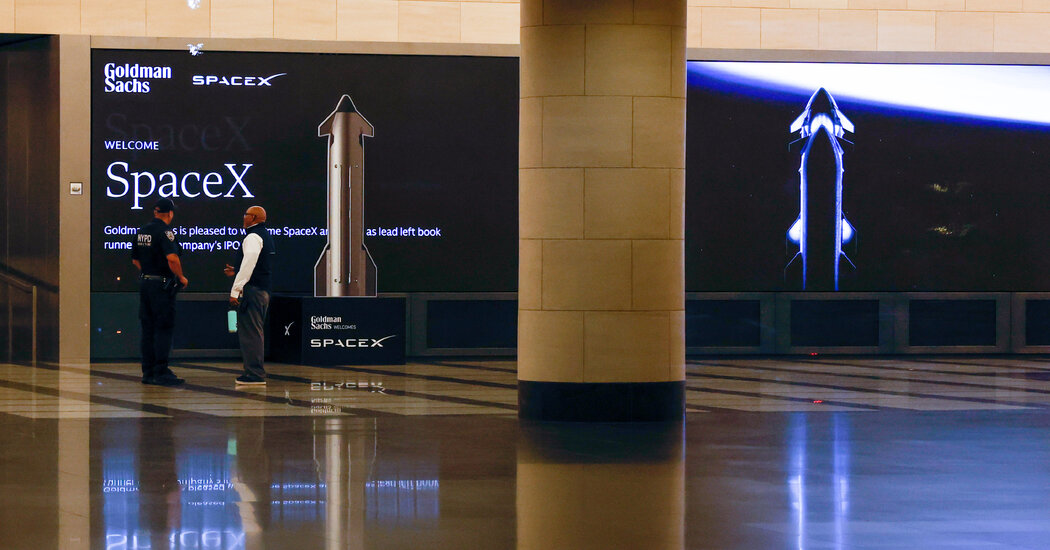
At Goldman Sachs’s Manhattan headquarters, rocket ships have taken over the lobby.
Not to be outdone, Bank of America is planning to light up the spire atop its Midtown offices on Thursday night to resemble a rocket taking off.
A few blocks away on Thursday, JPMorgan Chase hosted a SpaceX sales pitch to thousands of clients at its Park Avenue headquarters. It broadcast to 90 bank branches and offices across 26 states, some of which closed early for the event. The bank’s chief executive, Jamie Dimon, was there to sell the deal to the crowd himself.
There has never been a larger initial public offering than that of SpaceX, Elon Musk’s rocket maker and artificial intelligence company, and people involved in the sales effort who were not allowed to speak publicly said Wall Street’s efforts to sell the I.P.O. had been just as extraordinary.
SpaceX’s I.P.O., expected next week, is a high-stakes assignment for the 23 banks and brokerage firms that Mr. Musk has hired to sell shares to investors. The bankers are selling the deal to every possible corner of the investment world, from giant asset managers like BlackRock to individual buyers on Reddit.
At stake are the more than $500 million in fees that the banks will collect for their work on SpaceX. But the banks also need to ensure that Mr. Musk’s deal is an unequivocal success to boost confidence in two other mega-offerings of public stock expected in the coming months: OpenAI and Anthropic.
On Wednesday, SpaceX set the price for its I.P.O. at $135 a share, which would value the company at $1.77 trillion and make it the largest public offering ever.
At that price, SpaceX would raise $74.4 billion from the offering, and its valuation would be more than 40 percent higher than the $1.25 trillion that it valued itself at in February. The current I.P.O. record is held by Saudi Aramco, Saudi Arabia’s state-owned oil company, which was valued at $1.7 trillion and raised more than $29 billion when it went public in 2019.
“Even if they were giving away gold bricks” the sales effort would be “massive,” given the amounts SpaceX is looking to raise, said Edward Best, a partner in capital markets at the law firm Willkie Farr & Gallagher.
SpaceX did not immediately respond to a request for comment.
The preparation has been brewing for weeks. SpaceX’s bankers have already had a number of “testing the waters” conversations with potential major investors. Such conversations are not atypical, but the size of the multibillion-dollar checks being discussed are.
Unlike a traditional roadshow in which companies crisscross the country to pitch investors, SpaceX is planning more discreet settings for its largest potential investors. In the coming days, bankers at Morgan Stanley and Goldman Sachs will invite investors to their Manhattan offices to privately sell them on the deal, three people familiar with the plans said.
It’s unclear whether Mr. Musk will attend any of these meetings, but he will nonetheless be the star attraction. Part of the pitch is his stature as a once-in-a-lifetime visionary and his company, which envisions the potential colonization of Mars, as a multigenerational deal.
The bankers are projecting a take-it-or-leave-it attitude to investors. Instead of going through a lengthy back-and-forth to set a range of prices for the I.P.O., the banks landed on $135 a share, which investors either have to accept or sit out.
SpaceX also decided to forgo disclosing historical quarterly earnings in its I.P.O. registration documents, as companies traditionally do.
“For a fast-growing company, you would typically expect to see the quarterly breakdown,” said Matt Kennedy, a senior I.P.O. market strategist at Renaissance Capital. He added that the lack of extensive quarterly numbers indicated that the company’s view should largely be considered through longer-term lenses.
Everyday investors are expected to play an inordinately large role in the offering, making up some 30 percent of the buyers. That reflects both Mr. Musk’s fan base among day traders and other individual investors and the large amount of money SpaceX is looking to raise.
Fidelity said on Thursday that it would facilitate purchases in SpaceX’s I.P.O. for customers with at least $2,000 in a retail brokerage account, less than it usually requires for public offerings.
On Wednesday, Fidelity hosted a webinar for its legions of 401(k) and other customers about how to “get in early” on an I.P.O.
While these sorts of events may help build enthusiasm, most of the individual buyers are likely to be very wealthy investors who can afford a significant number of shares at $135 apiece, Mr. Best said. SpaceX has already hosted some prospective high-net-worth investors on field trips to its campus in Hawthorne, Calif., to show off the technology it uses to design and assemble rockets.
The banks are doing what they can to ensure that they corral as many of these investors as possible. About 100 of Bank of America’s financial advisers recently squeezed into a room at the bank’s headquarters for a training on how to sell SpaceX I.P.O. shares to their high-net-worth clients.
At JPMorgan’s event on Thursday, Mr. Musk addressed the audience remotely; the crowd, in a large room on the 51st floor with expansive views of the city, included his mother. The bank posted a livestream of the presentation on Mr. Musk’s social media platform, X.
Also on Thursday, SpaceX’s chief operating officer, Gwynne Shotwell, and its chief financial officer, Bret Johnsen, were set to speak at the Bank of America headquarters to some 5,000 clients.
Bank of America is calling its gatherings “launch parties.”