Geoff Bennett:
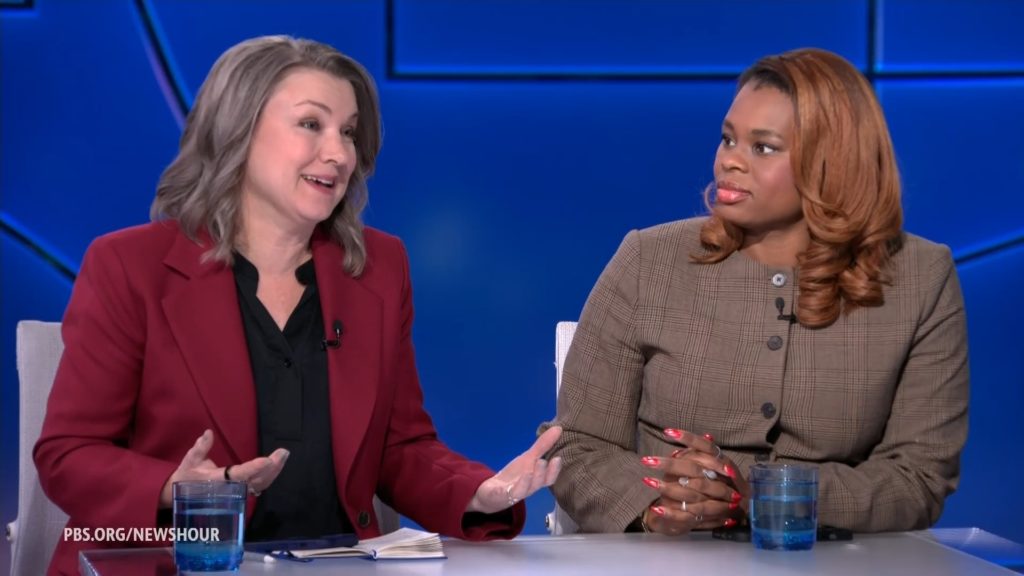
Let’s delve deeper now into the political headlines shaping this week so far with today’s Politics Monday duo.
That’s Tamara Keith of NPR and Jasmine Wright, White House correspondent for NOTUS. Amy Walter is away this evening.
It’s good to see you both.
So, Tam, we spent all last week talking about how the latest primaries show President Trump’s grip on the GOP. This latest development where he is now tabling, at least for now, this $1.8 billion compensation fund for his supporters, it really shows the limits of his influence over congressional Republicans in many ways.
Tamara Keith, National Public Radio:
Well, in some ways, his great victory in defeating Republicans who were not loyal enough now creates a larger what NPR were calling YOLO caucus, you only lose once, and then you are a little bit more free to do whatever you want after that.
But it’s not just them. There’s a large number of Republicans. Ted Cruz on his podcast said something like 20 Republicans in a closed-door meeting with Todd Blanche were pushing back really hard on this so-called anti-weaponization fund.
And the bigger issue is that there are very few Republicans, very few, who want to go out into swing districts and campaign on this or have to answer for it. And so there is a very big political problem for this fund, which is why you see this quiet backing away, though it’s not clear — until the TRUTH Social post is out and until the president says it with his own mouth, it’s not clear really whether they’re doing anything more than following what a judge says they need to do for the next two weeks.
Geoff Bennett:
Right.
What’s your latest reporting on this?
Jasmine Wright, NOTUS:
Yes, backing away for how long I think is kind of the question that not just we at “News Hour” are asking, but folks on the Hill are starting to ask.
We know, according to my colleagues at NOTUS, that the president met with Speaker Mike Johnson today at the White House. And an issue like this was raised. Obviously, I think for a long time Republicans, particularly John Thune, has been saying that they don’t have the votes for this. Mike Johnson expressed that this was in trouble and kind of tried to convince Trump, according to a source — told NOTUS, to back away from it.
And that factored into this decision which led to that tweet by the Justice Department. We will see how long that lasts. But this is something that the president wanted. This is something that other officials within the administration talked about, but it’s not something that necessarily resonates with the base.
They don’t — they are supportive of January 6 folks who believe in the MAGA effort, but do they really need to see folks getting paid? One source told me, probably not. And so it’s going to — a question of where it’s going to go still remains.
But I think a larger question is, how does this represent the people that President Trump is supposed to be representing going into the midterm elections? And I think folks have questions on that part too.
Geoff Bennett:
Well, the president spent part of the weekend Saturday posting on social more than 60 times over a six-hour stretch, Tam, a slew of A.I. images celebrating himself. He described himself at one point as being bigger than Elvis.
And this had to do with the unceremonious collapse of this America 250 concert where you saw artist after artist after artist drop out. The president is now proposing replacing all of it with a political rally.
What’s your read on what happened?
Tamara Keith:
Well, you’re just describing an average weekend on President Trump’s TRUTH Social feed, which is a lot of stuff.
What happened here is that Freedom 250 is actually a Trump-affiliated organization that was created to plan, among other things, the Great American State Fair on the National Mall, which was supposed to be like a World’s Fair, modeled after the Chicago World’s Fair, with a giant ferris wheel and some acts that you would see at a state fair or maybe a county fair in the ’90s.
And then they announced these acts. It wasn’t a big concert. It was just like acts scattered over this two-week period. And all of a sudden, these people who were on the list of artists were both being mocked and being criticized for doing something too closely affiliated with President Trump.
These artists came out and said, we didn’t know this was a Trump thing. And it completely imploded. I think the bigger issue here is that in this current era of American politics, with a president who’s putting his face on money, or wants to, his name on buildings, there is not seemingly a safe space where you can just have the president be the president for all Americans and a patriotic moment for the 250th birthday of America.
Instead, it all comes back to politics and this division that it seems no one really likes and yet everyone continues to feed.
Geoff Bennett:
Well, on that point, I mean, the 250th birthday is supposed to be a bipartisan celebration of this country and all that it has stood for.
Are we at a point now where you can’t really separate a national celebration from partisan politics in this Trump era?
Jasmine Wright:
I think that people would hope not. But, I mean, after the imploding of this Freedom 250 state fair, the question is perhaps.
Obviously, the president has said that he wants it to be the greatest birthday celebration for the country ever. And that is why Freedom 250 was commissioned by that executive order. And so you’re seeing the president do so much across the city of D.C., fusing about $100 million of taxpayer money to beautify D.C. ahead of it.
And so I don’t think you’re going to see the president step back from trying to make sure this is the greatest American birthday, regardless of if people feel that it is becoming politicized with his involvement.
Geoff Bennett:
Jasmine Wright, Tamara Keith, thank you both.
Tamara Keith:
You’re welcome.