It’s a common problem when visiting a restaurant – do you order your favourite dish or try something new that might be better?
Now, experts have solved a decades–old puzzle that finally settles the issue.
Researchers combined mathematical modelling with large–scale behavioural experiments to study the ‘explore vs exploit’ problem – whether to keep trying new options or stick with a favourite.
From this, they calculated the ultimate strategy for maximising total satisfaction across all meals.
And it’s all to do with how many times you expect to eat at the restaurant in the future.
The key idea is that early on, when you still have many opportunities left, it is worth exploring new dishes because you might discover something even better, they said.
But later, as you run out of opportunities, you should become increasingly willing to stick with the best dish you’ve already found.
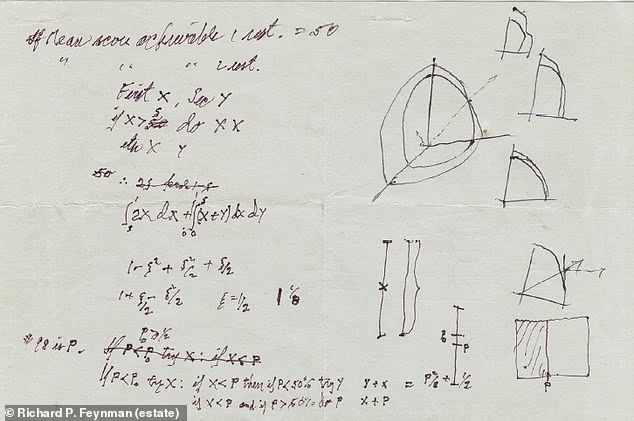
‘In the 1970s physicist Richard Feynman turned lunch with a friend into a math problem…but his handwritten notes remained a mystery for decades,’ the researchers said. ‘Here, we present the fully deciphered problem and solution.’
Part of Professor Richard Feynman’s handwritten notes detailing the restaurant problem, which he jotted down during lunch with a friend

American physicist Richard Feynman (pictured) turned the dilemma into a math problem and solved it, but never published his analysis
The original problem first arose when Professor Feynman – famous for his groundbreaking contributions to quantum physics – met up with his friend Ralph Leighton around 40 years ago.
They went to a Thai restaurant in Glendale, California, and his friend was debating whether to order his favourite – the ginger chicken – or to try something different.
Professor Feynman turned the dilemma into a math problem and solved it, but never published his analysis.
All that remained from the conversation were his handwritten notes, which Mr Leighton happened to keep.
‘The notes remained inscrutable for decades,’ the researchers, from Princeton University, wrote in the journal PNAS.
‘Until we managed to decipher them and reconstruct Feynman’s original problem and solution.’
The mathematical model they devised predicts a threshold rule. Essentially, early in the sequence of visits, trying new dishes is valuable because there is time to benefit from discovering a better dish.
As the number of remaining visits decreases, the threshold for settling for your favourite becomes lower and, near the end, exploiting the best–known option becomes optimal.
| Situation | What the study suggests |
|---|---|
| First visit to a restaurant | Try something new |
| You’ve only tried a few dishes and expect many future visits | Keep exploring |
| You’ve found an excellent dish and only have a few visits left | Stick with it |
| Last visit | Order your favourite |

Researchers combined mathematical modelling with large–scale behavioural experiments to study the ‘explore vs exploit’ problem – whether to keep trying new options or stick with a favourite
The authors recruited 2,520 participants and gave them a series of decision–making tasks designed to mimic the restaurant dilemma.
The experiments varied in terms of how many choices remained, the quality of the current ‘best’ option and the uncertainty about unexplored options.
They discovered that humans naturally follow a similar rule – they start out exploring and gradually switch towards exploiting their favourite option.
In fact, they found that participants tended to explore a bit more than the mathematically optimal strategy, especially early on.
‘We find definitive evidence that humans use a decision threshold that decreases linearly with the proportion of trials remaining, achieving performance remarkably close to the optimal solution found by Feynman,’ they wrote.
To conclude, the study’s advice is not simply to always try something new, or to always stick with your favourite.
It says your decision should depend on how many future meals you expect to have at that restaurant, or in that city.