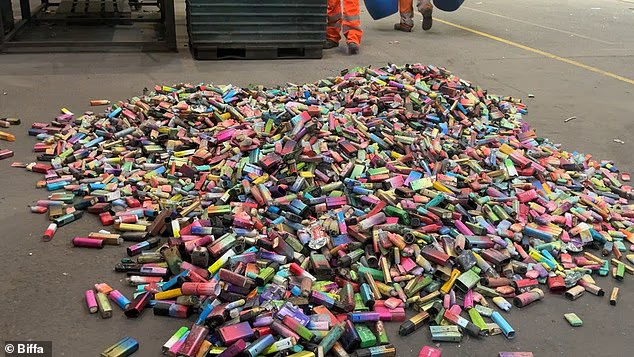
It’s been a full year since the UK’s disposable vape ban – yet it seems the eco–friendly policy has failed to clean up Britain’s act.
Experts have revealed that millions of e–cigarettes still plague the nation’s waste system, creating a risk of destructive fires.
Data shared with Electrical Safety First by the UK’s largest waste management company, Biffa, shows that over 6,500 vapes wind up in processing sites every single day.
Between June 2025 and March 2026, Biffa found more than two million incorrectly discarded vapes across just four of its sites.
These discarded e–cigarettes aren’t just bad for the environment – they are also a serious danger to recycling centre staff.
Vapes contain lithium–ion batteries, which can cause explosive and highly toxic fires if damaged.
When they are thrown in household rubbish and recycling bins, vapes can be crushed, punctured, or compacted – turning them into ticking time bombs.
Giuseppe Capanna, product safety engineer at Electrical Safety First, said: ‘Every vape thrown into household rubbish or recycling has the potential to create very real and frightening risks for waste collection workers who are simply doing their job.’
It’s been a full year since the UK’s disposable vape ban – yet it seems the eco–friendly policy has failed to clean up Britain’s act

When thrown into household rubbish or recycling bins, vapes can be crushed, punctured, or compacted during the waste process, causing the batteries inside to overheat or ignite
On 29 April 2025, it became illegal for businesses to sell or supply single–use vapes in the UK.
Speaking at the time, Circular Economy Minister Mary Creagh said: ‘For too long, single–use vapes have blighted our streets as litter and hooked our children on nicotine.
‘That ends today. The Government calls time on these nasty devices.’
One year on, Electrical Safety First surveyed 1,000 British vapers.
The charity found that despite the ban on disposable vapes, many continue to dispose of their non–disposable vapes incorrectly.
More than half (59 per cent) admitted to disposing of their vape in household rubbish or recycling bins over the past 12 months.
For comparison, 28 per cent said they take their used devices to a recycling centre or drop–off point, while just 16 per cent said they return them to a shop or retailer.
Worryingly, more than a quarter (27 per cent) said they did not know vapes needed to be disposed of in a specific way, whilst a quarter assumed placing them in the bin was fine.

More than half (59 per cent) admitted to disposing of their vape in household rubbish or recycling bins over the past 12 months
Shocking footage shared with the Daily Mail shows the rubbish in a bin lorry being set alight.
Electrical Safety First warns that these fires are common – and can spread quickly, putting workers at risk, and causing major disruption and costly damage.
What’s more, damaged batteries can also leak harmful chemicals into the environment if they are not recycled properly.
‘Vapes contain lithium–ion batteries, and when they are disposed of incorrectly, those batteries can be crushed or damaged, which can lead to fires that can escalate rapidly and put workers at risk,’ Mr Capanna explained.
‘Safe disposal can start with simple changes.
‘If you use vapes, build safe disposal into your routine, for example, every time you go to the supermarket or a vape shop, drop off your used vapes at the designated vape disposal point.
‘Every household can help turn the tide on this issue by making safe disposal a habit rather than an afterthought, therefore reducing the number of dangerous batteries entering the waste stream.
‘We urge all households to stop, think, and don’t bin the battery.’