Most siblings will have argued over who had it hardest growing up.
Now, scientists can finally put an end to the debate – as research confirms parents really are more lenient with later–born children.
As part of a study, experts from Monash University discovered later–born kids spend less time on enrichment activities and more time on social media compared to first–borns.
And this could be because they’re less likely to have strict rules and expectations placed on them, they said.
‘The increase in digital media time for later–born children is largely driven by those activities that children do alone,’ the study, published in the Journal of Economic Behavior & Organisation reads.
‘We show that one possible explanation for this is that parents are more lenient with later–born children.
‘Parents are less likely to have rules around TV watching and video games for later–born children, and later–born children themselves are less likely to perceive that their parents expect them to follow rules.’
The concept is commonly played out in books and TV series – for example in the Bridgerton family, as first–born son Anthony shoulders the crushing weight of responsibility while younger brother Benedict is allowed to drift through life pursuing art and bohemian passions.
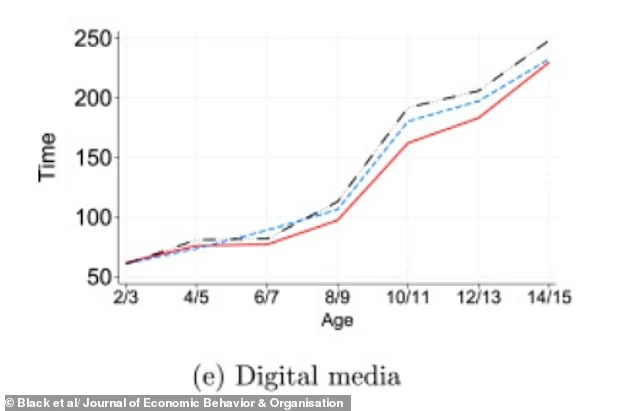
This graph shows how first–borns (the red line) spend less time on digital media compared to second and third–borns (the dotted lines)

In the Bridgerton family, first–born son Anthony (front, centre) shoulders the crushing weight of responsibility while younger brother Benedict (back, right) is allowed to drift through life pursuing art and bohemian passions
For their study, the team examined data on around 5,000 children aged between two and 15 years old.
Time use was recorded by parents for younger children, while children over the age of 10 completed their own time diaries over 24 hours.
The researchers grouped all activities into seven categories: sleep, school, enrichment activities, physical activities, social activities, digital media, and general care.
Enrichment activities included homework, reading, music lessons, and board games, while digital media included television, video games, internet use, and social media.
Overall, they found that compared with first–born children, second and third–borns spend between nine and 14 minutes extra each day looking at screens.
‘We find that parents become more lenient with rules for later–born children when they are older which corresponds with older later–born children spending more time with digital media,’ they wrote.
The researchers said their results are consistent with a previous study that found later–born children are less likely to experience strict parental supervision regarding homework and rules on watching TV.
That study, published in 2015, also concluded: ‘When asked how they will respond if a child brought home bad grades, parents state that they would be less likely to punish their later–born children.’

The findings will come as no surprise to Kylie and Kendall Jenner – the youngester members of the Kardashian/Jenner family – who were often left to the own devices on the early seasons of Keeping Up With The Kardashians
The team also discovered that among second–born girls, the gender of their older sibling can have an effect on the expectations parents place on them.
When their older sibling is a boy, there is no difference in the expectation from either parent to follow family rules.
However when their older sibling is also a girl, there is a reduction in the perceived expectation to follow family rules for the second–born.
To conclude, the researchers said: ‘We find that parents become more lenient with rules for later–born children when they are older which corresponds with older later–born children spending more time with digital media.’