Amna Nawaz:
The Anti-Defamation League recently announced a decline last year in antisemitic incidents, like vandalism and harassment, but physical assaults against Jews in America reached their highest level since 1979, with over 200 such attacks reported. One of the highest-profile cases was in the nation’s capital.
Nick Schifrin has more on that story and the father fighting to preserve his son’s legacy.
Nick Schifrin:
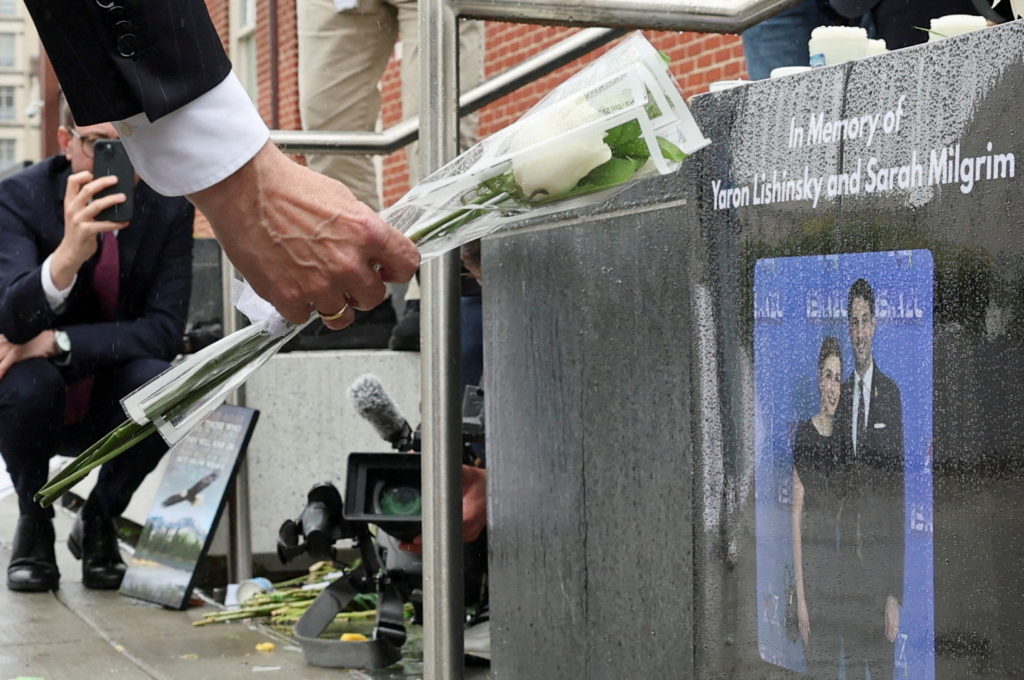
One year ago, a gunman approached an event for young diplomats at the Capital Jewish Museum in Washington, D.C., and killed two young employees of Israel’s U.S. Embassy.
Yaron Lischinsky was 30 years old. Sarah Milgrim was 26. They were about to become engaged. This month, the Department of Justice announced that it would seek the death penalty for their alleged killer.
And I’m pleased to welcome Daniel Lischinsky, Yaron Lischinsky’s father.
Thank you very much for being here.
Daniel Lischinsky:
Thank you.
Nick Schifrin:
What do you want people to know about your son?
Daniel Lischinsky:
Yaron was a peacemaker. He was a person that he tried to bring together.
And, also, if you knew him, he was approaching every person like a human being, never looking for your title, your position, your — if you are rich, poor, or Black or white or Jewish or Gentile. He was simply a human being, like most of us Israelis. So…
Nick Schifrin:
He was born in Israel. You moved to Germany when he was very young, and you moved back to Israel when he was 14. And he had been working at the embassy since September of 2022. And that is where he met Sarah.
What did he hope for his future?
Daniel Lischinsky:
I think he would have stayed one year more here and then to decide maybe to get married in that year with Sarah and together to decide.
They wanted to live in Israel and I think to work for the understanding between the people. That was her heart’s desire, yes.
Nick Schifrin:
The American Jewish Committee recently said this of your son’s death and Sarah’s death.
“The attack spread fear throughout the Jewish community across the world.”
Do you think that’s true?
Daniel Lischinsky:
I think it’s no doubt that the antisemitism is growing.
Yesterday, we were in the U.S. Holocaust Memorial, where they also honored Sarah and Yaron. And you go through the museum, and you see how it began. And it began with the lies that we hear today in the news and in the media. And it began with propaganda.
And, sadly, it’s what we are seeing today.
Nick Schifrin:
The Anti-Defamation League measures antisemitic incidents. And it said that, in 2025, there were 6,274 antisemitic incidents in the United States. That’s actually 33 percent lower than the 9,354 incidents from 2024, but it is five times higher than one decade ago.
What do you think the cause is of that kind of hate?
Daniel Lischinsky:
Well, what we hear is that the cause is the war in Gaza, the Gaza war.
But antisemitism is an old virus. It’s an old demon that sometimes awake and begin to make the bad work.
Nick Schifrin:
The prosecutors who are pursuing your son’s alleged killer released some of the language that he wrote.
And he wrote — quote — “The atrocities committed by the Israelis against Palestine defy description and defy quantification. Nonviolent protest has not amounted to much. There are many Americans for which my action will be highly legible and in some way the only sane thing to do. Free Palestine.”
Do you see a connection between how the state of Israel acts and antisemitic violence?
Daniel Lischinsky:
I see that people make a connection, but I don’t see any connection.
There is no other country that, if you attack a neighborhood or something, first, you ask the people to leave the neighborhood because you will attack, because you know that terrorists start hiding in that neighborhood, that if you will attack a building, you will knock on the roof first, yes, with these kinds of knocking on the roof, before giving time to the people.
There is no other country that will do something like this. It’s like in the Nazi time. The lies that they came about the Jewish people, the lies that they tried to put in the minds of the people, I see the same that is happening today, sadly.
Nick Schifrin:
The Justice Department recently said it would seek the death penalty in the person who allegedly killed your son. And you recently gave an interview where you said that that made you conflicted.
Why?
Daniel Lischinsky:
My wife, she says that he deserved it. He cannot — he premeditated. He planned it. He came from Chicago to kill her son and Sarah and maybe more people if he would have had that.
For me, it’s still difficult to want the death of somebody. Of course, like I said in that interview, thank God that I am not the person that needs to decide that.
Nick Schifrin:
For Jews, memory carries responsibility. And so how will you not only remember, but honor your son’s legacy?
Daniel Lischinsky:
We are publishing a book with his pictures.
Personally, I want to engage also in speaking in churches against antisemitism. So I will dedicate part of my life also to that in memory of Yaron to try to — he was a peacemaker. He was a person bringing people together. I would like to — in that way, also to bring people together to try to teach about Israel and against antisemitism.
Nick Schifrin:
You have brought, if I may say, grace and compassion to this moment of your grief. How do you think you have maintained that grace and compassion, despite what you have been through?
Daniel Lischinsky:
We know that the grace and compassion comes from God, comes from above.
So we try to be ambassadors of him in this earth and to try to be compassionate with other people. We — to try. It’s not easy. We are human beings. And — but if we get grace and compassion from God, we can give to others.
Nick Schifrin:
Daniel Lischinsky, we appreciate your being here. Thank you very much.
Daniel Lischinsky:
Thank you very much for having me.