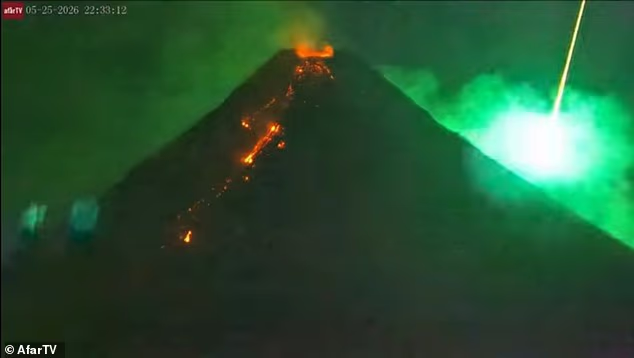
Nature’s destructive power was on full display in the Philippines, as a dazzling meteor burned through the sky above an erupting volcano.
Like a scene from a heavy metal music video, the green fireball blazed overhead as lava ran down the slopes of Mount Mayon – one of the world’s most active volcanoes.
This incredible moment was captured at 10:33pm (15:33 BST) local time on May 25 by a network of cameras livestreaming the eruption.
Onlookers were ‘shocked’ and ‘stunned’ by the astonishingly rare coincidence on Monday night, according to the Philippine Information Agency.
One terrified local from the nearby town of Los Baños even said he ‘thought it was a missile because of how bright it was’.
They added: ‘It burned bright green and white for less than a second before it disappeared into the clouds’.
The Philippine Institute of Volcanology and Seismology (PHIVOLCS) initially claimed their cameras had spotted the meteor ‘striking the northern slopes of Mayon Volcano’.
However, after reviewing the data more thoroughly, the agency later confirmed that the space rock actually broke up harmlessly in the atmosphere.
A video has captured the incredible moment a bright green meteor blazed over an erupting volcano in the Philippines
In a post on X, PHIVOLCS wrote: ‘Our review of seismic, infrasound and additional camera footages around the volcano indicate that the meteor disintegrated while in the atmosphere and did not strike the slopes of Mayon, contrary to our initial post.’
If the fireball had collided with the volcano, it would have almost certainly left a fairly obvious impression.
According to the Philippine Information Agency, one local astronomer calculated the meteor’s energy was equivalent to 6.8 million kilograms of gunpowder.
PHIVOLCS’ seismic data captured 27 volcanic tremors and 341 rock falls in the 24 hours surrounding the meteor’s arrival.
However, there was no data to suggest that the meteor had impacted the ground or exploded with enough force to be felt on the surface.
On social media, space fans were shocked by the incredible spectacle.
One commenter on X wrote: ‘Imagine checking a volcano cam before bed and seeing the apocalypse start.’
‘I bet dinosaurs saw this kind of stuff a lot,’ added another.

The shooting star was captured burning up above Mount Mayon, located on the island of Luzon, which is one of the most active volcanoes in the world
While one commenter joked: ‘Damn, Philippines getting hit from all sides rn [right now].’
Although this might seem like an incredibly rare coincidence, the chances of a meteor arriving over Mount Mayon’s eruption are actually relatively high.
Mount Mayon, located on the island of Luzon, is the most active volcano in the Philippines and one of the most violent anywhere in the world.
By the time the meteor appeared, the volcano was on its 140th consecutive day of effusive eruption – meaning lava is escaping onto the surface – which has been filmed continuously by multiple cameras.
Meanwhile, every day, around 25 million pieces of debris hit Earth and create shooting stars.
As tiny pieces of rock and dust collide with the planet, they smash into the upper layers of the atmosphere at speeds up to 45,000 miles per hour (72,400 km/h).
The enormous friction between the meteor and particles in the air heats their surface to around 1,600°C (2,912°F), vaporising them in a flash, which we see as a shooting star.
Typically, these meteors are white or yellow, but traces of metals in the rocky fragments can give them bright colours, including red, blue, and green.

By the time the meteor appeared, the volcano was on its 140th consecutive day of effusive eruption, meaning that lava has been escaping to the surface. However, there was no sign that the meteor hit the volcano or the surrounding area
Our atmosphere offers such effective protection against space rocks that only the largest pieces have a chance of making it to the ground.
Yet even these usually fall to Earth as small chunks that don’t have the force to cause any destruction.
However, the Earth has had a number of close calls with asteroids large enough to cause serious damage.
Earlier this month, a space rock called 2026 JH2 passed the planet at a distance of just 56,000 miles (90,000km).
Scientists said that this was ‘as close as you can without hitting’, but that there was no chance of a collision in the next 100 years.
The asteroid is up to four times the size of a London bus and packed enough potential energy to destroy a city.