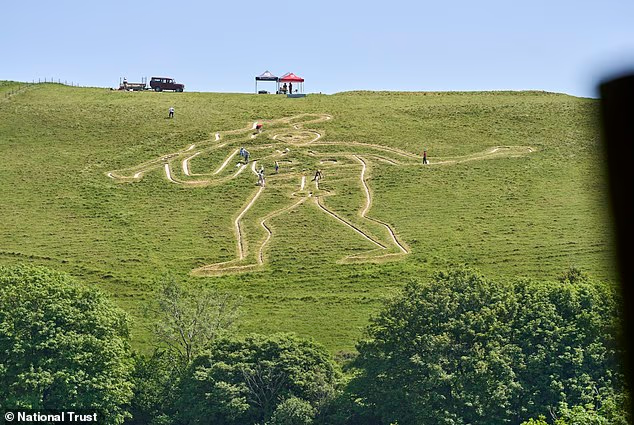
Dorset’s famous Cerne Abbas Giant – Britain’s largest and most iconic chalk figure – is getting a makeover.
The landmark, which measures 180 feet (55 metres) tall, has dominated the Cerne Abbas hillside for at least 700 years.
Experts have now begun the arduous process of re–chalking the imposing figure, which is historically associated with fertility due to its exaggerated anatomy.
His outline is being carefully restored using around 17 tonnes of fresh chalk by National Trust staff, volunteers and members of the public.
The steep chalk hillside – sloping at around 33 per cent – is vulnerable to erosion, meaning the chalk must be packed tightly by hand to keep water out and prevent weeds from taking hold.
Given the Giant’s enormous size, the highly–skilled process will take around two weeks of intensive labour.
‘Re‑chalking the Giant relies on techniques that haven’t changed for generations – carefully digging out older material and packing in fresh chalk by hand on a very steep slope,’ Luke Dawson, Lead Ranger for the National Trust at West Dorset & Cranborne Chase, said.
‘It’s how we’ve kept him visible for centuries.’
The landmark, which measures 180 feet (55 metres) tall, has dominated the Cerne Abbas hillside for at least 700 years

The Cerne Abbas Giant’s origins long puzzled historians, sparking theories ranging from a Roman Hercules to a satirical depiction of Oliver Cromwell
Mr Dawson said in recent years, algae growth has started to dull the Giant’s bright white outline.
‘We can’t say for certain what’s driving that but warmer, wetter conditions may be a factor and it’s something we’re continuing to investigate,’ he explained.
‘We’re also seeing more intense rainfall, which can increase water run‑off and gradually wear away the chalk, so we’re planning further monitoring to understand the impacts and how we might need to adapt – potentially by re‑chalking more often.
While the re–chalking usually happens once every decade, the charity said this time is especially significant as they recently purchased a significant area of land around the Giant.
This was the result of a national fundraising appeal, which helped secure more than 130 hectares of land surrounding the figure.
‘This re‑chalking feels especially meaningful,’ Hannah Jefferson, general manager for the National Trust at West Dorset & Cranborne Chase, said.
‘For centuries, people have cared for the Giant by renewing him in chalk. Now, thanks to thousands of people coming together through the appeal, we can care not just for the figure itself, but for the extraordinary landscape that surrounds him.
‘As fresh white chalk restores the Giant’s unmistakable outline once more, it’s a powerful reminder that his story is still being written – not just by history, but by the people of today.’

Re chalking the Giant relies on techniques that haven’t changed for generations – carefully digging out older material and packing in fresh chalk by hand

While the re–chalking usually happens once every decade, the charity said this time is especially significant as they recently purchased a significant area of land around the Giant
The Cerne Abbas Giant’s origins have long puzzled historians, sparking theories ranging from a Roman Hercules to a satirical depiction of Oliver Cromwell.
But in 2021, scientific analysis revealed the Giant was probably first carved in the late Saxon period, between 700 and 1100 AD.
Making use of Lidar technology to look for no longer visible lines, they found he may originally have been wearing trousers, with evidence the phallus was added later, in the 17th century to turn it into a ‘figure of fun’.
In 2024, disappointed tourists complained that the Giant – and his appendage – had become overgrown with grass.
Visitors who travel in from all over the country said they struggled to make out the chalk outline.
This prompted calls for the National trust, which has owned the site since 1920, to restore the figure to his former glory.
Others joked online that the Giant just ‘needs a bit of manscaping’.
The trust put the reduced visibility down to the ‘exceptionally wet summer’ which has caused the grass to become so overgrown.

His outline is being carefully restored using around 17 tonnes of fresh chalk by National Trust staff, volunteers and members of the public

In 2024, disappointed tourists complained that the Giant – and his appendage – had become overgrown with grass (pictured)
The Giant was last re–chalked in 2019 to commemorate the National Trust’s 100–year ownership of the landmark.
Commenting on the recent acquisition of extra land Steve Timms, National Trust archaeologist, said: ‘The Giant was never meant to exist in isolation.
‘By protecting the surrounding land, we now have the chance to explore how people moved through, used and understood this landscape over thousands of years.’
Sian Wilkinson, Head of Public Fundraising at the National Trust, added: ‘The re‑chalking is a powerful symbol of what can happen when people come together – renewing something ancient, while investing in its future.’