It’s a question that has baffled scientists for decades: could humans ever have babies in space?
Now, China has taken a major step towards a definitive answer.
The nation has become the first in the world to blast ‘human artificial embryos’ into orbit.
The embryos arrived at China’s Tiangong space station in the early hours of May 11, travelling with the Tianzhou–10 resupply mission.
They were allowed to develop for five days, 280 miles (450 km) above the Earth, before being frozen for later study.
Once the embryos are back on Earth, scientists will compare their development to those grown on the ground, to see if the harsh environment of space causes problems for human reproduction.
This would be a key step towards China’s ambition of establishing a permanent human presence beyond Earth’s atmosphere.
Leqian Yu, a researcher at the Chinese Academy of Sciences’ (CAS) Institute of Zoology who is leading the experiment, says he hopes the experiment will ‘address the risks and challenges humans may face during long–term space habitation.’
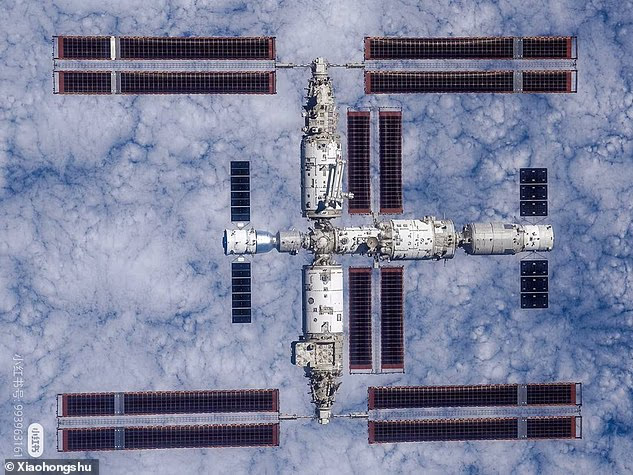
China has taken one step closer towards raising babies in space after sending ‘human artificial embryos’ to the Tiangong space station (pictured)
Artificial embryos are collections of stem cells that resemble real human embryos in key aspects, but can’t develop in the same way.
Importantly, the stem cells can never grow to become a functioning foetus, which allows researchers to investigate human development with fewer ethical concerns.
Dr Yu says: ‘The human artificial embryo is made of human stem cells as raw materials.
‘This is not a real human embryo and does not have the ability to develop into an individual.’
The researchers sent two different types of artificial embryos to the space station, each representing a critical stage in human development.
The first is a ‘peri–implantation model’, designed to mimic the key moment when an embryo attaches to the uterine wall.
The second is a ‘peri–gastrulation model’, which replicates the moment in early development when a single layer of cells splits into layers that will form different tissues and organs.
‘This stage is a critical window in early human development, during which the building blocks for future organs begin to form, and the entire body axis — which determines the head and the tail — is established,’ Dr Yu told state–run media.

The embryos were launched aboard the Tianzhou–10 cargo mission (pictured), arriving on the space station in the early hours of May 11. The embryos were allowed to develop for five days to test the viability of human reproduction in space
‘Therefore, these models were brought to space to explore whether life, which has evolved under gravity for hundreds of millions of years, is affected by its sudden absence.’
What the scientists want to see is whether the mechanisms that dictate how an embryo develops can still function without the pull of gravity.
Currently, scientists are concerned that microgravity might lead to developmental defects, which could make human reproduction in space impossible.
However, since these conditions are almost impossible to recreate on Earth for any length, artificial embryos must be sent into space to find out.
Similar experiments involving zebrafish and mouse embryos were also sent to the Tiangong space station aboard Tianzhou–10, alongside 6.3 tonnes of cargo, including food, fuel, and space suits for the crew.
Dr Yu says: ‘By comparing embryo development in space with that on the ground, we can investigate how the space environment impacts critical events in human development.’
For humanity to establish itself as a space–faring species, scientists need to find a way for people to safely reproduce.
However, the conditions beyond our home planet might be a serious barrier to natural reproduction.

Previous studies have shown that microgravity interferes with human reproduction, modifying the number of foetal cells within an embryo. The left image shows the cells in normal gravity, compared to in microgravity (right)
Studies have shown that sperm can become ‘disoriented’ in microgravity, significantly lowering the chances of conception.
Besides the issue of gravity, craft outside Earth’s protective atmosphere are also bombarded with high levels of radiation.
Cosmic radiation, made up of charged subatomic particles, is constantly shooting through space, smashing any DNA it encounters along the way.
Scientists are concerned that this might lead to genetic damage, leading to a high risk of cancer or birth defects for babies born in space.
However, new research is beginning to show that methods like IVF could be tweaked for use in orbit, paving the way for the first generation of space babies.
Last year, researchers from Kyoto University showed that mouse egg and sperm cells could survive in space and go on to produce healthy offspring.
Meanwhile, Dutch Biotech startup Spaceborn United have launched the first miniature lab for in vitro fertilisation (IVF) and embryo processes into orbit.