Earth’s population currently sits at 8.3 billion people – but it could crash within the next 40 years, experts have warned.
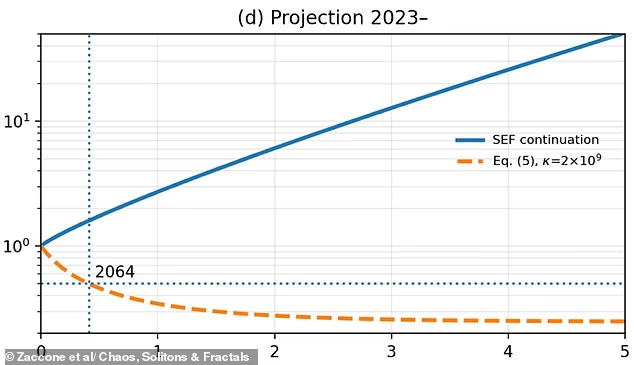
Scientists say that, in a worst–case scenario, humanity could potentially be halved by the year 2064.
This could be the result of climate collapse, a pandemic, global conflict or resource shortages, they warned.
‘The most provocative part of our paper explores hypothetical future scenarios,’ the researchers, from the University of Milan, said.
‘We modelled what could happen if major environmental crises abruptly imposed severe carrying–capacity limits on Earth.
‘Under a deliberately conservative worst–case assumption that Earth’s sustainable carrying capacity suddenly dropped to around two billion people, our model predicts a rapid global population decline, with humanity potentially halving by around the year 2064.’
The researchers maintain that this is not a forecast, but an ‘illustrative mathematical scenario’ which shows how sensitive population dynamics may be to abrupt changes.
But with researchers sounding alarm bells about global warming, recent pandemics such as Covid and falling birth rates, the scenario is not completely unrealistic.
Scientists say that, in a worst–case scenario, humanity could potentially be halved by the year 2064
For the study, published in the journal Chaos, Solitons & Fractals, the researchers analysed 12,000 years of human population growth.
From this, they were able to devise a mathematical equation that accurately reproduced the major population growth patterns from the Neolithic era to the modern age.
The model takes into account that in some periods, human population expanded slowly and steadily while in others, growth accelerated explosively.
Overall, they found the current trajectory remains relatively stable and does not imply imminent collapse.
But in a ‘worst–case illustration’ Earth’s carrying capacity could plummet to just two billion, they warned.
This would mean that the maximum number of people our planet could sustain indefinitely would be around a quarter of its current population.
And, in turn, it would trigger a crash which could see the number of people on Earth halved.
‘In a scenario where carrying–capacity constraints suddenly become abruptly active, (our equation) predicts a rapid population decline,’ they wrote.

The model takes into account that in some periods, human population expanded slowly and steadily while in others, growth accelerated explosively
The model also revisits one of the most famous predictions in population science – the ‘doomsday’ scenario proposed in 1960.
This predicted that the global human population would approach mathematical infinity – resulting in mass extinction – on Friday November 13, 2026.
‘Humanity avoided that trajectory as fertility rates declined globally, but our new study argues that the underlying mathematics of runaway growth can still reappear under certain conditions,’ the researchers of the new study said.
‘In our baseline analysis, the current global trend does not produce a catastrophic singularity like the one predicted.’
Last year, a study found that populations may need a fertility rate of 2.7 children per woman to avoid long–term extinction.
This is higher than previous estimates of 2.1 children per women for population replacement.
In the UK, the average number of children per woman stands at 1.41, while in the US it is slightly higher at 1.62.
There are concerns that if fertility rates continue to plunge across the world, it may leave countries with too few younger people to work, pay tax and look after the elderly.
For years tech billionaire Elon Musk has warned about population collapse caused by a baby bust in America and the West.
Musk, who has 14 children with four different women, boasts of ‘always banging the baby drum’.
He previously said that low birth rates result in fewer workers, increased debt, strained healthcare and pension systems and total social unrest.
And he has gone so far as to call it the ‘greatest risk to the future of civilisation’.